
 Add as preferred on Google
How to Modernize a Legacy Learning Platform Without a Full RewriteRead More

Hiring an in-house AI team looks cheaper than a consulting firm on paper, but year-one total cost tells a different story.
Compare year-one total cost of ownership, not which line item looks smaller.
The cost comparison usually starts too small.
A CTO sees an artificial intelligence engineer at $180,000 to $220,000 and a consulting quote at $500,000 to $800,000. On paper, the employee looks cheaper. In practice, salary is not the same thing as usable AI capability, and a consulting quote is not always the full cost of getting a system into production.
The right comparison is year-one total cost of ownership, or year-one TCO. That includes hiring delay, ramp time, burdened compensation, recruiting, attrition, replacement risk, tooling, cloud usage, model evaluation, observability, governance, and knowledge transfer.
For the larger strategic choice, see the guide to build, buy, or partner for enterprise AI.
A payroll spreadsheet assumes people exist the moment finance approves headcount. AI hiring does not work that way.
Current AI compensation benchmarks put median AI professional pay around $160,000 globally, with mature markets paying significant premiums. Senior production-focused machine learning engineers, large language model operations specialists, GPU infrastructure engineers, and safety or evaluation specialists can reach much higher total compensation.
That still does not make salary the whole cost. A new employee has to be recruited, hired, onboarded, integrated into the company’s systems, and paired with the right data, product, security, and platform support.
A consulting firm has the opposite problem. The price looks concentrated, but it often bundles senior expertise, delivery management, reusable playbooks, and a cross-functional team. The quote may still exclude internal stakeholder time, cloud spend, data cleanup, legal review, and post-launch ownership.
The question is not “Which line item is lower?”
The question is: Which model gives you working, governed, supported AI capability in year one?
A planned five-person in-house AI team rarely arrives as a complete unit.
Senior AI and machine learning roles can take months to fill. Hires may start at different times. They also need time to learn internal systems, data constraints, security rules, and business workflows. A machine learning engineer may be blocked without data engineering. A data engineer may be blocked by access approvals. A product manager may be blocked without a clear business owner.
So a nominal five-person annual budget might produce the equivalent of two or three fully productive contributors during the first year, depending on hiring sequence and ramp assumptions.
Model capacity month by month. Do not multiply five salaries by twelve months and call it delivery capacity.
A serious AI consulting firm sells near-term capacity, specialization, and delivery structure.
That usually includes some mix of architecture, data engineering, machine learning, machine learning operations, product management, quality assurance, project management, model evaluation, documentation, and governance support. Smaller firms may price experienced AI consultants around $150 to $300 per hour. Premium enterprise consultancies can run materially higher, especially for senior or specialized work.
For a scoped use case with ready data and strong internal owners, a consulting team may move from discovery to a production-grade minimum viable product in weeks rather than the months required to hire and ramp a full team.
But consulting does not eliminate internal responsibility. Security decisions, product ownership, data access, adoption, governance, and long-term operations still need accountable owners inside the company.
A credible in-house AI budget starts with labor, then adds the costs that make labor productive.
At minimum, the year-one model should include compensation, employer burden, recruiting, onboarding, ramp time, tooling, cloud usage, data platform work, model evaluation, observability, security review, privacy review, and post-launch support.
Employer burden often adds 20% to 50% to base salary, depending on geography, benefits, payroll taxes, equipment, and overhead. That means a $200,000 salary may become a substantially higher employment cost before any cloud, tools, or recruiting fees are counted.
Production AI needs more than one “AI engineer.” For a serious enterprise initiative, model the roles required to move from idea to production:
Some of these may be fractional. Security, privacy, and observability might come from existing teams. That does not make them free. Their time is part of year-one TCO.
The biggest budgeting mistake is assigning one generalist to cover data engineering, model development, production deployment, security, evaluation, and product ownership. That can work for a narrow prototype. It is fragile for a production-bound system.
Base salary should become burdened compensation before finance sees the model. Add employer taxes, benefits, recruiting expense, equipment, shared services, management time, and onboarding.
Then add attrition risk.
AI talent remains mobile. Losing a key machine learning operations engineer or senior data engineer mid-project creates more than a replacement fee. It can mean lost context, delivery delay, repeated onboarding, and rework. In a small team, one departure can remove a critical capability.
A CFO-ready model should include at least one downside case where a scarce role turns over and takes months to replace.
Production artificial intelligence costs move with usage and architecture. The model should separate prototype costs from operating costs.
Typical categories include cloud compute, model inference, storage, vector databases, logging, monitoring, model observability, experimentation tools, security tooling, secrets management, and data pipelines. If the system uses retrieval-augmented generation, include embedding, retrieval, storage, and evaluation costs.
Governance also consumes time. Privacy review, model risk assessment, auditability, incident response, and security controls may involve legal, security, risk, and compliance teams.
None of these appear in a salary-only model. All of them affect whether the system can run in production.
A consulting quote compresses many cost categories into one commercial number. Unpack it before comparing it with internal hiring.
The pricing model matters. Time and materials gives flexibility but leaves more scope risk with the client. Fixed-fee pricing gives more cost predictability but depends on clear requirements and change-order rules. Retainers reserve capacity but may create waste if internal stakeholders are not ready. Milestone or hybrid pricing can work well when discovery is uncertain but production phases need discipline.
For a deeper comparison of firm tiers and quote size, see the guide to boutique AI firm versus Big 4 consultancy.
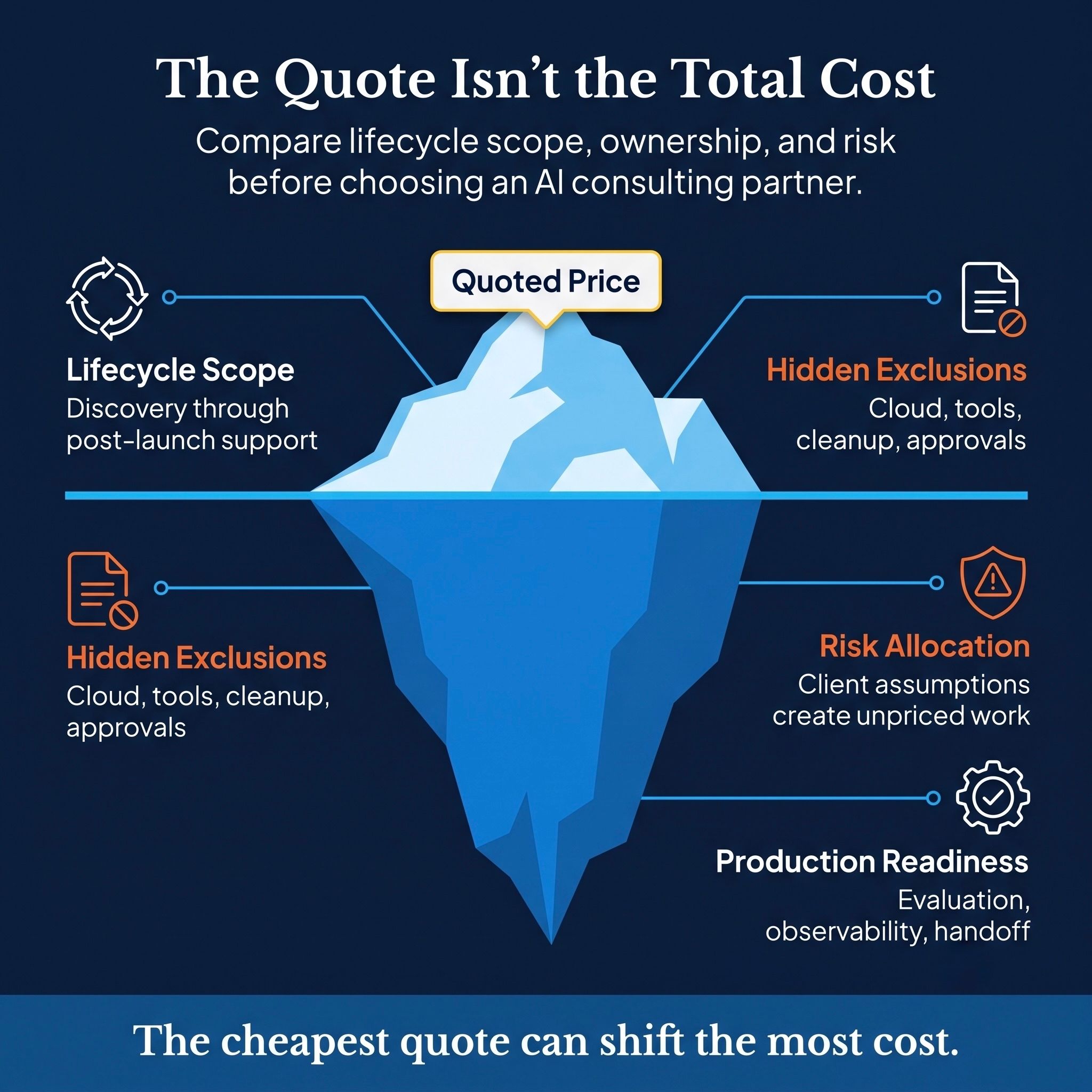
A credible AI consulting scope should cover the lifecycle, not just the build.
Look for discovery, data readiness, architecture, proof of concept, productionization, model evaluation, observability, security review, documentation, knowledge transfer, and post-launch support. The statement of work, or SOW, should define deliverables, assumptions, exclusions, staffing, acceptance criteria, and change-control terms.
Ask for role mix and allocation. A team with senior architecture, data engineering, machine learning operations, and product delivery coverage is different from a small build team with vague support around it.
Common exclusions include cloud usage, third-party tools, data cleanup beyond a defined scope, legal review, security review, privacy review, change management, internal stakeholder time, and long-term operations.
Those exclusions are not automatically a problem. Hidden exclusions are the problem.
If the consulting quote assumes the client will provide clean data, fast security approval, available domain experts, and production infrastructure, those assumptions need cost owners inside your model.
A lower quote often comes from narrower scope, more junior staffing, less governance, or more client-side responsibility.
That can be appropriate for a prototype. It becomes risky when the intended outcome is production. Missing evaluation, observability, documentation, security review, or knowledge transfer can create remediation cost later.
The fair comparison is not quote versus quote. Compare scope quality, staffing seniority, risk allocation, handoff plan, and post-launch support.
A useful comparison breaks the decision into shared categories. Some costs appear in both models. Cloud usage, product ownership, security review, and governance do not disappear because a consulting firm is involved.
Category | In-house AI team | AI consulting firm |
Labor | Salaries plus burdened compensation for AI, data, MLOps, product, security, and support roles | Hourly, daily, retainer, milestone, or fixed-fee delivery capacity |
Ramp and delay | Hiring, onboarding, staggered starts, and partial productivity | Faster start, but still dependent on client data, decisions, and access |
Tooling and infrastructure | Cloud, model access, data pipelines, observability, evaluation, and security tools | Similar underlying costs, often billed to the client or excluded from the quote |
Knowledge transfer | Retained internally if documented and managed well | Must be explicitly scoped through training, documentation, and handoff |
The table does not decide for you. It exposes where the economics differ.
Compare both options across these categories:
Mark each item as confirmed, estimated, excluded, or variable. That prevents a clean-looking total from hiding unfunded work.
Consulting can make financial sense even when the headline fee is higher. If the use case has meaningful business impact and delay is costly, speed has value.
In-house economics often improve after year one if the company keeps the team, reuses the platform, and applies the capability across multiple initiatives. That only works when there is a real roadmap and a retention strategy.
Break-even depends on hiring time, ramp speed, utilization, attrition, consulting extensions, change orders, cloud usage, and whether the capability will be reused.
Some AI use cases do not require a full custom build. A platform vendor may cover customer support automation, document search, analytics, or workflow automation with less custom engineering.
That does not remove integration, governance, data, and ownership work. It changes the amount of custom development required. For service versus product trade-offs, see the guide to AI development partner versus platform vendor.
The right model depends on urgency, AI maturity, data readiness, hiring strength, regulatory exposure, and how strategic the capability is.
Early-stage organizations may benefit from consulting for their first production deployment. Mature engineering organizations may prefer an in-house core team with targeted outside support.
Location also changes cost and coordination. Nearshore or offshore delivery can lower cash cost, but it affects communication, governance, and handoff. For that narrower question, see the guide to onshore, nearshore, and offshore AI development.
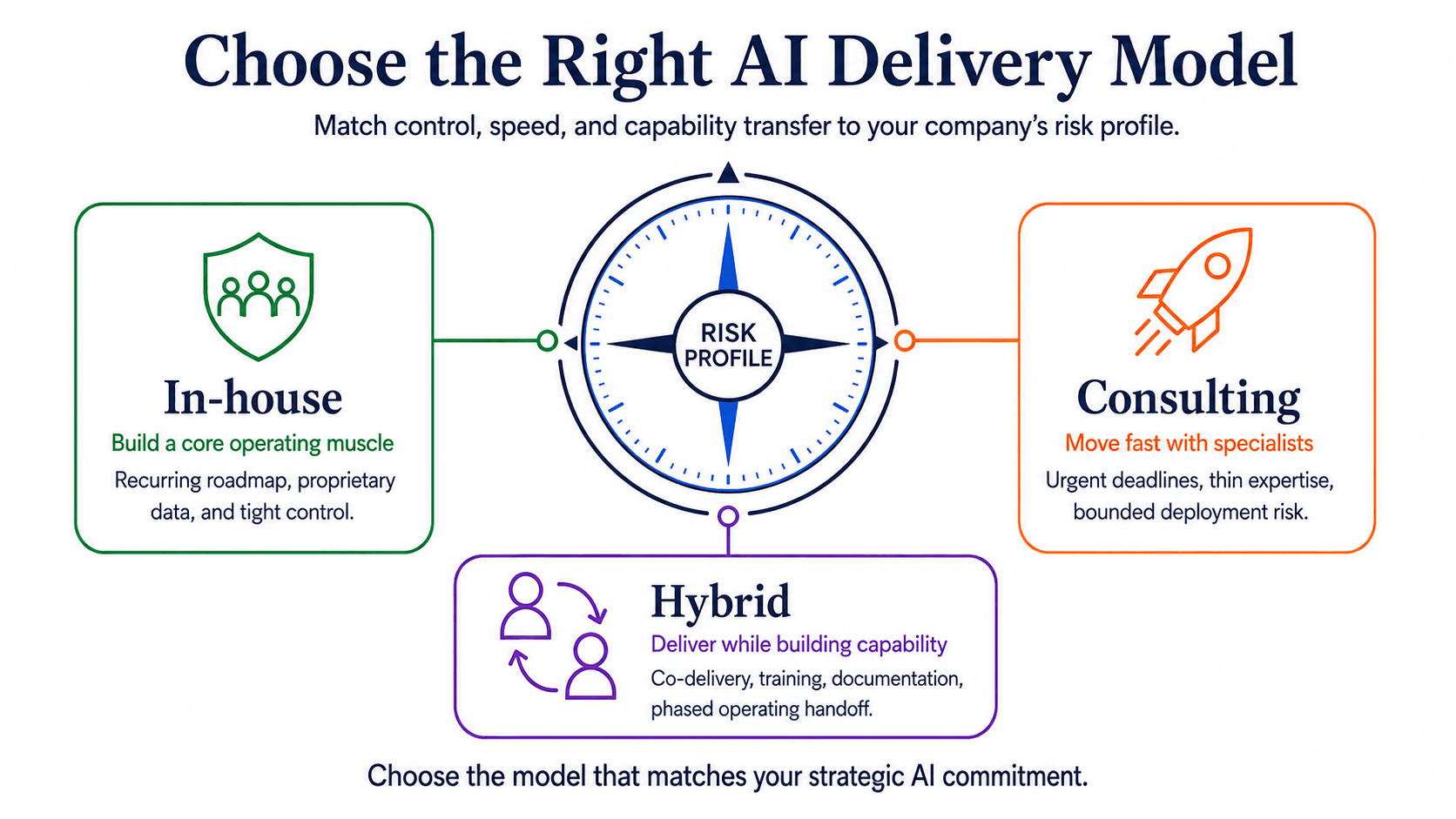
Choose in-house when AI will support a recurring roadmap, proprietary data is central to advantage, and the company needs tight control over model operations.
This path requires more patience in year one. It also requires real investment in people, tools, governance, and retention. Salary-only funding will not create durable capability.
Choose consulting when the deadline matters, internal expertise is thin, or the first deployment carries execution risk.
Consulting is especially useful for a narrow, well-scoped use case where the company wants production experience before committing to permanent headcount. The engagement still needs internal owners for product, data, security, and operations.
A hybrid model can pair consulting speed with internal learning. Patterns include co-delivery, embedded consultants, fractional technical leadership, train-the-team programs, and retained support.
Hybrid models only work when knowledge transfer is designed into the work. Pair internal staff with external roles. Require documentation, runbooks, training, and a phased operating handoff.
Under-modeled budgets usually fail in predictable ways. Internal plans omit hiring drag and production operations. Consulting proposals hide scope gaps behind polished language.
Watch for these signs:
Any one of these may be acceptable for exploration. Several together are a warning sign for production.
A risky proposal often has vague deliverables, no measurable acceptance criteria, no staffing plan, unclear seniority, missing data-readiness work, weak handoff language, or no post-launch support terms.
Also check who owns cloud spend, data cleanup, security review, privacy review, and change orders. A quote can be low because important work sits outside it.
A defensible decision model compares cash cost, time cost, execution risk, retained capability, and post-launch ownership.
Do not force a single estimate. Build ranges. A model that shows how the answer changes under different assumptions is more useful than a precise number built on fragile inputs.
Create low, base, and high scenarios for:
The decision may hinge on one or two variables. If hiring takes nine months, consulting may win on speed. If AI work will repeat across the company for years, in-house capability may become more attractive.
For an in-house plan, ask for job descriptions, hiring sequence, recruiting assumptions, ramp model, tool budget, cloud assumptions, governance plan, operating model, and roadmap.
For a consulting engagement, ask for the SOW, staffing plan, milestones, acceptance criteria, exclusions, assumptions, change-control rules, handoff plan, documentation list, and support model.
A practical decision rule: choose the model that gives you the highest probability of working, supported AI systems in production within 12 to 18 months, while leaving you with enough internal capability to run and extend them afterward.
For related buyer guides, return to the Complete Guide to Selecting an AI Engineering Partner.
It depends on year-one total cost, not salary alone. A $180,000 to $220,000 salary excludes recruiting, ramp, burden, cloud, and governance, which can flip the math.
First-year totals only compare properly when both sides use the same assumptions. External cost covers the engagement fee, discovery, cloud and model API spend, integration work, and post-launch support. In-house cost covers salaries, benefits, recruiting, six to nine months of ramp before delivery becomes reliable, tooling, and the risk of losing a key hire. The larger variable is which party absorbs uncertainty around data gaps, integration complexity, and security review. Maintenance gets left out of both estimates often: drift monitoring, retraining, and incident response continue for as long as the system runs.
Experienced AI consultants at smaller firms charge $150 to $300 per hour. Premium enterprise consultancies cost materially more, especially for senior or specialized work.
Senior AI roles take months to fill and hires start at different times. A nominal five-person budget often produces two or three productive contributors in year one.
Cloud usage, third-party tools, data cleanup, legal and security review, internal stakeholder time, and long-term operations. Hidden exclusions are the real problem, not exclusions themselves.
The answer turns on whether the capability is a durable differentiator. Outsourcing fits when the timeline is fixed, the internal team is already committed elsewhere, and AI supports the business without defining it. In-house ownership makes sense when AI is the product and the hiring ramp is affordable. The expensive failure mode is outsourcing with no handoff plan, which leaves a company permanently dependent on a vendor for a system that runs daily operations.
Runway and time-to-evidence usually bind harder than cost at startup stage, which favours outsourcing the first build. A partner can deliver a working version without the six-to-nine-month hiring cycle, and without committing senior ML salaries before product-market fit. Building in-house makes sense when the model itself is the product. A common middle path has a partner build v1 while one internal engineer works alongside them from day one, with maintenance moving inward after launch.
...Loading Related Blogs
Trusted by top platforms for our transformative solutions and exceptional results: