
 Add as preferred on Google
How to Modernize a Legacy Learning Platform Without a Full RewriteRead More
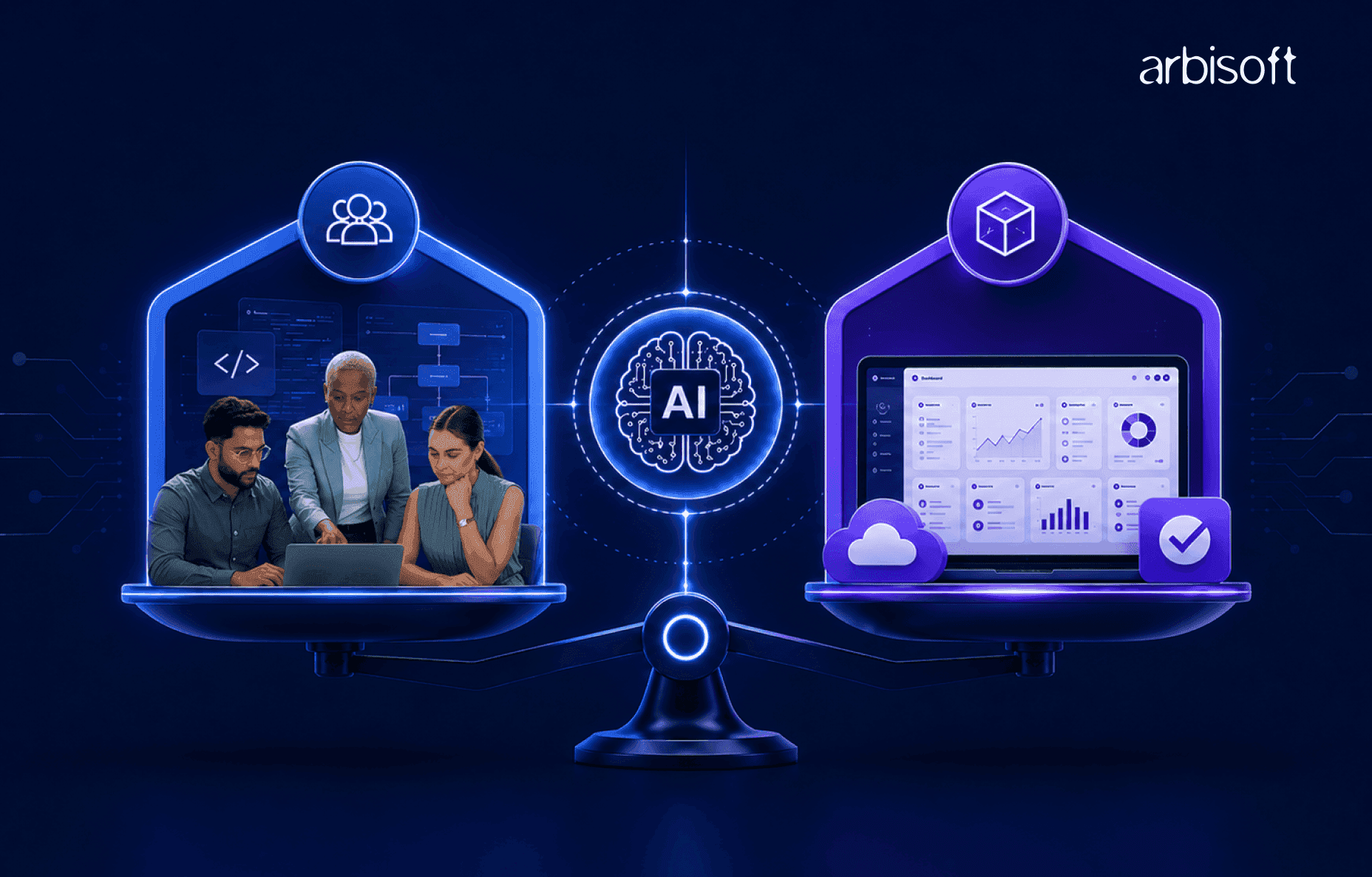
Most AI buying mistakes start with comparing vendors before defining the actual work the AI has to do.
Run one test: would the use case still create advantage if every competitor bought the same platform?
Artificial intelligence (AI) buying decisions go wrong when teams compare vendor labels before they define the work. An AI platform vendor, an AI development partner, and a hybrid delivery model can all look credible in a demo. The difference appears when the system has to operate inside real workflows, permissions, data quality, approvals, and user habits.
Use the job to be done as the first filter. Is the AI drafting common documents, searching across standard business tools, or summarizing meetings? A commercial AI platform may fit. Is it orchestrating a proprietary workflow across several systems, retrieving sensitive internal data, or producing outputs that create product differentiation? A development partner or hybrid path becomes more plausible.
This decision also belongs inside a broader AI Development Partner vs AI Platform Vendor selection process. For the larger capital allocation question, compare this page with the broader build, buy, or partner for enterprise AI framework.
Before any demo or discovery call, write down four things: the workflow, the data the AI must access, the systems it must touch, and the measurable outcome that proves value.
A commercial AI platform licenses prebuilt capability. An AI dev firm, better described as an AI development partner, helps engineer capability the business does not already have.
The distinction is not about whether one path is more advanced. It is about where responsibility sits. With a platform, the vendor owns the product roadmap, infrastructure, packaged features, and much of the operating environment. With a development partner, the engagement centers on discovery, architecture, custom engineering, deployment support, and handoff.
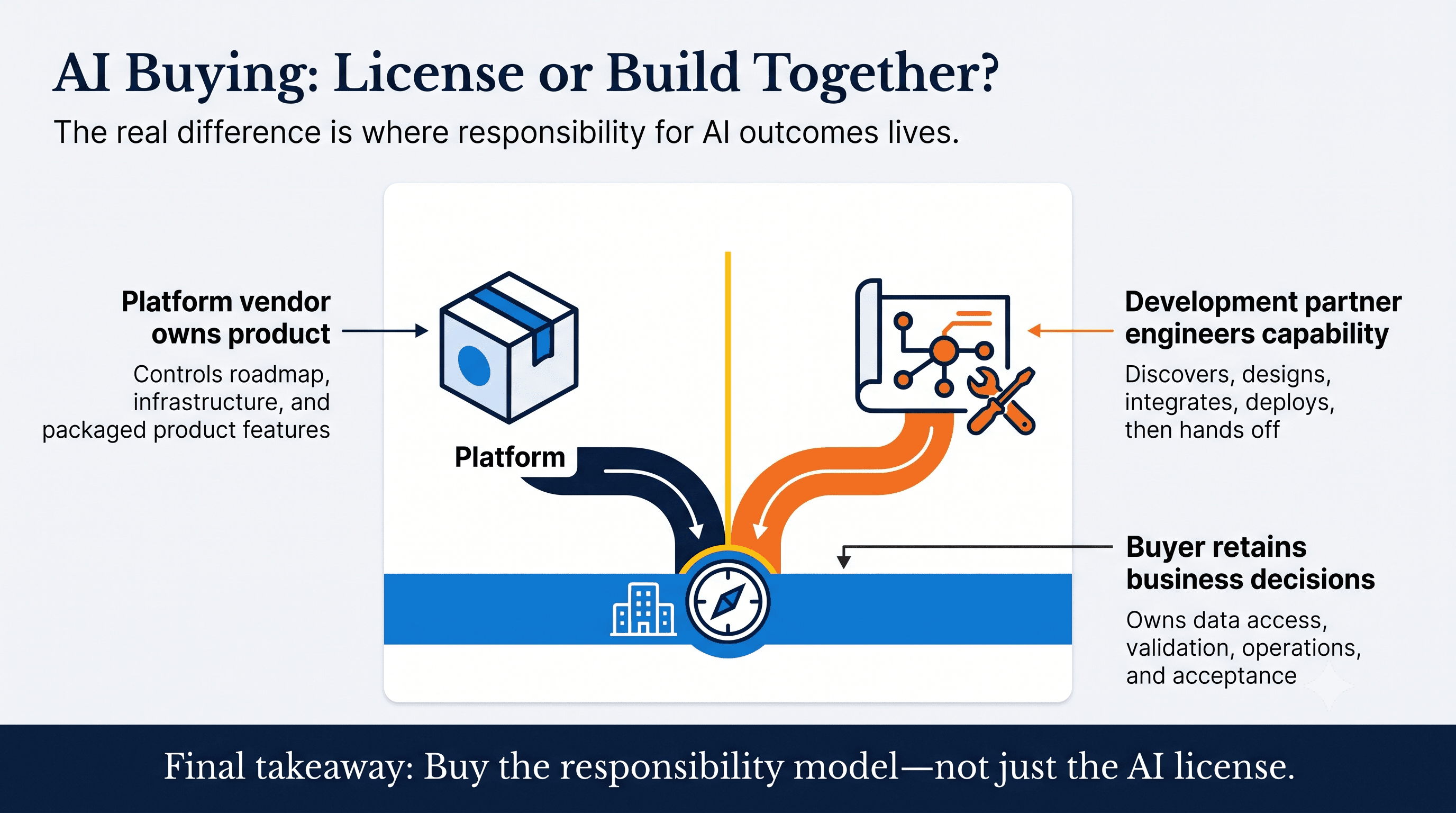
An AI platform vendor usually sells packaged software or model access under a product license. That can include embedded assistants, enterprise search, writing workflows, agent builders, admin controls, audit logs, connectors, application programming interfaces (APIs), and governance settings.
Glean illustrates the enterprise search and knowledge layer pattern. Writer illustrates the enterprise AI agent and workflow platform pattern. Cohere illustrates a model access and deployment options pattern. Microsoft Copilot illustrates AI embedded inside an existing productivity tenant.
None of those categories automatically means fit. The buyer still has to verify whether the documented capability works against their actual workflow, permissions, and data boundaries.
A development partner is usually responsible for the engineering path: technical discovery, architecture, data pipeline design, application development, model evaluation, integration, deployment planning, documentation, and knowledge transfer.
A serious services engagement should produce tangible artifacts. Look for a statement of work (SOW), architecture diagram, model evaluation plan, security plan, sprint plan, handoff plan, and maintenance model.
The buyer still owns business decisions. Data access, review cycles, acceptance testing, and post launch operations cannot be delegated entirely to the partner.
Many platforms now support extensions, APIs, custom connectors, retrieval augmented generation (RAG), partner marketplaces, and implementation services. That means a platform purchase can quietly become a services engagement.
The practical distinction is simple. Configuration changes supported settings inside the product. Customization extends product behavior. Custom engineering builds a system or workflow the product does not natively provide.
When those categories are blurred, budgets become misleading. The license is only one part of total cost of ownership (TCO).
A platform fits when the use case is common enough that the vendor has already productized most of the workflow. Standard productivity, knowledge search, document drafting, and broad internal assistant use cases often fall here.
The strongest platform case is speed with acceptable fit. You trade deeper ownership and customization for vendor managed capability, faster rollout, and less engineering burden.
A platform is a credible fit when these claims can be verified before signature:
Ask for a Service Organization Control 2 (SOC 2) Type II report where relevant, International Organization for Standardization (ISO) 27001 scope if claimed, data processing terms, access control documentation, and audit log examples.
Platform buying fails when the demo proves general capability but not production fit, the same gap that separates vendors that ship production systems from those still running pilots. Vendor loaded data, ideal workflows, and polished assistant scenarios often hide the work required to connect real systems and govern real users.
Microsoft Copilot is a useful caution pattern. It inherits user level permissions in the Microsoft tenant, so overshared data can surface through AI outputs unless governance is cleaned up before rollout.
Other risks include shelfware, hidden configuration work, unsupported edge cases, weak adoption, and roadmap dependency. If the workflow requires a feature the vendor has not shipped, the buyer waits or pays for workarounds.
Hire an AI development partner when the value is tied to something your business owns: proprietary data, unusual workflow logic, specialized evaluation criteria, regulated approval paths, or an AI enabled product feature. For teams weighing the partner's offshore delivery model, decision latency often matters more than the headline rate.
This path usually starts slower because discovery and architecture matter. It also creates more operational responsibility. In exchange, the buyer can shape the system around its workflow rather than bending the workflow around a product.
A services engagement is easier to justify when several of these conditions are present:
A partner who estimates a complex system without discovery is not reducing uncertainty. They are pushing it into the project.
Ask for evidence of delivery discipline, not just AI fluency. A credible partner should show how it scopes, builds, evaluates, secures, deploys, and transfers the system.
Useful proof includes sample architecture diagrams, evaluation plans, reference projects, security documentation, deployment plans, maintenance terms, and a knowledge transfer plan. The evaluation plan is especially important, and it helps to audit the vendor's evaluation suite coverage before signing. If the partner cannot define how the system will be judged, the buyer cannot know whether delivery succeeded.
Hybrid is often the most realistic enterprise path. A commercial platform or model provider supplies the base layer: model access, identity controls, admin features, connectors, or compliance infrastructure. Custom engineering supplies the business outcome.
This is where the comparison with a vertical AI vendor versus a horizontal platform becomes useful. A horizontal platform may cover the base capability, while custom work handles the domain workflow.
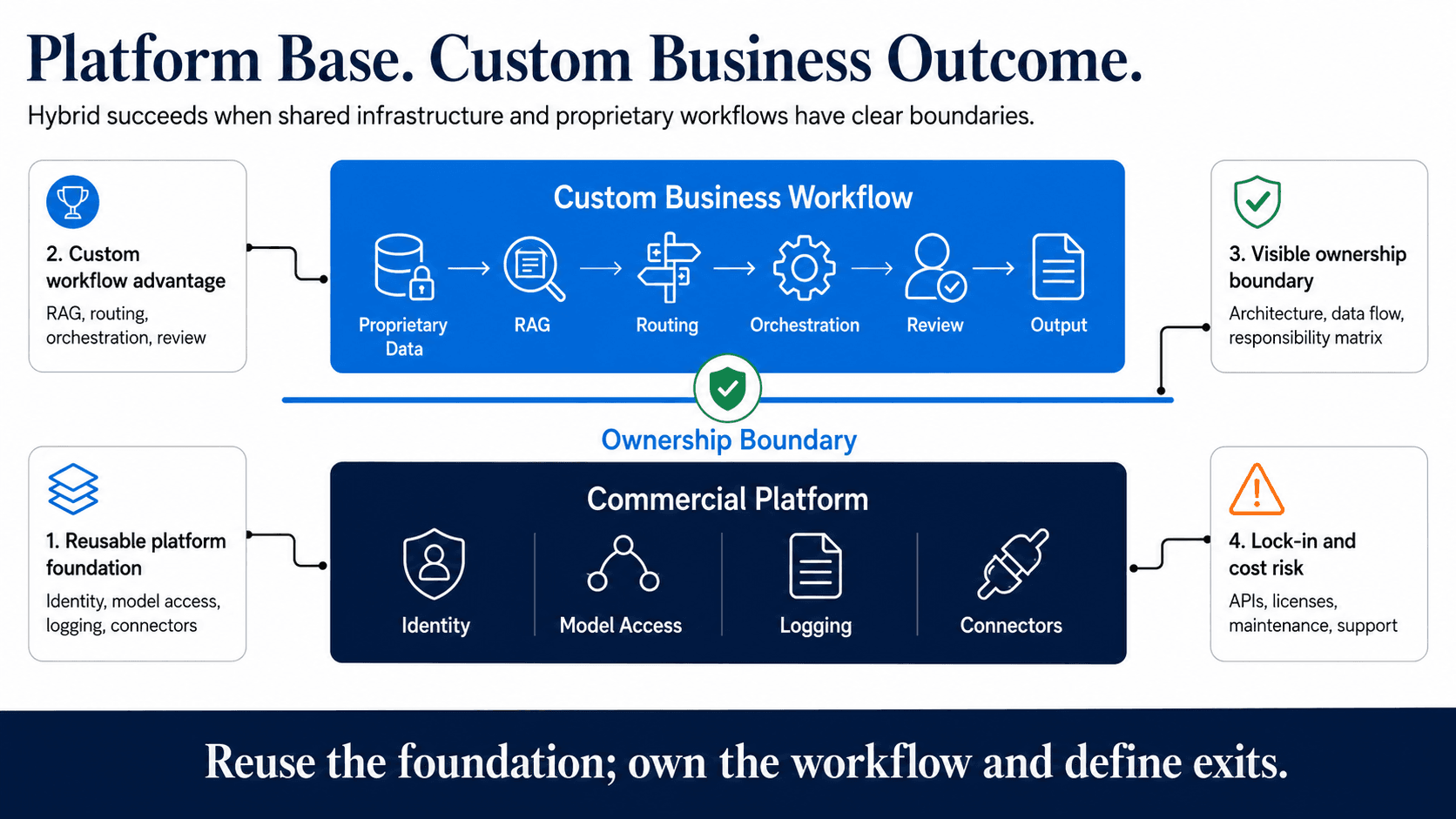
Platform-plus-custom reduces risk when the platform handles infrastructure the buyer does not need to reinvent. Identity access, model access, logging, and standard interfaces are good candidates for reuse.
Custom engineering should focus on the workflow specific layer: RAG over proprietary data, custom routing, multi system orchestration, regulatory review steps, or domain specific output formatting.
The boundary must be visible. Require an architecture diagram, data flow diagram, and responsibility matrix before approving hybrid scope.
Hybrid can also create cost and exit risk. Custom code may depend on proprietary APIs, model formats, embedding choices, connector behavior, or agent frameworks. Migration then becomes an engineering project, not a vendor switch.
Duplicated cost is another risk. The buyer may pay for platform licenses, implementation services, custom development, maintenance, and internal support at the same time. Clarify who owns custom code, who supports each component, and what happens if the platform changes pricing or APIs.
The choice becomes clearer when each path is compared across the same dimensions.
Dimension | Platform | AI development partner | Hybrid |
Workflow fit | Standard, documented use cases | Proprietary or complex workflows | Platform base with custom outcome |
Integration depth | Native connectors | Custom integrations and orchestration | Mix of connectors and custom work |
Ownership | Vendor owns product | Buyer can own code and artifacts | Split by component |
Cost model | License plus rollout work | Discovery, build, deployment, maintenance | License plus services plus maintenance |
This table is a shortlist tool, not a full financial model. For deeper economics, use a dedicated AI pricing models analysis and an in-house AI team cost comparison.
Use one test: would the use case still create advantage if every competitor bought the same platform?
If yes, the platform may be enough. If the value comes from proprietary data, unique process logic, or differentiated customer experience, a development partner or hybrid model is more likely to fit.
Integration depth often decides the path. Platforms work well when systems are standard and connectors are mature. Custom or hybrid paths become stronger when the AI must interact with legacy systems, proprietary data warehouses, approval workflows, or fine grained access rules.
For governance, request the boring documents early: architecture diagram, data flow diagram, security questionnaire, access control model, audit log documentation, and model evaluation plan. The National Institute of Standards and Technology (NIST) AI Risk Management Framework can help frame governance questions without turning vendor selection into a compliance exercise.
A platform usually looks simpler because the product license is visible. The hidden work is implementation, change management, connector validation, governance cleanup, and adoption.
A development partner makes delivery cost more visible, but scope risk and ongoing maintenance need discipline. Hybrid can be the hardest to model because license cost, custom work, and support responsibility overlap.
The most expensive warning signs appear before procurement, not after deployment. Treat vague requirements, unsupported integrations, no evaluation plan, missing security documentation, unclear ownership, and overpromised automation as risk signals.
If the vendor path cannot be tied back to the workflow, the buying process is drifting.
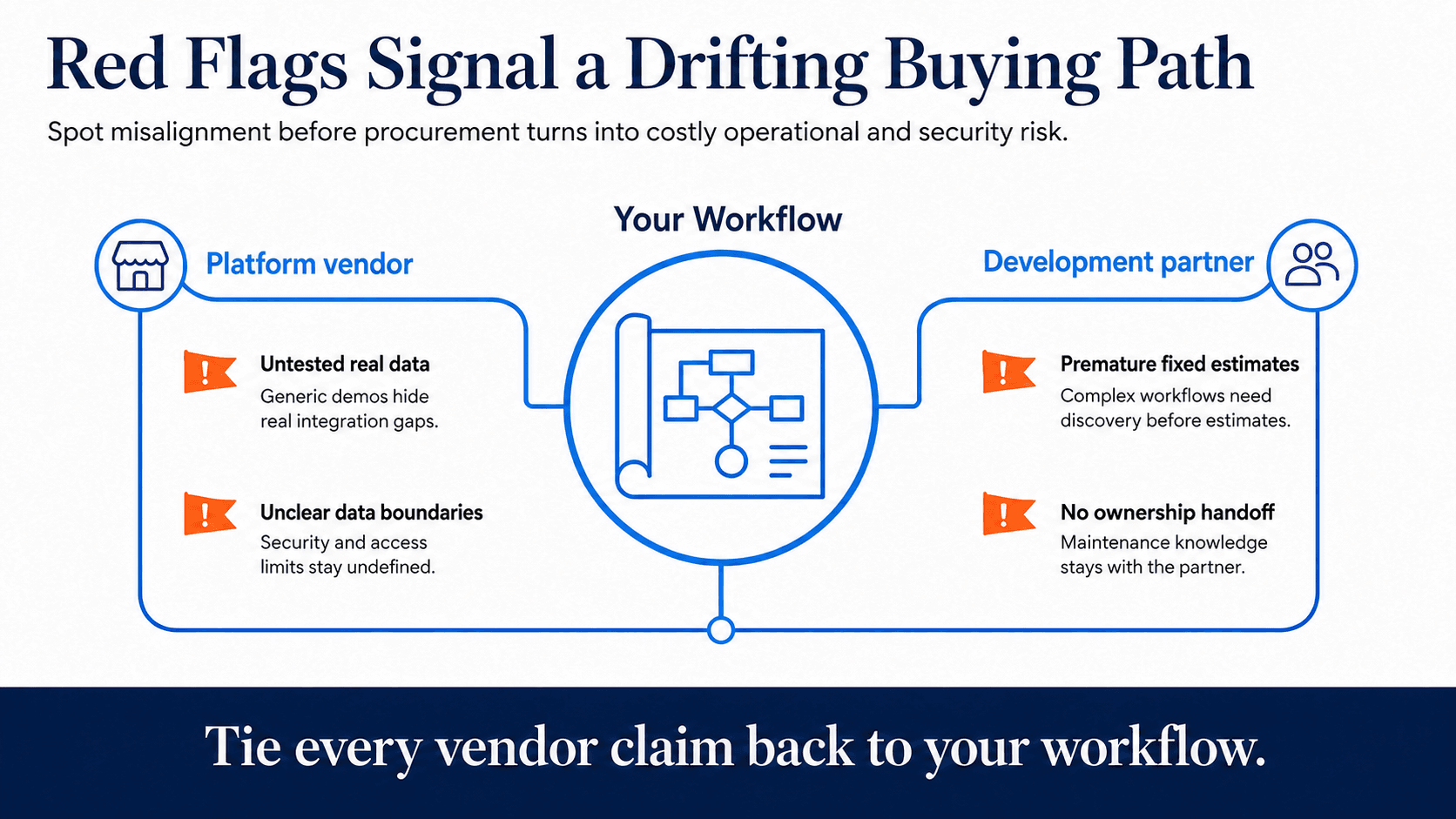
Watch for platform vendors that decline to test with your data, show only generic demos, blur native connectors with custom API work, cannot explain data boundaries, or rely on roadmap promises for required features.
Limited admin controls are another warning sign. If permissions, auditability, or access boundaries cannot match your operating model, the platform may be convenient but unsafe for the use case.
Be cautious when a firm skips discovery, gives a fixed estimate for a complex workflow too early, cannot produce sample deliverables, or has no deployment and maintenance plan.
No knowledge transfer plan is a major red flag. A partner should reduce long term dependency, not create a system only the partner can operate. If firm type is part of the decision, use a dedicated boutique AI firm vs Big 4 consultancy comparison rather than folding that whole choice into this one.
Choose a platform when the use case is standard, the workflow is already covered, integrations are mature, adoption speed matters, and roadmap dependency is acceptable.
Choose an AI development partner when the value depends on proprietary workflow, custom data access, complex integrations, regulated review paths, or differentiated capability the business needs to own.
Choose hybrid when the platform provides a strong base layer but custom engineering is required to create the business outcome.
For the broader vendor selection path, return to the AI Engineering Partner Selection Hub after you classify the use case.
Complete this checklist before vendor conversations:
A prepared buyer does not ask, "What can your AI do?" A prepared buyer asks, "Can your approach perform this workflow, with this data, inside these controls, at this operating cost?"
For relevant guides, return to the main guide for selecting an AI engineering partner.
Buy a platform when the use case is common and already productized. Hire a firm when value depends on proprietary data, workflow, or differentiation.
A platform licenses prebuilt capability under a product license. A dev firm engineers capability your business does not already have.
Use hybrid when a platform supplies the base layer but custom engineering is needed to create the business outcome. The platform covers model access, identity, and connectors while custom work handles the domain workflow.
Confirm the workflow is supported today, not just on the roadmap, and that the vendor will run a proof of concept against your own data. Required integrations should be native, and security docs like a SOC 2 Type II report should be available before procurement.
Platforms fail when a demo proves general capability but not production fit. Watch for shelfware, hidden configuration work, weak adoption, and waiting on roadmap features.
Integration and workflow fit account for most AI project failures, which makes systems engineering the real differentiator. Partners worth preferring work inside existing APIs, identity, logging, and legacy constraints. They assess data quality before building, design evaluation and monitoring alongside the feature, and architect so a model provider can be swapped without re-engineering. Documentation, runbooks, and clear IP terms come with the handover. A platform vendor optimises for its own platform, and a development partner optimises for the stack already in place.
Ask for sample architecture diagrams, an evaluation plan, reference projects, security docs, a deployment plan, and a knowledge transfer plan. The evaluation plan matters most, since it defines how delivery success will be judged.
Write down the workflow, the data the AI must access, every system it must touch, and a measurable success metric. Also list must-have integrations and assign post-launch ownership.
...Loading Related Blogs
Trusted by top platforms for our transformative solutions and exceptional results: