

 Add as preferred on Google
What a Good Custom Software Project Plan Looks Like (and What's Fake Confidence)Read More
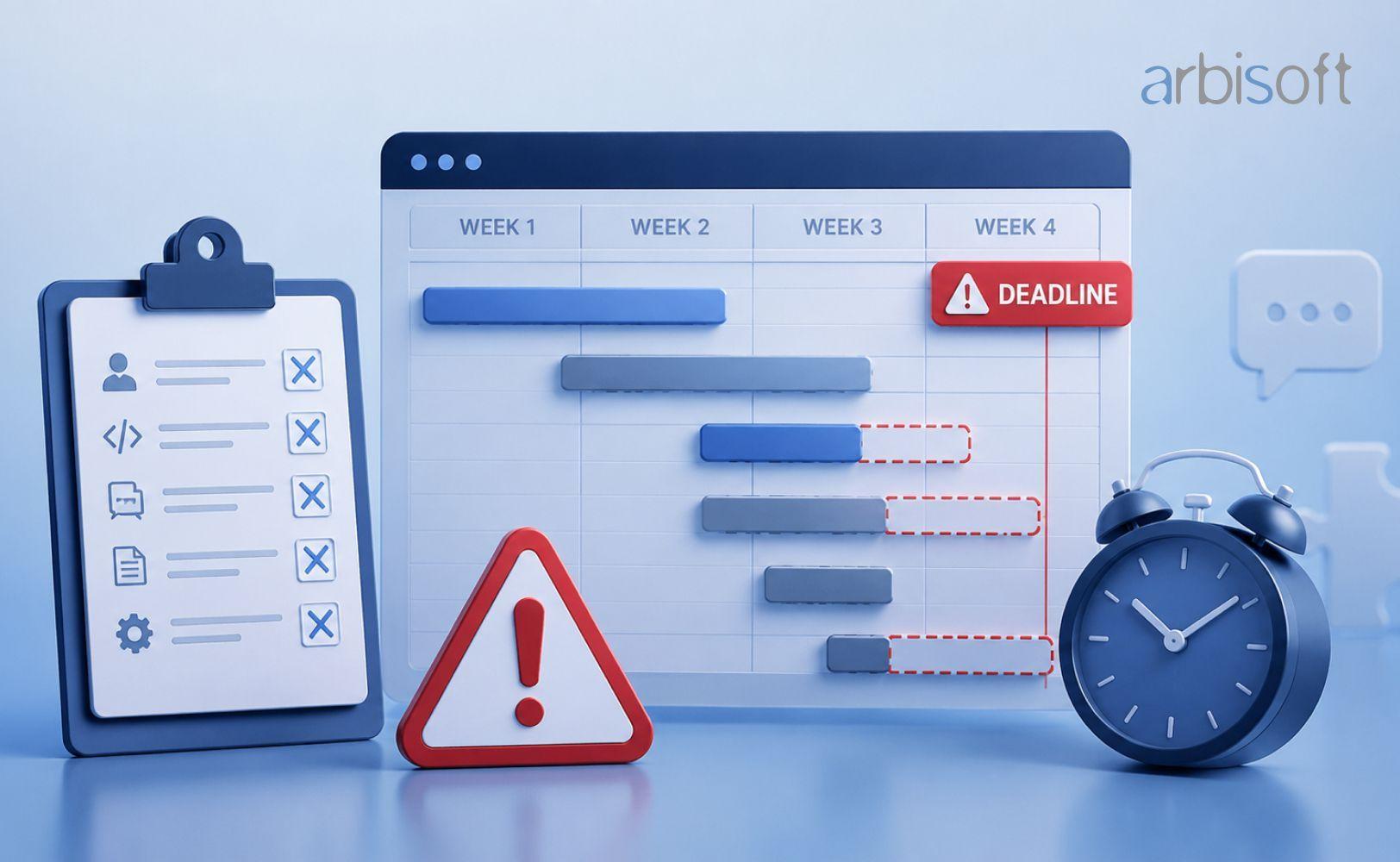
A custom software vendor is likely to miss the deadline when several signals appear together: milestone dates keep moving while the plan stays the same, progress updates are vague instead of demonstrable, the same blockers survive sprint after sprint, developers keep changing, quality falls as the team tries to catch up, and nobody can say what could still move the date. One late milestone is not that pattern.
The strongest warning sign is a persistent gap between what the vendor says, what the delivery evidence shows, and what changes after the gap becomes visible.
Verify before you escalate. Ask to see working software, compare the baseline against today's forecast, separate blocked work from unfinished work, and check that "done" features were accepted. If the pattern holds, require the root cause instead of a new date, plus a written recovery plan that states what is different from the plan that failed.
Schedule movement is not automatically evidence of vendor failure. Requirements can change, buyer approvals can arrive late, integrations can expose unexpected behavior, credentials can be delayed, and technical investigation can uncover legitimate complexity.
The difference is how the change is handled.
| Signal | Normal project uncertainty | Systemic deadline risk | What to verify |
| Milestone moves | Cause is identified and forecast changes accordingly | Dates keep moving with little change to the plan | Baseline, revised date, cause, corrective action |
| Dependency causes delay | Owner, impact, and escalation are visible | Same dependency remains unresolved without action | Blocker age, owner, escalation, resequencing |
| Scope changes | Change is documented with schedule impact | New work enters delivery without impact analysis | Scope baseline, change request, acceptance criteria |
| Estimate proves wrong | Assumptions are updated as new evidence appears | New dates replace old ones without explaining failed assumptions | Estimate assumptions, remaining uncertainty, reforecast logic |
A healthy reforecast preserves the original baseline. It explains what changed, how remaining work is affected, and what must now change in scope, sequencing, staffing, dependencies, or risk treatment.
Judge deadline risk as a pattern, not a collection of isolated red flags. The most useful signals fall into ten areas:
A firm date becomes questionable when it appears before the vendor has investigated requirements, integrations, data conditions, architecture constraints, deployment environments, external approvals, and specialist dependencies.
An early target date can still be useful. It should be conditional on visible assumptions.
Ask for the estimate assumptions, exclusions, major dependencies, technical unknowns, and conditions that could move the forecast. Where uncertainty is substantial, a short technical investigation or prototype may be more credible than simply adding confidence to an untested date.
Ambiguity creates two schedule risks. The team cannot estimate uncertain work reliably, and stakeholders can later disagree about whether delivered functionality satisfies the requirement.
Trace important features from the Statement of Work, or SOW, into requirements, backlog items, exclusions, acceptance criteria, and the shared Definition of Done.
Select several important features and ask the vendor's technical lead and your product owner what must be true before each is accepted. Materially different answers deserve attention before they become rework.
Lean documentation is not the same as absent traceability.
Critical knowledge may live in repositories, issue trackers, wikis, architecture tools, or automated pipelines. The practical question is whether another qualified developer could understand, build, test, deploy, and safely change the system using the available information and a reasonable handover.
Pay particular attention to business rules, architecture decisions, interfaces, environment configuration, deployment procedures, integration behavior, and decision history.
Every forecast assumes people will be available when needed.
Compare the proposed staffing model with the team actually delivering the project. Check roles, allocation, onboarding dates, specialist availability, vacancies, substitutions, and major responsibility changes.
Part-time specialists or a staffing substitution are not automatically problems. The warning appears when the forecast still assumes capacity that is no longer available.
Ask the vendor to show how the current team supports the remaining schedule.
"Almost done" can hide substantial integration, testing, defect correction, deployment, or acceptance work.
Request delivery evidence instead: working software, functioning integrations, completed user journeys, accepted features, test outcomes, known limitations, open defects, and milestone exit criteria.
A polished interface using mocked data may prove useful development progress. It does not prove the production integration, error handling, migration, deployment, or remaining quality work is complete.
Narrative status should explain the evidence, not replace it.
One transparent reforecast can be responsible management. Repeatedly moving dates while scope, capacity, sequencing, dependencies, and corrective actions remain unchanged is a different pattern.
For each significant movement, preserve:
If a milestone moved because capacity was insufficient, the new plan should show what changed about capacity, scope, sequencing, or expected output.
A blocker prevents specific work from progressing. It may involve a decision, approval, access requirement, technical problem, third party, or dependency.
A persistent blocker becomes more concerning when ownership and escalation are unclear.
Track its age, affected work, owner, controlling party, required decision, target resolution date, escalation history, and schedule impact. Also ask what work has been resequenced while the blocked item waits.
"Still blocked" is not a recovery strategy.
One personnel change does not establish team instability. Repeated handoffs become riskier when essential project knowledge is concentrated in individuals.
Review staffing history, replacement onboarding, role gaps, handover records, shared code ownership, review history, architecture documentation, and continued access to technical leadership.
A separate concern appears when technical leads become difficult to reach and delivery questions are filtered entirely through nontechnical account staff. That makes claims about remaining effort and technical uncertainty harder to test.
Change is normal. Healthy change control makes the consequences visible.
For a disputed item, reconstruct what the original scope said, what requirements and exclusions existed, what acceptance criteria applied, what later changed, and whether a change request was evaluated.
The forecast should separate approved scope change from execution variance. Without that distinction, you cannot tell whether delivery is slipping or the vendor is delivering more work than the baseline assumed.
A project can appear to accelerate by postponing testing, accepting unstable builds, allowing regressions, or deferring necessary technical work. That can widen the gap between "development complete" and releasable software.
Inspect build stability, test execution, failed tests, regression history, defect severity, unresolved release blockers, technical debt decisions, and release criteria.
Absolute defect counts need context. Trends, severity, recurrence, and resolution behavior are usually more informative than one raw number.
A credible forecast includes uncertainty.
Ask the vendor:
A vendor does not need a sophisticated forecasting model for every project. It should be able to explain why the current forecast is credible and what new evidence would cause it to change.
When confidence in status reporting falls, replace reassurance with triangulation. Compare several independent forms of delivery evidence before escalating.
Request a functioning increment in an appropriate project environment.
The demonstration should correspond to the milestone or acceptance criteria being claimed. Ask what remains outside the demonstration, including integration, configuration, testing, security work, migration, deployment, or defects.
Working software is strong evidence only when it represents the work being reported.
Put the original milestones beside today's forecast.
For each meaningful difference, record whether the cause was scope, an assumption, a dependency, staffing, sequencing, technical approach, or an external constraint.
Keeping both views prevents repeated reforecasting from erasing the history of schedule variance.
Classify remaining work by status and control.
An unfinished feature still being built differs from a feature waiting for buyer approval, third-party access, production credentials, or a vendor-owned technical solution.
That distinction improves accountability without assuming every delay belongs to the vendor.
"Coded" and "accepted" are not necessarily the same state.
Sample several supposedly completed features. Trace each against acceptance criteria and the agreed Definition of Done. Check test evidence, unresolved defects, environment status, integration, security verification, deployment readiness, and User Acceptance Testing, or UAT, where applicable.
Use one completion definition consistently when calculating progress.
Reconstruct the capacity assumptions behind the latest forecast.
Compare planned and actual roles, allocations, vacancies, replacements, specialist availability, and substantial responsibility changes. Then verify that the remaining estimate was recalculated around today's team.
Also look for concentration risk, such as one person holding most deployment or integration knowledge.
Do not begin recovery by negotiating another date. First determine why the existing forecast failed.
A proportionate recovery sequence moves from cause analysis to scope and planning decisions, stronger delivery evidence, continuity protection, and independent review when necessary.
Require an explanation that connects the variance to specific work.
It should identify the failed assumption or event, why the previous plan did not handle it, what work was affected, whether the cause remains active, and what corrective action now changes the forecast.
"Development took longer than expected" does not provide enough information to test whether the same problem will recur.
If the business deadline matters more than releasing every feature simultaneously, sequencing or reducing scope may improve forecast credibility.
Separate must-have launch outcomes from deferrable functionality, but evaluate dependencies first. A seemingly optional feature may still be required for migration, security, integration, operations, or acceptance.
Document what is deferred and how the decision changes acceptance and timing.
A credible recovery plan should be testable. It should cover:
Most importantly, it should state what is different from the plan that failed.
Review recovery through intermediate evidence, such as accepted increments, resolved critical blockers, improving quality indicators, and more stable forecasts.
More meetings do not automatically create more control.
Increase the frequency of evidence instead. A compact recovery rhythm can combine working-software demonstrations, milestone acceptance, ageing-blocker review, important decision and scope-change logs, defect review, and short forecast updates when underlying evidence changes.
Escalation should follow changed evidence, not an arbitrary meeting calendar.
If confidence is deteriorating, verify practical continuity before transition becomes urgent.
Check appropriate access to source repositories, history, build and deployment pipelines, environments, configuration, architecture information, interfaces, tests, deployment instructions, issue records, and integration knowledge.
Contractual rights vary, so access questions may require separate legal review. From an operational perspective, the key question is whether another qualified team could continue the project with the assets and knowledge currently available.
An independent technical or delivery review can be appropriate when repeated variance, disputed completion, unstable software, inaccessible artifacts, architectural concerns, or uncertain remaining effort cannot be reconciled.
The purpose is to establish project state, not assign blame.
A useful review tests demonstrated functionality, acceptance status, major technical risks, code and test condition, deployment readiness, dependencies, staffing assumptions, schedule logic, and the evidence supporting remaining effort.
Replacement introduces its own onboarding, knowledge-transfer, and technical risks. The stronger decision signal is what happens after the delivery problem is made explicit.
Recovery becomes more credible when the vendor:
Earlier disclosure of bad news can actually indicate improving control if it is accompanied by evidence and action.
Transition risk rises when the same behaviors persist after corrective discussions.
Watch for repeated unexplained milestone movement, status claims that conflict with working software, inaccessible project assets, continuing team churn without effective handover, recurring scope disputes, weak documentation, falling quality, or recovery plans that change only the date.
A delivery problem may be recoverable. A governance system that repeatedly fails to expose, explain, or respond to delivery problems is harder to trust.
Many warning signs can be tested before kickoff.
Ask prospective vendors how they perform discovery, which assumptions support the estimate, what remains uncertain, how integrations and dependencies are validated, whether early dates are targets or commitments, and which people are actually available.
Also clarify how working software will be demonstrated, how milestones are accepted, how changes are evaluated, how blockers are escalated, and what project documentation and technical assets remain accessible throughout delivery.
Comparable-project evidence is useful when the projects are genuinely comparable. Generic experience claims do not validate a specific schedule.
One delay should trigger diagnosis, not panic.
Continue normal delivery when schedule movement is isolated, explained, reflected in the forecast, and supported by credible delivery evidence. Move into structured recovery when several signals show material deadline risk but the vendor remains transparent and capable of changing course. Consider independent review when claims and evidence cannot be reconciled. Prepare for replacement when that mismatch persists and continuity risk increases.
The decision system is simple:
What does the vendor say? What does the evidence show? What changes after the problem is discovered?


Trusted by top platforms for our transformative solutions and exceptional results: