arbisoft brand logo
Contact Us

Engineering Success with Oracle AI Data Platform

Oracle's new AI Data Platform (AIDP) gives enterprises another way to unify data and AI, right alongside the Databricks and Snowflake environments many have already built. Arbisoft has hands-on experience migrating petabyte-scale lakehouses, and we're already fluent in how AIDP works under the hood.

Oracle Enters the AI Data Race with AIDP

More than 10,000 companies, including over half of the Fortune 500, run data and AI workloads on Databricks. Snowflake holds a similarly dominant position across enterprise analytics.

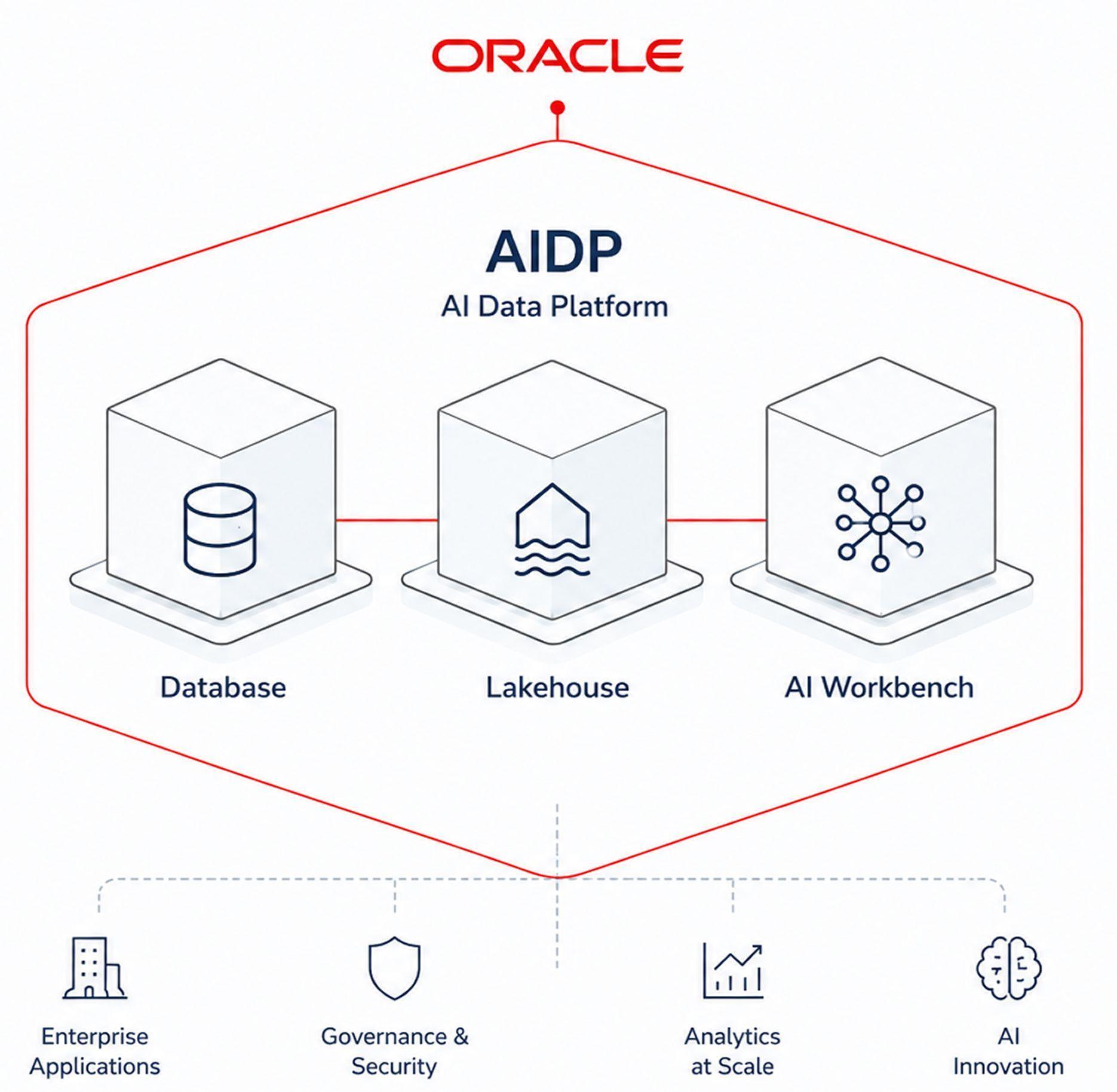
In October, 2025, at Oracle AI World, Oracle launched its AI Data Platform (AIDP) - a converged database, lakehouse, and AI workbench built to compete directly for that workload.

Oracle has moved fast since: an AIDP offering for Life Sciences shipped in January 2026, and one for U.S. federal agencies followed in March 2026.

For any enterprise already running Databricks or Snowflake, that's a serious new variable to understand, whether the plan is to adopt it, integrate with it, or simply know what it changes.

Content Image

What Oracle's AI Data Platform (AIDP) Actually Does

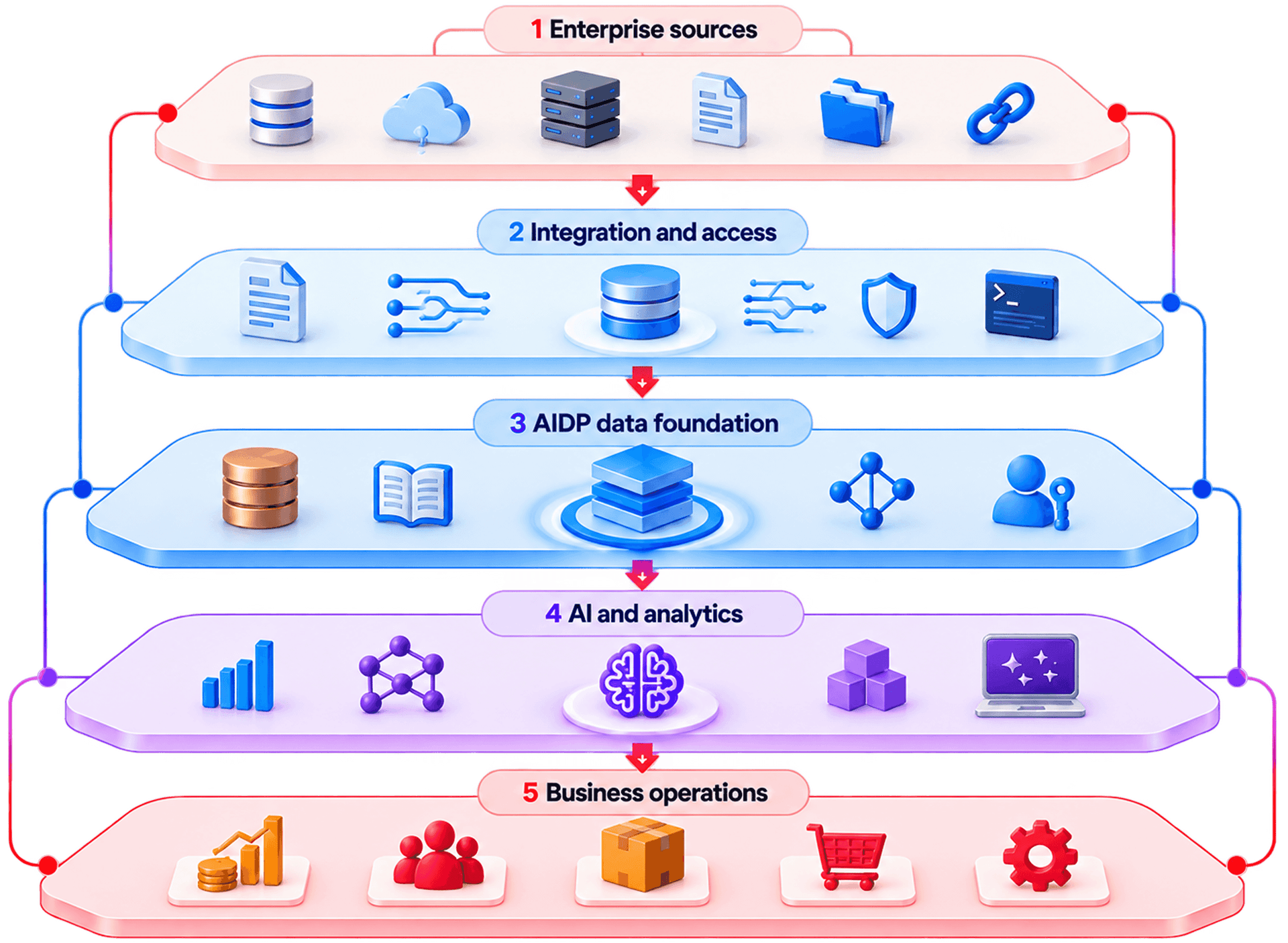
AIDP bundles several previously separate Oracle products under one name. Here's what's actually inside it and specifically where Databricks and Snowflake fit.

  • One Converged Database

    Oracle AI Database 26ai sits at the center of AIDP, combining SQL, JSON, vector search, and graph in a single engine, with no separate vector database required.

  • An Iceberg-Native Lakehouse

    Autonomous AI Lakehouse pairs Autonomous Database with native Apache Iceberg support, available on OCI, AWS, Azure, GCP, and Exadata Cloud@Customer.

  • Databricks Migration Path

    Oracle built a dedicated, agentic migration toolkit that ports Databricks notebooks, jobs, and Unity Catalog or Hive Metastore schemas onto AIDP - not a generic import script.

  • Snowflake Interoperability

    For Snowflake, AIDP's story is different: zero-copy federation through Iceberg and Polaris catalog compatibility, so Snowflake tables can be queried in place instead of migrated wholesale.

  • AI-Assisted Migration Engineering

    The Databricks migration path runs on an AI coding agent that rewrites, executes, and verifies each notebook cell, then flags anything it can't confidently fix for a human engineer.

Arbisoft Oracle AIDP & Platform Expertise

We help organizations modernize, optimize, and scale their data platforms on Oracle's enterprise-grade technologies from Oracle Cloud Infrastructure, Exadata and Oracle Database to GoldenGate, and Oracle Database Appliance. We bring that same engineering discipline to Oracle's newest platform, AIDP. We offer deep, hands-on data engineering expertise across Oracle's stack, old and new, backed by two decades of expertise.

Design, migration, and modernization of secure, scalable data workloads on Oracle Cloud Infrastructure (OCI).

Performance tuning, capacity planning, and modernization of Exadata environments for mission-critical, data-intensive workloads.

End-to-end Oracle Database lifecycle support: administration, performance tuning, migration, high availability, and backup/recovery.

Real-time replication and Change Data Capture (CDC) across Oracle and heterogeneous environments, including cloud and hybrid integration.

Design, deployment, configuration, and optimization of Oracle Database Appliance (ODA) environments for dependable enterprise workloads.

Evaluate your current Databricks/Snowflake estate, map dependencies, and scope what an AIDP move, or a federated integration, would actually involve.

Hands-on migration of notebooks, jobs, DAGs, and Unity Catalog/Hive Metastore schemas, using and extending Oracle's own agentic migration tooling.

Architecture for federated, zero-copy access between Snowflake and AIDP via Iceberg/Polaris catalog compatibility.

Apache Iceberg and Delta Lake table design, medallion (bronze/silver/gold) architecture, and schema evolution planning.

Storage format, compression, and file-layout optimization for data lakes measured in hundreds of terabytes to petabytes.

Our Approach to Oracle AI Data Platform Engineering

Whether you're moving workloads onto AIDP or building a federated bridge to it, the engineering discipline is the same.

Step 1

Assess

Inventory your Databricks/Snowflake estate: notebooks, jobs, dependency chains, catalog schemas, and data volumes.

Step 2

Plan

Build a migration or integration roadmap, sequenced by dependency and risk, and decide what gets ported versus re-implemented.

Step 3

Migrate or Integrate

Execute: port notebooks and jobs, rewrite catalog DDL, or stand up federated access - using Oracle's own agentic tooling where it fits and hands-on engineering where it doesn't.

Step 4

Verify

Validate every migrated job for correctness, not just "it ran": check outputs, logs, and performance against the source system.

Step 5

Optimize

Tune performance, storage layout, and cost once workloads are live on the new architecture.

Step 6

Support

Stay engaged post-launch so the platform keeps working as data volumes and use cases grow.

All the A's to Your Q's

  • AIDP is Oracle's converged data-and-AI platform, launched in October 2025. It combines Oracle's AI Database, an Iceberg-native lakehouse (Autonomous AI Lakehouse), a notebook-based development environment (AIDP Workbench), and a shared metadata layer (Master Catalog) under one product.

  • Not automatically, and not for everyone. AIDP gives enterprises another option for where data and AI workloads run, but Databricks and Snowflake remain mature, widely-adopted platforms in their own right. The right call depends on your specific workloads, team skills, and roadmap.

  • Oracle built a dedicated migration toolkit that ports notebooks, jobs, schedules, and Unity Catalog or Hive Metastore schemas onto AIDP. It uses an AI coding agent to rewrite and test each notebook cell, verify the output multiple ways, and automatically retry fixes before flagging anything that needs a human engineer.

  • No - this is a common misconception. For Snowflake, AIDP's current story is interoperability, not migration: through Iceberg and Polaris catalog compatibility, AIDP can query Snowflake tables in place rather than porting them onto a new platform. If your organization needs an actual Snowflake migration path, that's a gap worth planning around, not assuming away.

  • Delta Live Tables pipelines, streaming tables, and MLflow model registries aren't part of the automated path today - they need manual re-implementation. Object-level permissions, stored procedures, and some DDL objects also need a human review pass.

  • It scales with notebook complexity. Oracle's own migration tooling reports roughly 5–15 minutes and $1–3 in AI compute cost per 30-cell notebook on a warm cluster. A multi-job workflow of around 150 cells runs 30–90 minutes and costs $10–30. That's the automated portion - real engagements also need planning, catalog migration, validation, and handling anything the automation can't confidently fix, which is where our team comes in.

Have Questions? Let's Talk.

We have got the answers to your questions.

We'll send a mutual NDA before the discovery call if requested. Zero obligation.