
 Add as preferred on Google
How to Modernize a Legacy Learning Platform Without a Full RewriteRead More

An offshore AI team can quote 40 to 70 percent below US rates, but the rate card hides what it costs to ship the work.
Split the initiative into workstreams and match each one to geography by ambiguity, sensitivity, and decision speed.
A 70 percent saving can be real on a rate card. It is not automatically real once the work reaches production.
For a US buyer, the comparison is whether the geographic delivery model gives your artificial intelligence initiative the right balance of cost, working-hour overlap, governance, and decision speed rather than whether onshore, nearshore, or offshore delivery is "better”. The lower the quoted rate, the more important it is to examine what the quote assumes about your team, your data, and the work itself.
Rate differences can be substantial. Recent market ranges place senior US engineering or consulting work far above many offshore equivalents, so a 40 to 70 percent rate gap can be plausible for particular roles and locations. But an hourly comparison captures only the labor line item. It does not show the effort required to turn uncertain AI work into accepted production output.
A lower rate only lowers total delivery cost when the operating model is equally disciplined.
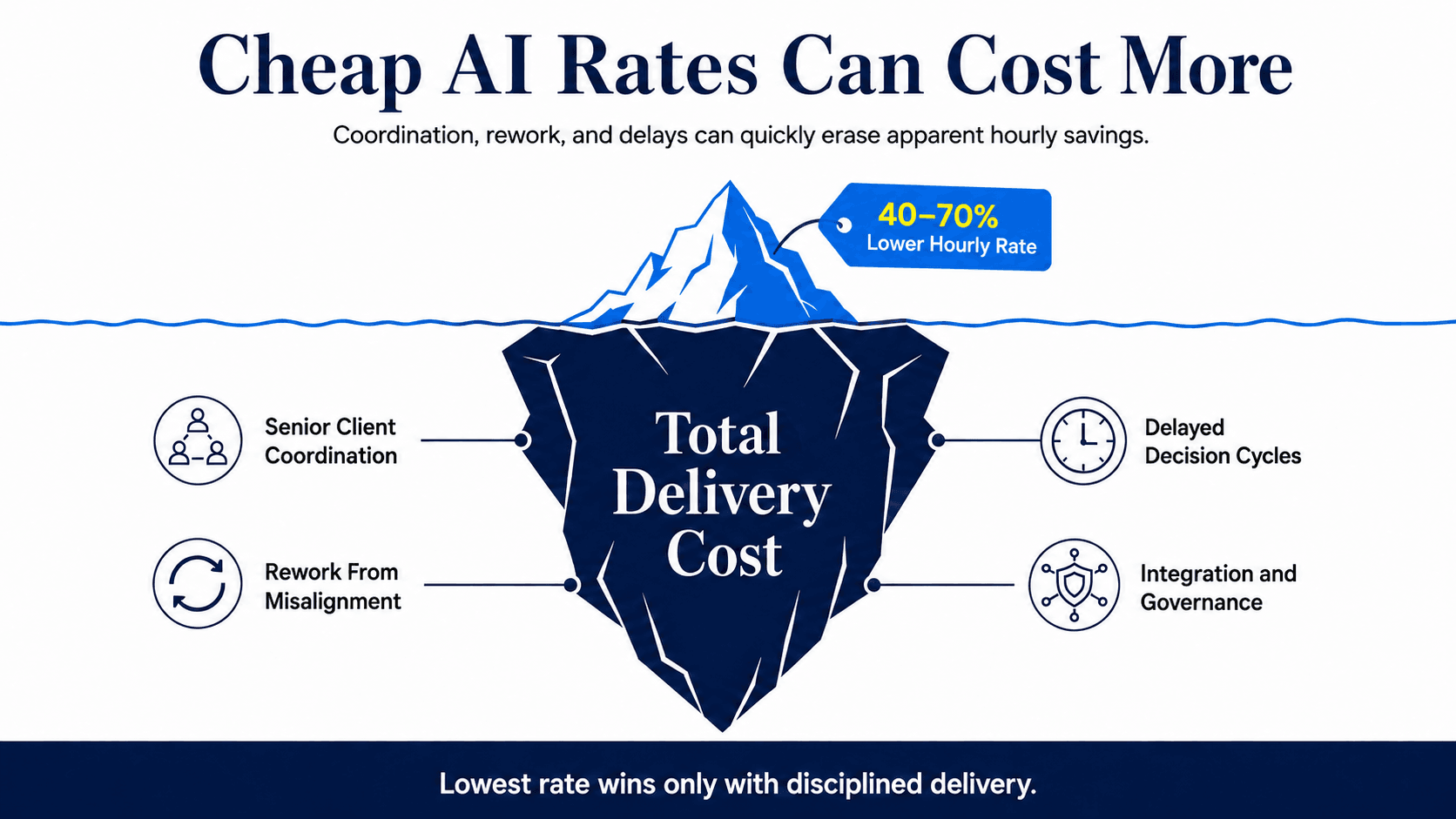
A blended rate is the average price of the proposed role mix. Total delivery cost is broader: the labor, coordination, governance, rework, integration, evaluation, and client-side effort required to deliver a usable result.
For AI work, those omitted categories can be material. Product owners may refine success criteria. Domain experts may need to review model behavior. Security and data teams may need to approve access patterns. Engineers may need to integrate the model with identity systems, applications, monitoring, and release processes.
Compare proposals using the same cost frame. Ask each provider to separate discovery, implementation, integration, testing, AI evaluation, security review, documentation, and infrastructure usage. Then identify the client time assumed for product, architecture, data, and security leaders. A low blended rate can look less compelling when the buyer must supply a large amount of senior coordination.
Time-zone separation does not make delivery ineffective by itself. Mature distributed teams use overlap windows, written decisions, shared tooling, and clear escalation paths to reduce friction. The problem begins when work requires rapid back-and-forth but the delivery model treats it as asynchronous.
A requirement that would take 30 minutes to clarify can become a day-long cycle when the relevant stakeholders do not overlap. If the team proceeds on an assumption, the delay may later appear as rejected output, a change request, or a defect cluster. The risk is highest when requirements are unstable or acceptance criteria are not explicit.
Watch for operational signals rather than relying on geography as a proxy: unresolved decisions blocking multiple tickets, repeated clarification on the same issues, rising change requests, defects tied to misunderstood requirements, and slow escalation of blockers. Those patterns are coordination costs.
For a US buyer, onshore delivery usually means a team operating in the same country and similar time-zone bands. Nearshore delivery commonly means nearby regions with meaningful overlap, often Latin America. Offshore delivery means a more distant team with limited shared working hours. These labels describe operating conditions.
For a broader framework on provider selection, use the complete AI Engineering Partner Selection Guide alongside this comparison. It helps place geographic fit within the wider vendor decision.
This is a starting point. A well-governed offshore team can outperform a poorly run onshore engagement. What matters is the fit between the workstream and the way the team will operate.
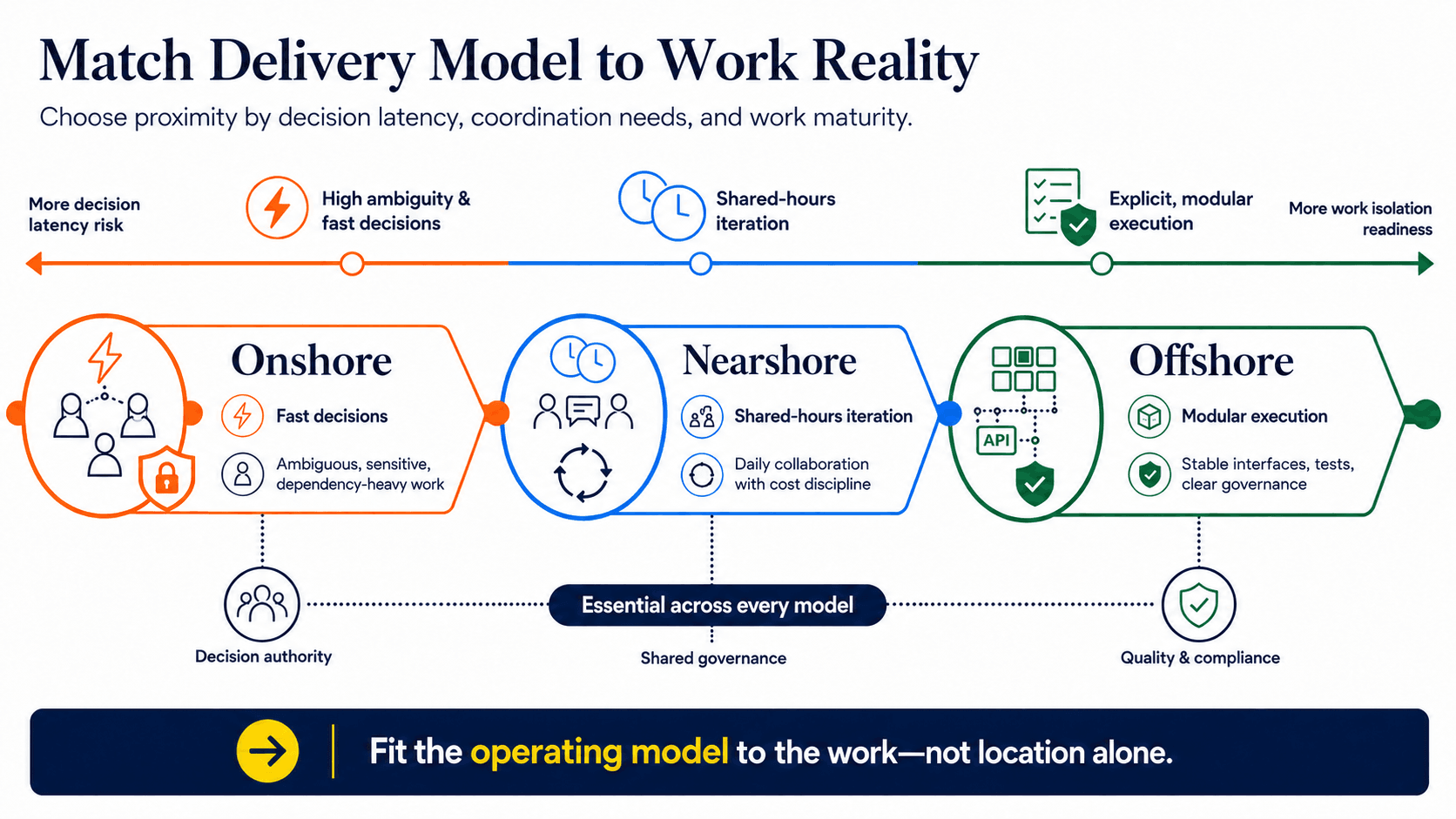
Onshore delivery is most valuable when delayed decisions carry a meaningful cost. Early discovery, problem framing, architecture choices, and user-facing AI behavior often require input from product leaders, domain experts, data owners, security stakeholders, and engineers within short cycles.
It can also reduce operational complexity when work involves sensitive data, demanding audit requirements, or frequent coordination with internal systems. Proximity can be physical, temporal, or organizational. The practical benefit is access to people who can decide.
Do not treat onshore as a shortcut around due diligence. Local providers can still have weak security practices, thin AI expertise, or undisclosed subcontracting arrangements. Ask for named delivery leadership, decision authority, escalation expectations, and ownership of architecture and model behavior.
Nearshore delivery can work well when your initiative needs daily collaboration but does not require every contributor to sit beside decision-makers. Several shared working hours support live reviews of model behavior, integration decisions, sprint planning, and incident response without paying fully onshore rates for every role.
The model is useful for established AI products that still need iterative feature development, prompt and retrieval refinement, or cross-functional collaboration. It is less useful when the overlap window is nominal rather than real. A nearshore team cannot create faster decisions if your product owner, architect, or security lead is unavailable during the shared hours.
Request a specific operating cadence: overlap hours for senior roles, meeting routines, response expectations, named technical leads, and an escalation process.
Offshore delivery is strongest when work can be isolated through stable interfaces, explicit specifications, objective tests, and clear acceptance authority. Examples can include well-defined application programming interfaces, data transformation pipelines with clear schemas, repeatable infrastructure modules, or established AI inference patterns inside an already approved architecture.
The model needs senior oversight on both sides. Buyer-side leaders must own architecture, data use, and risk decisions. Provider-side leads must translate those decisions into daily execution, review work, and escalate ambiguity quickly. Definitions of done should cover more than code completion. They should include tests, documentation, quality checks, and agreed behavior for the AI component.
Work is not offshore-ready simply because it has been put into tickets. Frequent specification changes, unclear dependencies, disputed success metrics, or missing test data are signs that the work still needs closer collaboration, the same signals that separate a shippable vendor from one still stuck on demos, which screening AI vendors for production-readiness covers in depth.
Conventional software can often converge on predictable behavior from a stable specification. AI systems add uncertainty in the data, the model's responses, the evaluation method, and the controls needed in production. That makes ambiguity more expensive to manage across distance.
The National Institute of Standards and Technology AI Risk Management Framework emphasizes iterative measurement, feedback, and adjustment. This is not an argument against distributed teams. It is a reason to match the team structure to the speed and quality of decisions the initiative requires.
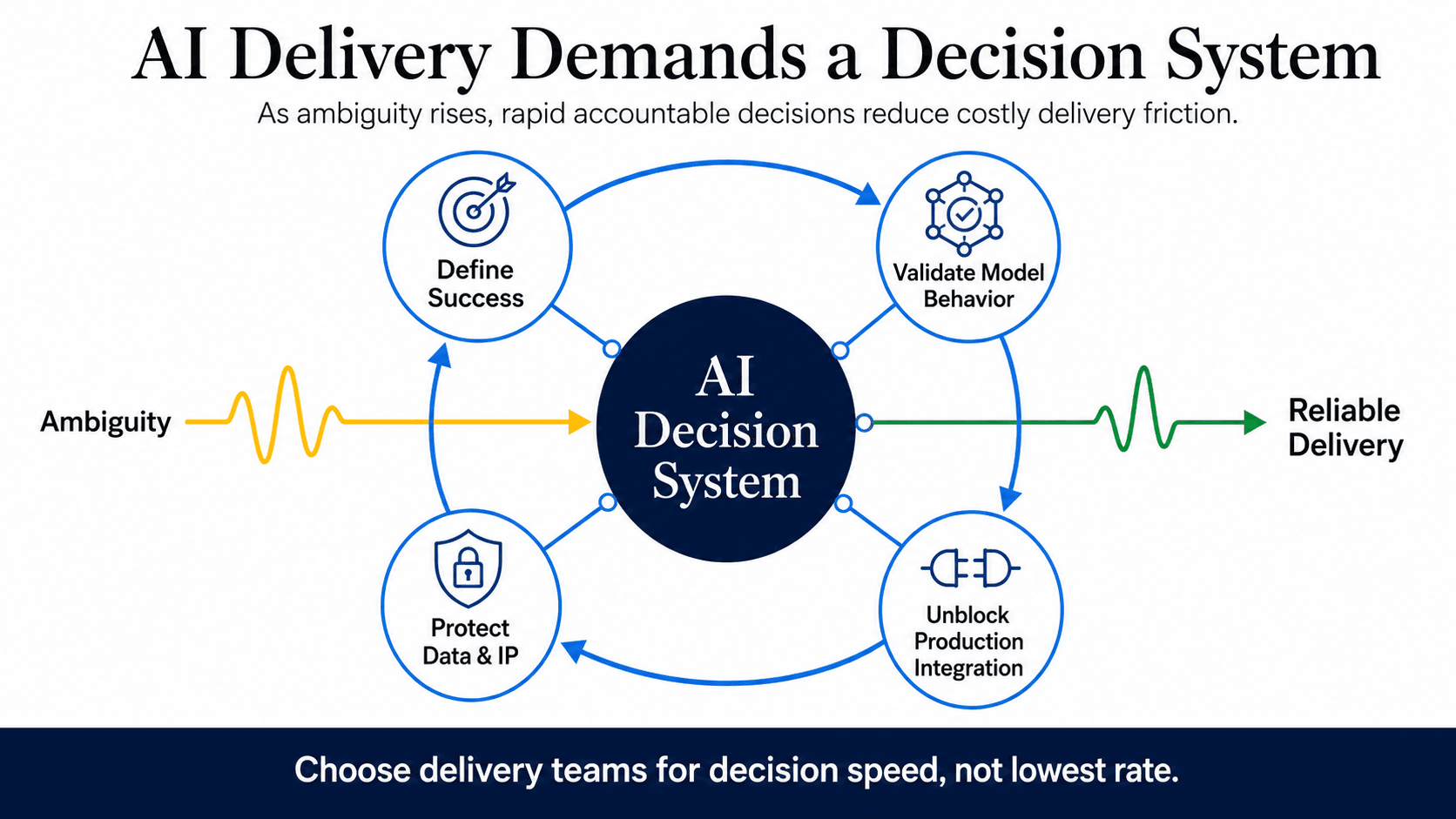
AI discovery is not a single requirements workshop. Teams must decide which problem is suitable for AI, what success looks like, which data can be used, how model behavior will be evaluated, and which failures are acceptable. Testing often produces new questions about prompts, retrieval logic, safety filters, latency, cost, or human review.
Those decisions should sit close to accountable product, domain, security, and architecture leaders. When model behavior changes after testing or integration, the team needs a practical way to review evidence, decide on mitigations, and act without waiting through multiple handoffs.
Before selecting a delivery model, ask to see the decision log, evaluation plan, escalation process, and expected turnaround time for approvals. An initiative with fast-changing assumptions needs more than a lower hourly rate. It needs a working decision system.
Data residency concerns where data is stored or processed. Access control concerns who can use it. Data processing obligations govern permitted uses and safeguards. Intellectual property protection concerns rights in code, models, training artifacts, and third-party components. They overlap, but they are not interchangeable.
Standards and guidance such as ISO/IEC 27001 supplier controls, the NIST AI Risk Management Framework, and Cloud Security Alliance AI security guidance help buyers frame the questions. They do not prove that a provider follows the controls in day-to-day work. A certification, contract clause, or self-attestation is useful evidence.
Request a data-flow diagram, access-control model, data processing agreement, IP assignment terms, subcontractor disclosure, incident-response process, and audit-rights provisions. Legal interpretation of cross-border data use and contract enforceability should be reviewed with qualified counsel for the deployment context.
An AI feature rarely lives on its own. It may touch applications, application programming interfaces, data stores, identity systems, logs, monitoring tools, security controls, and customer or employee workflows. Production also requires ongoing monitoring for performance, drift, unexpected behavior, and incidents.
These dependencies can make a low-rate implementation expensive when the external team has indirect access to systems or decision-makers. A blocked integration, a security alert, or a data-source change can require rapid coordination across several internal groups.
Ask each provider for a dependency map, environment-access plan, monitoring ownership model, release process, and incident-escalation path. The goal is to determine whether the delivery team can operate inside your production system.
Do not buy a single geographic model for "the AI project." Break the initiative into workstreams and assess each one by ambiguity, data sensitivity, dependency density, decision frequency, and whether acceptance can be measured objectively.
A blended delivery model may place discovery, governance design, and sensitive integrations with onshore or high-overlap leaders; place iterative feature work nearshore; and allocate stable, testable implementation or testing work offshore. This can align cost with risk. It can also create blurred accountability unless ownership is explicit.
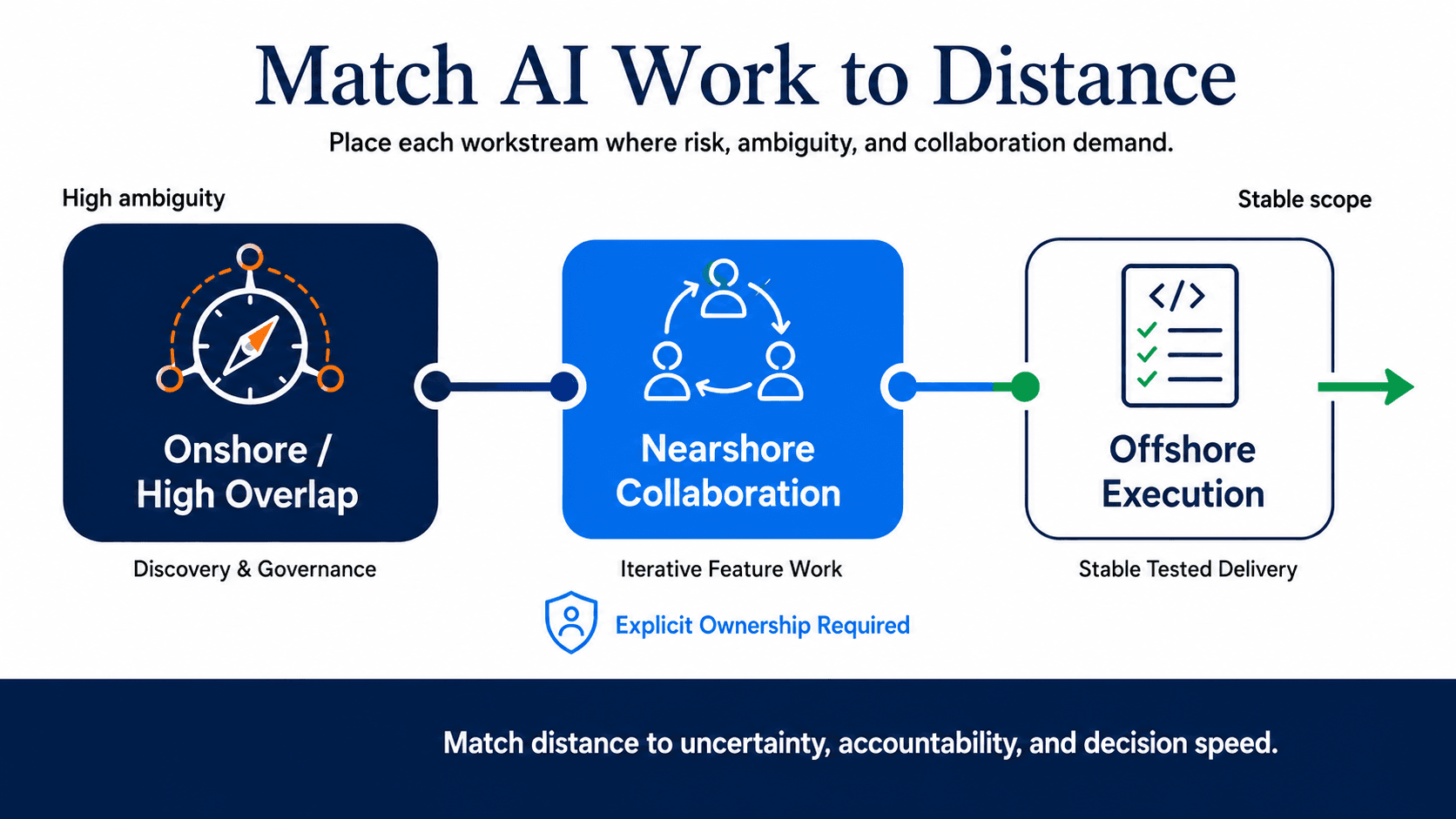
Keep work close when requirements change frequently, the data is sensitive, trade-offs are contested, or the result carries significant business or regulatory consequences. Discovery, architecture, compliance decisions, and production incident decisions commonly fit this profile.
Closeness does not always mean physical location. It can mean sufficient working-hour overlap, direct access to accountable leaders, and authority to resolve issues quickly. But when these conditions are missing, a lower-cost model may transfer the coordination burden back to your internal team.
Nearshore teams are often a strong fit for ongoing feature work after core architecture and governance are in place. Examples include improving retrieval quality, adding domain integrations, refining non-critical user experiences, and maintaining established AI services.
The team should operate as part of the product system. Shared decision records, clear ownership for backlog items, common tooling, and access to product and engineering leads matter as much as the overlap window.
Consider offshore delivery for work with stable requirements, clear interfaces, objective tests, and limited dependence on rapid stakeholder decisions. Mature acceptance tests, documented code-review practices, defined severity levels, and responsive technical leadership make the model more predictable.
Before moving a workstream, inspect the specifications, definition of done, test design, technical design, seniority allocation, defect process, and acceptance authority. If stakeholders still disagree about success metrics or dependencies, the work is not ready for distance.
A lower offshore quote often assumes that scope is stable, junior or mid-level contributors can carry most of the work, overlap is limited, and the buyer will absorb some integration, security, or stakeholder-management effort, which is why vetting offshore AI development companies is better treated as a delivery-risk decision than an hourly-rate one. None of those assumptions are necessarily unreasonable. They should simply be visible and priced into the decision.
Ask finalists:
Vague promises of flexibility are not operating commitments. Look for named leads, clear decision rights, a documented escalation ladder, and a staffing plan that explains senior coverage.
Request a detailed statement of work, master services agreement, data processing agreement, staffing plan, security documentation, and escalation plan. For production support, a service-level agreement may also clarify availability and response expectations.
Each artifact has limits. Security certifications do not replace context-specific controls. Access policies do not prove enforcement. Incident-response plans do not prove the teams have exercised them together. Treat these documents as an integrated assurance package and test how they connect to daily delivery.
Score each workstream against the conditions that drive cost and risk: required working-hour overlap, requirement ambiguity, governance maturity, data sensitivity, integration complexity, and acceptance measurability. Set minimum thresholds for non-negotiables such as data handling and accountable technical leadership, then compare options within those constraints.
A practical sequence is:
This is distinct from deciding whether to build internally or hire a consulting firm. For that broader comparison, see what an in-house AI team costs in year one versus a consulting firm.
A: A low rate only lowers total cost when the operating model is equally disciplined. Coordination, rework, governance, and your own staff time can erase the savings.
A: A blended rate is the average price of the proposed role mix. Total delivery cost adds coordination, governance, rework, integration, testing, evaluation, and client-side effort.
A: When work needs fast back-and-forth but the team treats it as asynchronous, delays pile up. A quick clarification can stretch into a day-long cycle and show up later as rejected output.
A: No. A well-governed offshore team can outperform a poorly run onshore engagement. These labels describe working conditions.
A: Keep it close when requirements change often, data is sensitive, or trade-offs are contested. Discovery, architecture, and production incident decisions usually fit.
A: Work with stable requirements, clear interfaces, objective tests, and limited need for rapid stakeholder decisions. Think defined APIs, data pipelines, or established inference patterns inside an approved architecture.
A: AI adds uncertainty in the data, the model's responses, and how you evaluate it. That uncertainty costs more to resolve across distance and time zones.
A: Ask how many shared working hours their leads keep, who owns architecture and acceptance, how blockers escalate, and how much of your own team's time they assume.
...Loading Related Blogs
Trusted by top platforms for our transformative solutions and exceptional results: