
 Add as preferred on Google
How to Modernize a Legacy Learning Platform Without a Full RewriteRead More

A $2M consultancy quote and a $400K boutique quote usually fund different jobs, not the same job at different prices.
Score both finalists against one brief, not the logo on the cover.
A $2 million proposal and a $400,000 proposal can both make sense. But they are rarely proposals for the same job.
One may fund an enterprise transformation program with operating-model design, governance, stakeholder alignment, change management, and program oversight. The other may fund a senior-led team to build and integrate one defined artificial intelligence (AI) capability. The difference is not simply prestige versus price. It is engagement design.
Before you compare fees, make each proposal answer the same questions: What work is included? Who makes decisions? Which people will do the work? Who owns the production outcome? What happens when data, security, or integration assumptions prove wrong?
A large strategy consultancy often structures work around a broader organizational problem. A boutique AI engineering firm is more likely to price a focused strategy-to-delivery engagement, such as a pilot, a production build, or a specified integration.
That distinction matters because a proposal can look complete while covering only one layer of the initiative.
Published rate estimates vary widely. Treat them as a starting point only, because team mix, contract structure, geography, duration, and included work can move the total sharply.
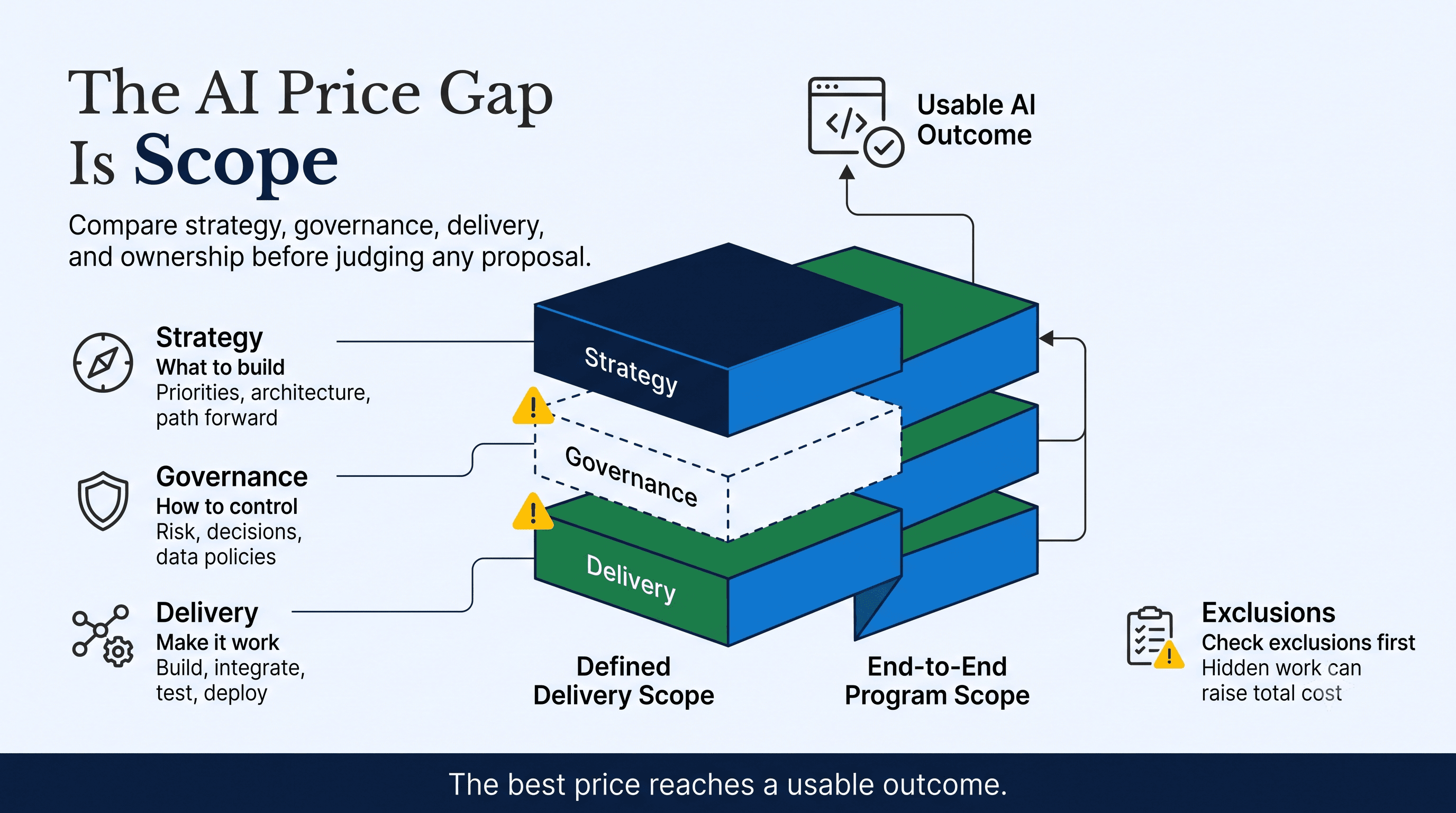
Strategy defines the problem, priority use cases, architecture direction, and path forward. Governance establishes decision rights, data policies, risk controls, and oversight. Delivery builds, integrates, tests, and deploys a working capability.
They can be bought together or separately. NIST's AI Risk Management Framework treats governance, mapping, measurement, and management as distinct functions, which is a useful reminder that technical delivery does not eliminate governance work.
A large consultancy may price all three lines of work into one program. A boutique may price a defined delivery scope while leaving enterprise-wide governance or operating-model redesign outside the engagement. The issue is whether the excluded work is unnecessary, owned internally, or merely postponed.
The senior-engagement signal is often the clearest difference between the models. Large consultancies commonly use leverage: a smaller group of partners and managers directs a larger team of junior consultants. That can bring coordination capacity, but do not assume that the people in the sales meeting will perform the day-to-day work.
Boutique AI engineering firms often operate with fewer management layers and a higher concentration of senior practitioners in discovery, architecture, and delivery. That can reduce handoffs and speed up technical decisions when the use case is bounded.
Ask for a named staffing plan by phase. It should show each person's role, expected allocation, delivery responsibilities, and decision rights. A generic team chart is not enough. You need to know who will resolve an integration issue, approve an architecture choice, and stay accountable through production release.
A $400,000 proposal may be an efficient, tightly scoped engagement. It may also leave out work that becomes expensive later: security review, data governance, multi-system integration, user training, monitoring, model maintenance, or operational handoff.
The practical test is simple: request an exclusions and assumptions schedule. It should identify data access dependencies, client-side resource commitments, integration boundaries, post-launch support, change-control rules, and acceptance criteria.
Lower overhead is valuable only when the scope still reaches a usable outcome.
Both models can create value. The fit depends on whether the hard part is delivering a defined capability or orchestrating a complex organizational change.
A boutique can be a poor choice for a multi-business-unit transformation, and a large consultancy can be more structure than a defined AI use case requires.
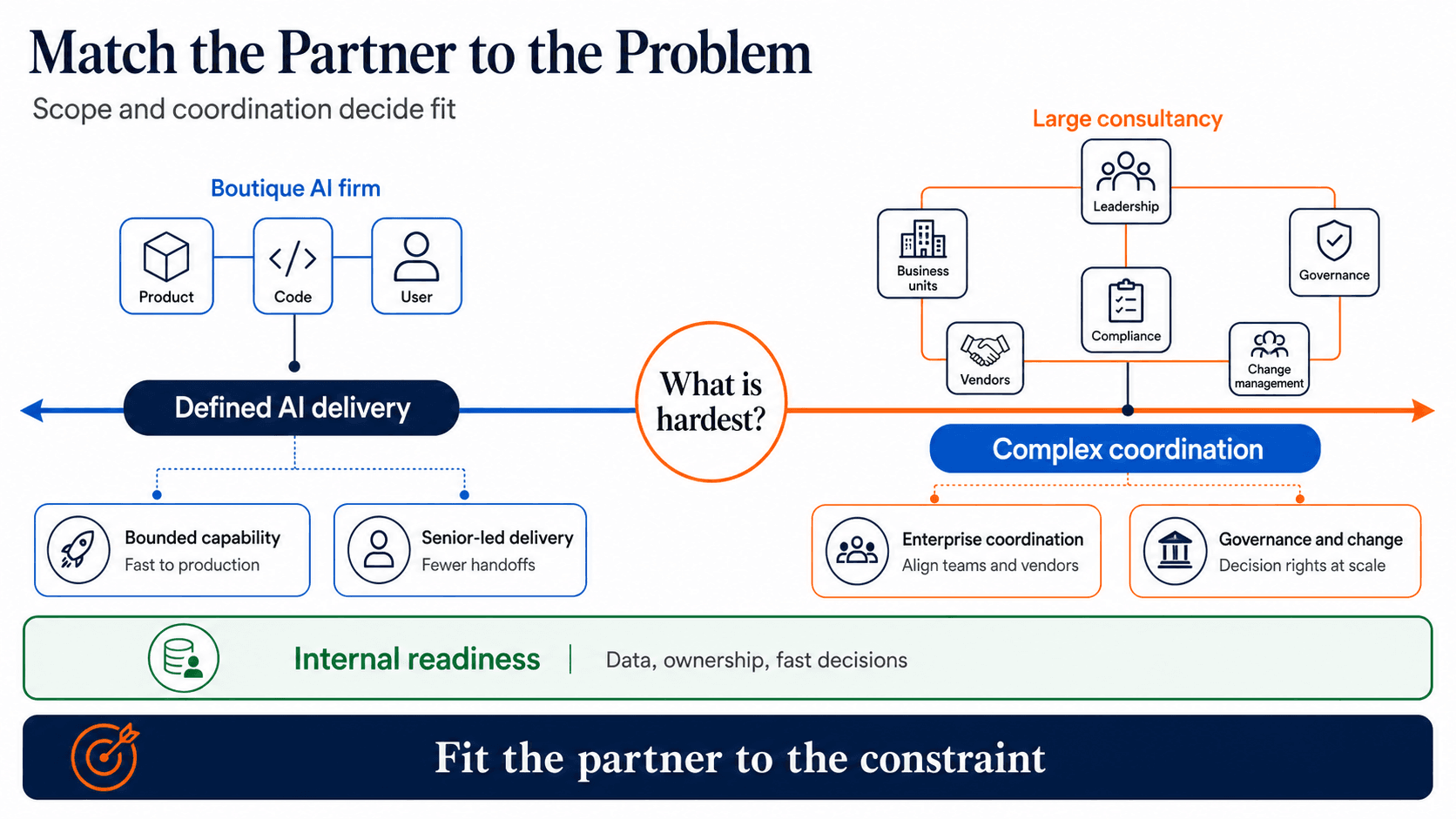
Boutiques tend to fit when the buyer has a bounded problem, an engaged executive sponsor, accessible subject-matter experts, and enough internal readiness to make decisions quickly.
Picture a company that wants to automate one high-volume workflow, has identified its systems and data owners, and needs a working capability rather than an enterprise AI roadmap. A senior-led boutique can often move from problem definition through implementation with fewer layers between the business need and the technical work.
The value is not simply a lower day rate. It comes from matching experienced practitioners directly to a problem that does not require a broad transformation apparatus. That model is strongest when the company can provide timely decisions, data access, security input, and operational users for testing.
A large strategy consultancy earns its premium when the central problem is organizational coordination.
Consider an initiative that affects several business units, enterprise architecture, compliance, procurement, workforce processes, and multiple implementation vendors. The work may require executive facilitation, formal change management, an operating model, and governance that sets clear decision rights across the organization. In that situation, the program-management capacity is not a side cost. It is part of the deliverable.
BCG and McKinsey both frame durable AI value as more than a technology question. Governance, leadership, talent, behaviors, and operating-model choices must work together. A delivery team can build a capable product, but it may not be equipped to resolve a stalled decision across functions or establish an organization-wide governance model.
Scope creep can damage either model. AI work often reveals data-quality problems, unexpected integration needs, adjacent use cases, or stakeholder disagreements after discovery begins. Without a written change-control process, a sensible refinement becomes a costly extension.
Strategy-to-build handoffs require particular scrutiny. When one team defines the roadmap and another team implements it, ask how decisions, constraints, and technical rationale will transfer. The same concern applies when senior staff rotate off after the early phase.
Internal readiness is the other overlooked factor. An external team cannot substitute for unresolved ownership, unavailable data, or an executive sponsor who cannot make decisions. Those gaps can make a boutique look under-resourced or a large consultancy look slow, when the underlying constraint is inside the company.
A boutique AI engineering firm is usually the stronger fit when the initiative is specific enough to be delivered by a focused team and the organization can provide the inputs that team needs.
This is where a boutique's leaner operating model can be useful. It can concentrate budget on architecture, engineering, testing, and implementation accountability rather than broader transformation layers that a bounded initiative may not need.
Do not accept a senior-led promise without evidence. Request:
A large strategy consultancy is a stronger fit when the organization must solve coordination before it can solve implementation.
At that scale, the premium can buy capabilities a narrow delivery engagement does not offer. Verify that they are required by this initiative, rather than inherited from a standard transformation playbook.
A large-firm proposal needs the same commercial discipline as a boutique proposal, with extra attention to staffing and handoffs.
A comparable proposal process answers three questions: Is the initiative ready? What external help is needed? Which firm can credibly provide it?
Score each response against the same decision brief, not the logo on the cover page.
For a wider capital-allocation decision that includes building, buying, or partnering, see Should you build, buy, or partner for AI? A cost comparison that holds up to your CFO. Keep that question separate from the firm-selection question. First define the delivery model you need. Then compare providers that can execute it.
A proposal comparison only works when every firm responds to the same brief. Specify the business outcome, use-case boundary, target users, technical environment, integrations, data constraints, governance expectations, deliverables, acceptance criteria, and client responsibilities.
That structure exposes omissions and makes real experience easier to spot. A firm with relevant delivery history can name practitioners, describe likely dependencies, and connect milestones to business outcomes. A generic response may contain polished methodology without showing how the work will reach production.
That comparison is separate from a full in-house hiring analysis. For that cost view, use What an in-house AI team really costs in year one, compared to hiring a consulting firm.
Choose a boutique when you have a defined AI initiative, a decisive sponsor, and a need for senior, hands-on delivery. Choose a large consultancy when the work genuinely requires enterprise-wide alignment, transformation governance, and coordination across complex stakeholders, vendors, or regulated processes.
Before signing, ask both finalists for named staffing, phase-by-phase allocation, explicit exclusions, comparable production work, a knowledge-transfer plan, and acceptance criteria. Compare those artifacts against the same brief.
The price gap is real. So is the difference in what each engagement model is designed to do.
For the broader selection framework and related buyer guides, return to the Ultimate Guide to Selecting an AI Engineering Partner.
Because they are rarely quoting the same job. A $2M proposal often funds enterprise transformation, while a $400K one funds one defined AI build.
A boutique fits a focused build-and-integrate job with senior practitioners doing the work. A large firm fits cross-unit transformation, governance, and change management.
Not on its own. A low quote can be tightly scoped and efficient, but it may also omit security review, integration, training, or operational handoff.
Boutique and mid-sized AI firms typically take startup work, while Big 4 engagement minimums price most startups out. Useful signals include minimum project sizes in the $10K to $50K range, a scoped first deliverable instead of a multi-quarter program, and senior engineers as the primary contact with no account layer in between. Asking whether the firm will commit to shipping one production feature within 90 days tends to separate the two groups quickly.
Structure matters more than brand here, because the firm's delivery model determines what actually gets built. Questions worth asking cover who performs the hands-on work, how long the engagement runs and where the exit points sit, whether strategy and implementation are staffed by the same people, what reaches production in the first 90 days, and how IP and data terms are written. A first deliverable that is a strategy document with no working software attached is a reliable warning sign.
When the hard part is coordination across business units, compliance, procurement, and multiple vendors. There the program-management capacity is the deliverable, not overhead.
Named staffing with phase-by-phase allocation, a written exclusions schedule, comparable production work, a knowledge-transfer plan, and outcome-based acceptance criteria.
Work that surfaces later: security review, data governance, multi-system integration, user training, model maintenance, and operational handoff.
...Loading Related Blogs
Trusted by top platforms for our transformative solutions and exceptional results: