

 Add as preferred on Google
In-House vs Outsourced Custom Software Development: Cost, Risk, and Reversal Cost Framework (2026)Read More

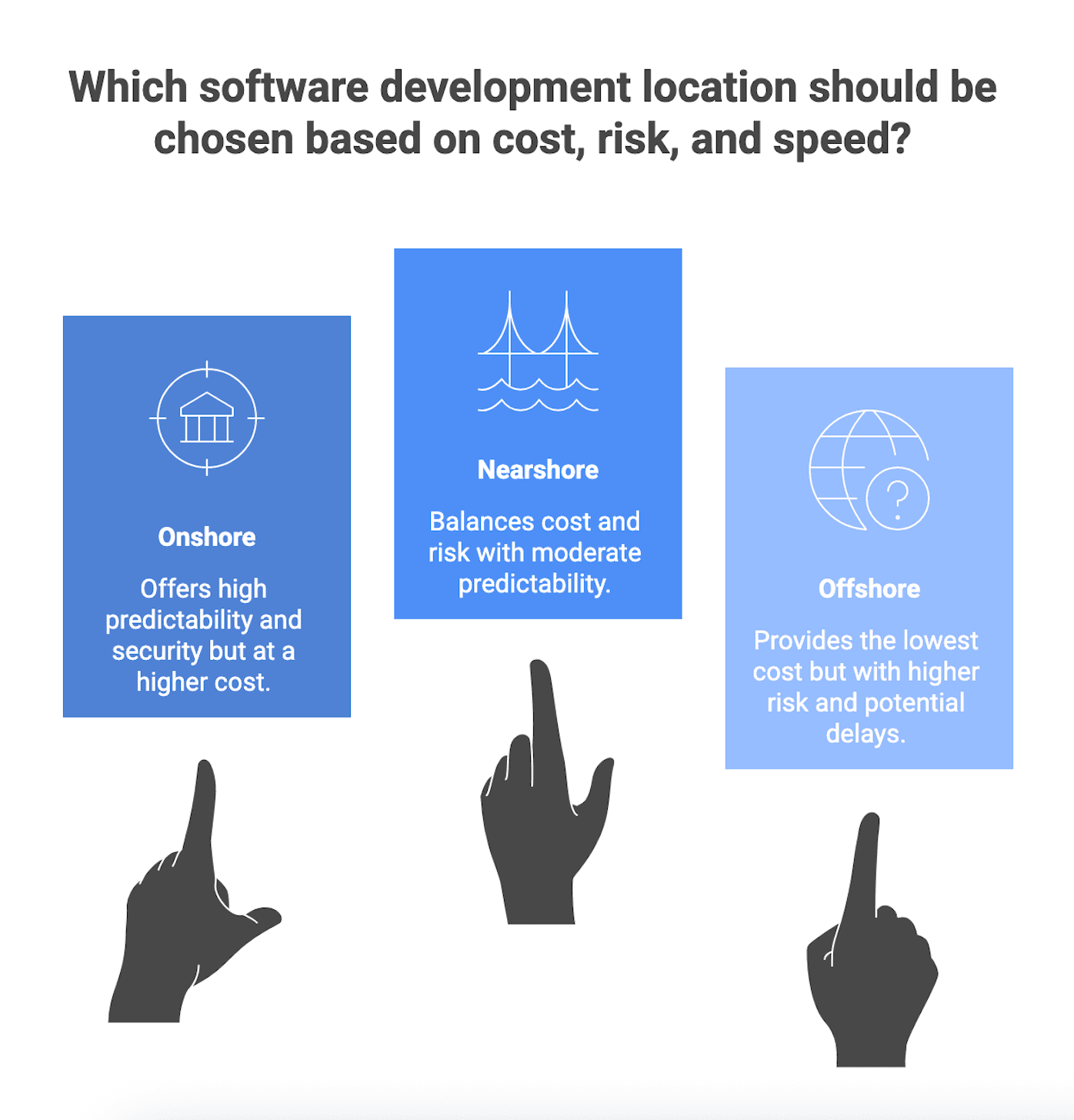
If you are a US buyer choosing between onshore development (US-based delivery), nearshore development (nearby time zones relative to the US), and offshore development (significant time zone separation), the most defensible way to decide is to treat geography as a proxy for constraints, not as a proxy for quality.
Two mandatory caveats up front:
A practical way to use this page: pick the model that fits your collaboration needs and risk profile, then validate it with a pilot that forces evidence (acceptance criteria, QA proof, delivery cadence, security posture) before you scale. If you want the broader selection method and scorecards, start with the buyer’s guide.
Geography most directly affects the “collaboration physics” of an engagement:
Those constraints change how quickly a team can resolve ambiguity, validate assumptions, and unblock work.
Where geography matters less than most buyers assume:
Geography choices get blamed for problems that are often internal to the buyer org:
Before you pick a geography, be honest about the availability of your product leadership, SMEs, and security reviewers. Your governance model has to match your internal decision speed.
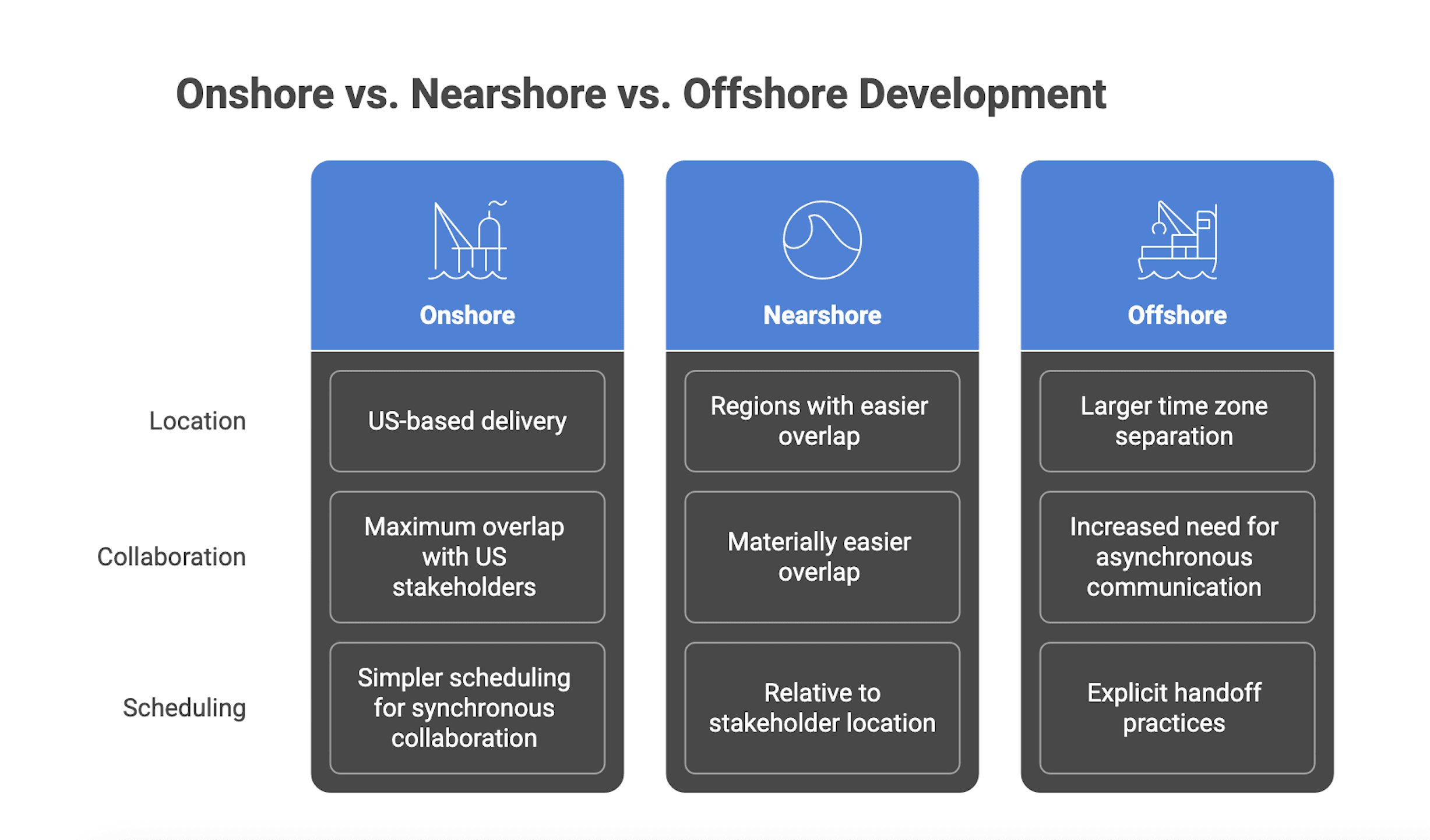
Onshore development (US-based delivery): Delivery primarily performed within the United States, typically enabling maximum overlap with US stakeholders and simpler scheduling for synchronous collaboration.
Nearshore development: Delivery performed in regions that enable materially easier overlap and travel compared to distant regions. “Near” is relative to where your stakeholders sit (US East vs US West matters) and to the actual overlap schedule the vendor commits to.
Offshore development: Delivery performed with larger time zone separation from core US stakeholders, which usually increases the need for asynchronous communication, written decisions, and explicit handoff practices.
Ask these four questions in your internal kickoff:
Then ask vendors: “Show a sample weekly calendar for ceremonies, overlap windows, and escalation availability.”
Dimension | Onshore (US-based) | Nearshore | Offshore |
| Potential overlap with US stakeholders | Highest | Negotiated, often easier | Negotiated, often harder |
| Async burden (writing, handoffs) | Lower | Medium | Higher |
| Travel feasibility for workshops | Easier | Easier than distant regions | Harder |
| Rate leverage (labor economics) | Typically lowest | Medium | Typically highest |
| Governance required to stay predictable | High | High | Very high |
The point is not that one is “best.” The point is which constraints you can realistically support.
Hourly rates are not your total cost. Total cost of ownership (TCO) often includes:
A defensible principle: finding defects earlier generally reduces cost and effort compared to finding them late. That “shift left” mindset applies to delivery, too. Earlier clarity reduces later churn.
Where cost gets eroded fastest: ambiguous work with frequent change (discovery, UX iteration, integration-heavy modernization). In those cases, rework and decision latency become dominant cost drivers, and rate advantages can be overwhelmed by iteration inefficiency.
Context anchor (not a pricing model): the US Bureau of Labor Statistics reports a median annual wage of $133,080 (May 2024) for software developers. This helps explain why buyers explore nearshore or offshore. It does not translate directly into vendor rates or engagement savings.
Sanity-check cost realism by asking for evidence. Request vendor inputs that reveal the real operating cost:
Then add your own buyer-side cost: product owner time, SME time, security review time, environment provisioning time, and time spent clarifying requirements.
When buyers say “risk,” they usually mean a bundle of concerns. Break it into categories you can verify:
Instead of accepting marketing language, ask vendors to map their practices to outcomes-based expectations (for example, the NIST Secure Software Development Framework structure across Prepare, Protect, Produce, Respond). The buyer-friendly move is to request artifacts and controls you can evaluate.
If a vendor claims SOC 2, avoid treating it as a binary label. Ask:
A small, organized proof pack is often lower risk than big promises.
This is not legal advice, but you can reduce exposure operationally by verifying:
Speed is not one thing:
Geography affects iteration speed more than raw throughput because overlap constraints change decision latency. When overlap is low, “waiting for answers” stretches cycle time and increases rework. This is especially visible in discovery-heavy work.
Offshore teams can maintain speed when the engagement is built around:
Agree on definitions and track a small set of signals:
If a vendor cannot define or measure these, geography will not save the engagement.
Collaboration intensity is a practical selector that avoids stereotypes.
High-collaboration work (needs more overlap):
Lower-collaboration work (can tolerate more async):
Even execution-heavy work still needs some overlap for alignment and escalations. The question is how much overlap you need, and whether you can sustain it.
Below are eight mechanism-based scenarios. “Best fit” means likely fit if governance conditions are met, not a guarantee.
Consider: offshore or nearshore delivery with a strong buyer-side product owner; hybrid (onshore leadership plus offshore delivery pod) often fits.
Governance must be true: tight backlog hygiene, testable acceptance criteria, definition of done that includes testing, explicit overlap plan for decisions.
Validate: request a sprint 0 plan, sample acceptance criteria, and pilot one sprint scoring predictability and late-found defects.
Alternative: nearshore if the work needs more real-time collaboration than expected.
Consider: onshore or nearshore; or hybrid with onshore product and architecture plus parallel offshore build only when interfaces are clear.
Governance must be true: rapid decision-making, clear escalation, release readiness discipline.
Validate: ask for a delivery plan that includes QA and release steps, and inspect how PR reviews and testing hold up under time pressure.
Alternative: offshore can still work if scope is already well specified and the team is truly autonomous with clear acceptance criteria.
Consider: any geography can work if the vendor has verifiable controls. Buyers often prefer onshore or nearshore for perceived audit comfort, but evidence should dominate.
Governance must be true: access controls, auditability, secure build and release, incident response readiness, clarity on scope of attestations.
Validate: request a security proof pack and verify what is in scope, what period is covered, and what evidence exists for secure SDLC outcomes.
Alternative: hybrid with an onshore security or compliance lead plus nearshore or offshore delivery if responsibilities are explicit and evidence is strong.
Consider: onshore or nearshore for discovery; hybrid with onshore discovery and offshore build after discovery outputs stabilize.
Governance must be true: facilitated workshops, documented decisions, prototypes, tight iteration cadence.
Validate: ask who runs discovery and what artifacts they produce, and request examples of decision logs.
Alternative: offshore can work if your internal product leadership can provide exceptionally clear written outputs and make fast decisions.
Consider: hybrid with onshore or nearshore technical leadership plus nearshore or offshore execution pods once the approach is mapped.
Governance must be true: interface contracts, migration plan with stage gates, strong regression strategy.
Validate: require a time-boxed spike plan with clear outputs, and confirm how they monitor defect leakage.
Alternative: onshore end-to-end if risk tolerance is low and domain knowledge is scarce.
Consider: offshore or multi-region coverage can help only if operational process maturity is high.
Governance must be true: incident response process, escalation paths, documented runbooks, measurable restoration expectations.
Validate: ask for sanitized incident postmortems and runbook excerpts, and how they institutionalize lessons.
Alternative: onshore with a paid on-call rotation if the system requires deep domain context that is hard to distribute.
Consider: nearshore or offshore augmentation with clear boundaries; delivery pods aligned to internal tech leads.
Governance must be true: explicit ownership boundaries, PR review standards, definition of done, repo permissions and access controls.
Validate: pilot a small vertical slice and inspect integration with your workflows and code review expectations.
Alternative: onshore for the first phase if the codebase is highly coupled and onboarding is the real risk.
Consider: onshore or nearshore is commonly used; offshore is possible if scope is tightly bounded and acceptance criteria are explicit.
Governance must be true: strict change control, objective acceptance criteria, explicit QA scope.
Validate: ask how changes are handled and how acceptance is proven, and require a pilot sprint demonstrating acceptance discipline.
Alternative: hybrid where high-risk decisions stay in higher-overlap windows, while well-bounded execution is distributed.
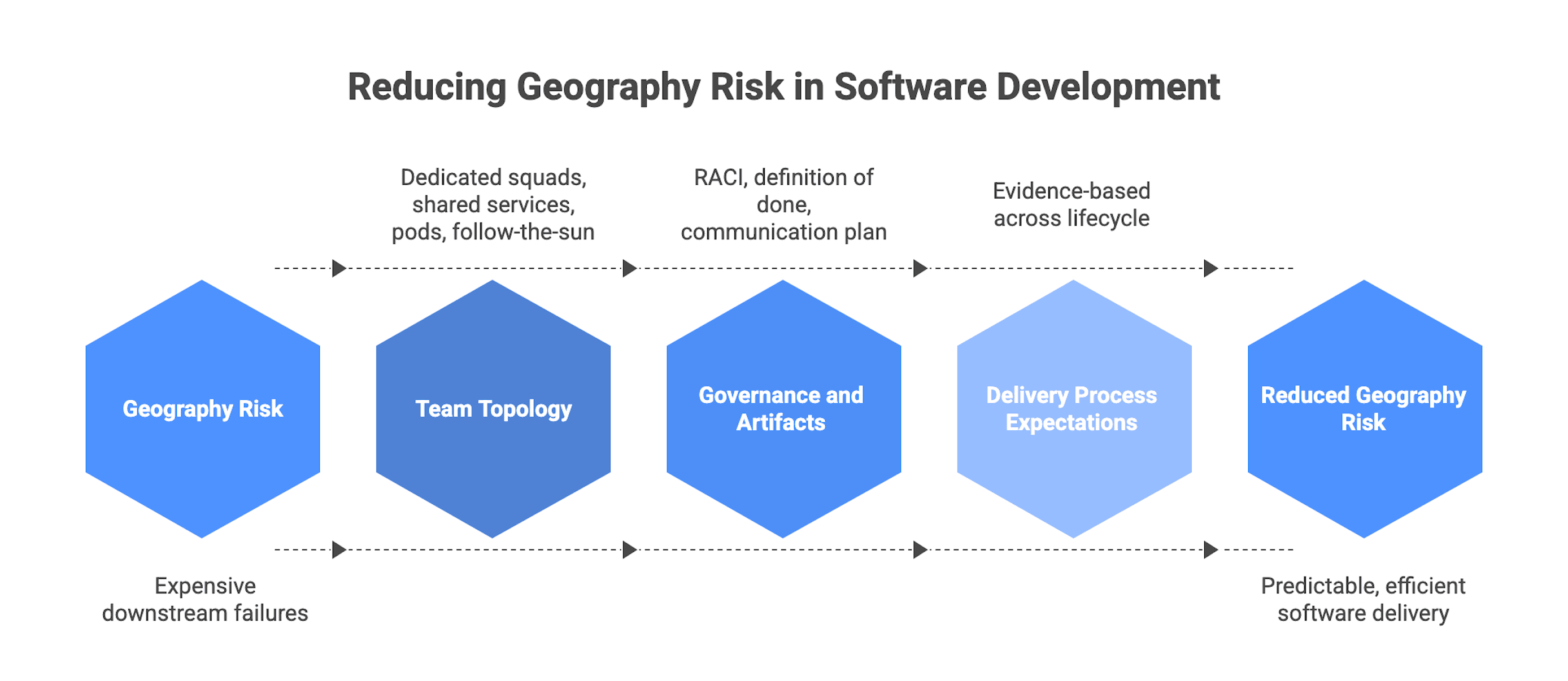
Dedicated cross-functional squad (product, engineering, QA): often reduces coordination overhead because ownership is clearer and feedback loops are tighter. This tends to improve predictability for product-centric work.
Shared services (pooled QA, pooled architects): can improve utilization but increases dependency management and queueing. It can slow delivery when priorities shift or handoffs are frequent.
Pod-based delivery: scales when pods have clear interface boundaries and shared standards. Look for evidence of interface discipline and decision documentation.
Follow-the-sun: only credible when tasks are well specified, environments are reliable, and ownership is unambiguous. Otherwise it amplifies handoff waste.
More overlap is not free. If overlap is achieved through shift work, design it sustainably or you risk attrition and continuity issues.
Governance is not a document pile. It is the minimum set of shared rules and artifacts that prevents expensive downstream failures.
Minimum artifacts that reduce risk across geographies:
If you want a deeper walkthrough of contract and governance mechanics (MSA, SOW, SLAs, IP, change requests), use the custom software development contracts & governance guide.
Distributed delivery fails most often at handoffs and late QA. Keep expectations evidence-based across the lifecycle:
If you do only one thing, make it this: evaluate what is inspectable.
Without turning this into legal advice, ask:
Goal: validate governance, collaboration, and quality signals early.
Pass signals:
Fail signals:
There is no universal best geography model. Onshore, nearshore, and offshore are different ways of buying overlap, logistics, and cost structure. Outcomes depend heavily on governance and vendor maturity.
A defensible sequence after you pick a model:
If the vendor cannot produce evidence, switching geography will not fix it. Replace the vendor or redesign the governance.


Trusted by top platforms for our transformative solutions and exceptional results: