

 Add as preferred on Google
Custom Software Development Legal & Contract Checklist (US): IP, Indemnity, SLAs, TerminationRead More

Custom software projects rarely fail because one clause was “wrong.” They fail when contracts and governance do not translate into clear delivery behaviors: who decides what, how changes are approved, how “done” is measured, and what happens when production support begins.
This guide is a delivery focused way to think about the contract stack and the governance mechanics that keep scope, quality, and ownership predictable. If you are still early in vendor selection, use the broader buyer’s guide to choosing a custom software development partner to make sure contracts fit the engagement model you are choosing.
This section supports one decision: whether your contract stack will actually run the project the way you think it will. The goal is to connect legal terms to day to day delivery, so you can reduce the most common friction points before kick off.
When governance is weak, the problems show up in meetings, tickets, and invoices long before they show up in court. Common breakdowns include:
None of these are purely legal problems. They are operating problems. The contract stack is the operating system that determines which conversations happen early, which decisions are documented, and how disputes are resolved when pressure rises.
Use this sentence to align stakeholders fast:
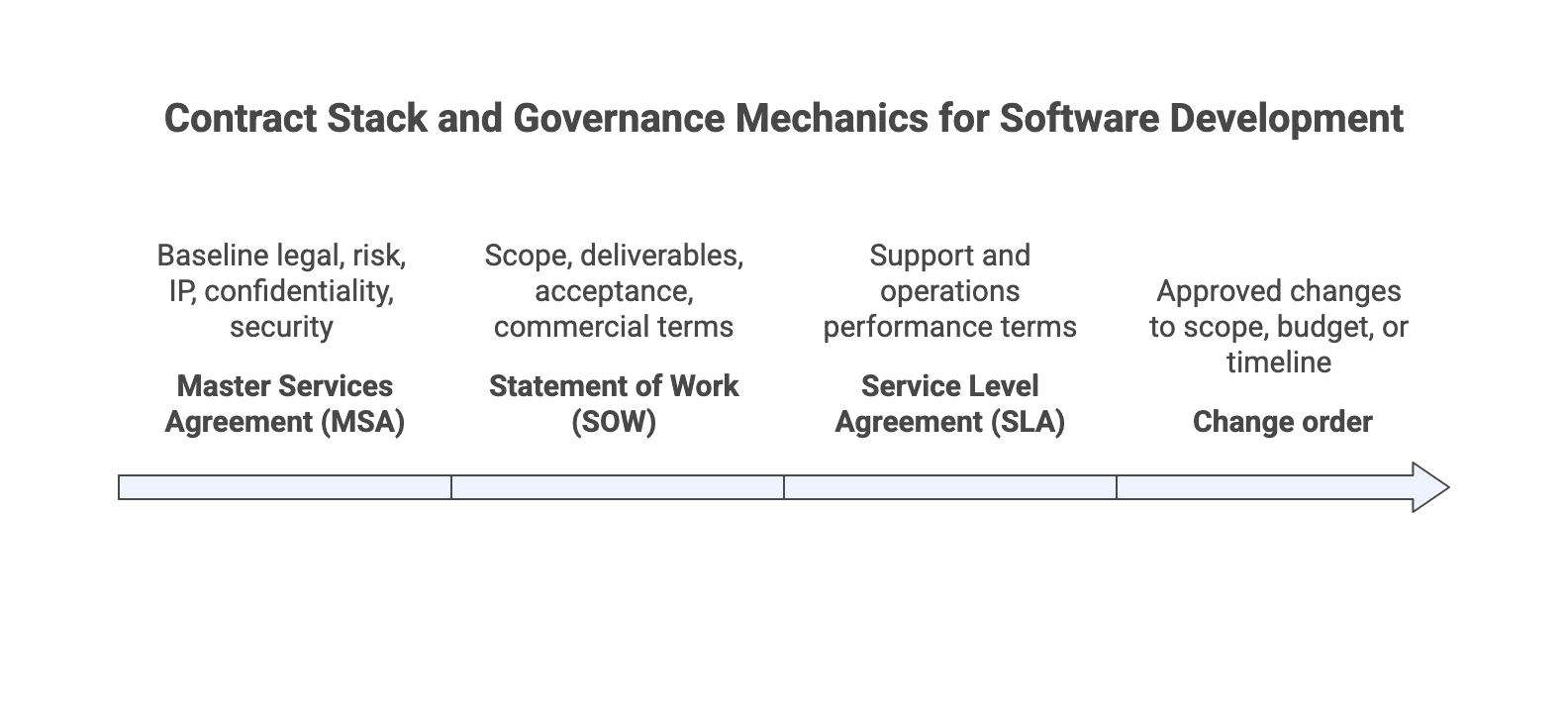
The Master Services Agreement (MSA) sets the baseline legal and risk terms, the Statement of Work (SOW) defines what you are building and how acceptance and payment work, any Service Level Agreement (SLA) governs ongoing support and operations, and change orders document approved scope, budget, or timeline changes so delivery tools and invoices stay consistent.
This section supports a practical negotiation decision: are you using the same words the vendor uses, and do those words map to the right document? Misaligned definitions are a reliable source of later disputes.
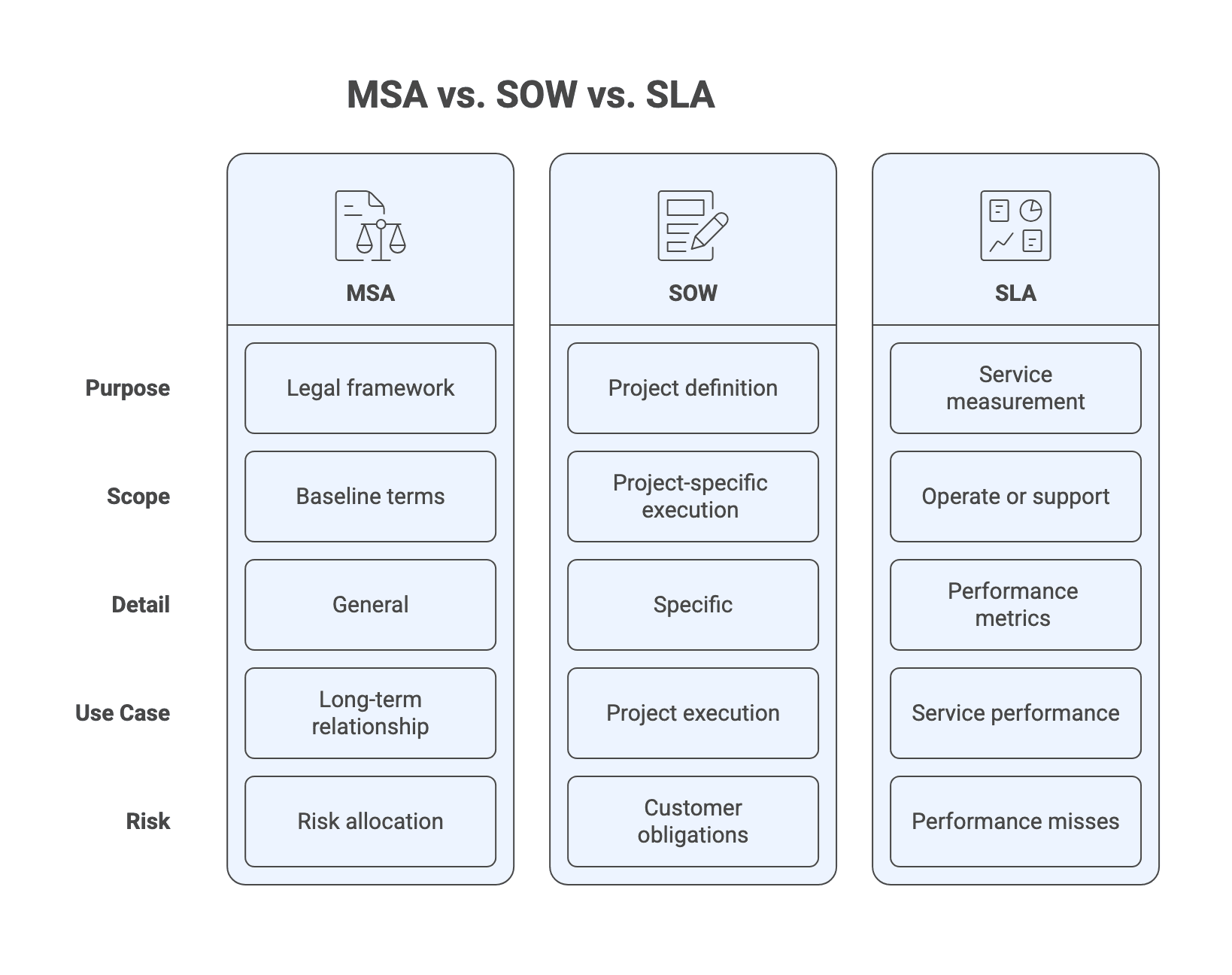
An MSA is a baseline agreement. It should establish the legal framework for the relationship: risk allocation, confidentiality, intellectual property boundaries, security obligations, and how disputes are handled.
What it should not do is attempt to describe the entire project. When an MSA tries to carry project scope, milestones, or acceptance detail, it tends to become either too vague to enforce or too rigid to support iterative delivery. The better pattern is: stable baseline terms in the MSA, project specific execution detail in each SOW.
A SOW is the project’s executable definition of “done.” It is where scope boundaries, deliverables, assumptions, acceptance criteria, and commercial terms become specific enough to run delivery and invoicing.
A useful SOW also makes customer obligations explicit. Many delivery issues come from missing inputs, delayed access, or unclear decision rights. If responsibilities are not written down, they are often “discovered” during escalation.
An SLA is most valuable when the engagement includes operate or support. It becomes the mechanism for measuring service performance in production: availability, response times, resolution times, and remedies when performance misses targets.
An SLA can be a distraction when it is attached to build work where metrics are hard to measure objectively. In those cases, a warranty period, support terms, and clear acceptance criteria often do more to reduce disputes than forcing SLA style metrics onto a development phase.
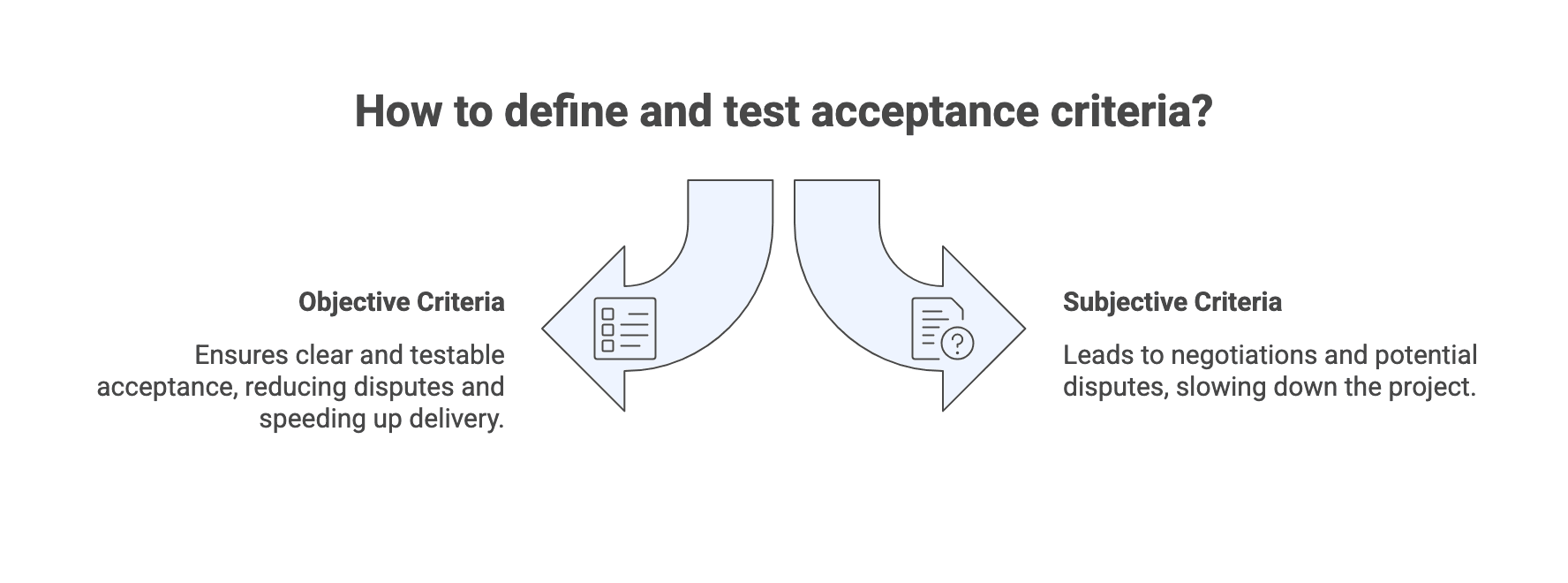
Acceptance is where scope and payment meet. Acceptance criteria define what “done” means for a deliverable, and acceptance testing defines how that determination is made.
A practical approach is to keep acceptance objective and testable. If acceptance relies on subjective judgment, it becomes a negotiation every time a milestone is reached. That slows delivery and increases the likelihood of invoice disputes.
A simple acceptance mini template you can reuse in a SOW:
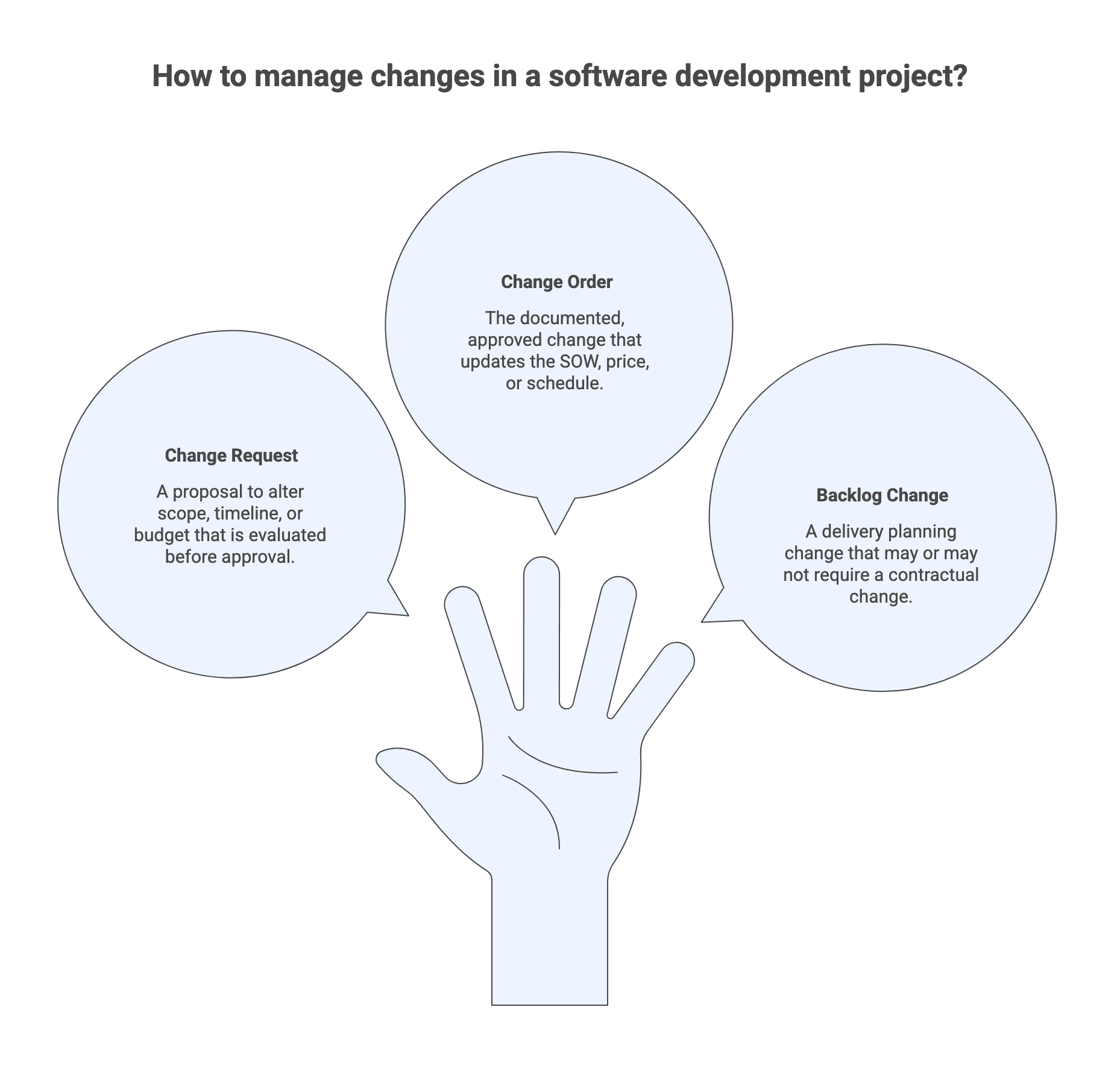
These terms are easy to mix up, and that confusion causes process breakdowns.
The core governance goal is to define when a backlog change becomes a contractual change. That boundary is where many projects either maintain trust or start accumulating friction.
This section supports one decision: do your documents and governance mechanics prevent conflicts, or do they create ambiguity when priorities change? The focus is on order of precedence, decision rights, and the minimum artifacts that keep everyone aligned.
Order of precedence prevents “which document wins” debates. Without it, teams can end up arguing whether the SOW overrides an exhibit, whether security terms live in a separate addendum, or whether a later statement in email changes obligations.
A practical hierarchy usually makes the MSA the baseline, then allows SOWs and approved change orders to control project specifics. Security addenda and other exhibits need explicit placement in that hierarchy so project teams do not discover conflicts after signature.
Here is a compact way to sanity check the stack before you sign:
Document | Primary job | Typical owner | What to verify |
| Master Services Agreement (MSA) | Baseline legal, risk, IP, confidentiality, security | Legal, procurement | Clear order of precedence and no conflicts with SOW or addenda |
| Statement of Work (SOW) | Scope, deliverables, acceptance, commercial terms | Delivery leadership | Objective acceptance criteria and explicit assumptions |
| Service Level Agreement (SLA) | Support and operations performance terms | Ops, support | Metrics are measurable and aligned to monitoring sources |
| Change order | Approved changes to scope, budget, or timeline | Governance forum | Updates both the SOW and the delivery backlog mapping |
Treat the table as a reading checklist. If any row is unclear, you are likely to see that same confusion later in status meetings.
Governance is not a slide deck. It is decision rights plus cadence plus evidence.
A working governance model typically clarifies:
Even if you are running agile delivery, governance still needs a formal path for decisions that have contractual impact. When governance is informal, scope and payment disputes tend to become personal and slow.
Governance requires artifacts that preserve decisions and reveal cumulative impact. A minimum set often includes:
The goal is traceability instead of paperwork. When scope or quality debates happen, you want a shared record of decisions and assumptions, rather than a reconstruction from chat history.
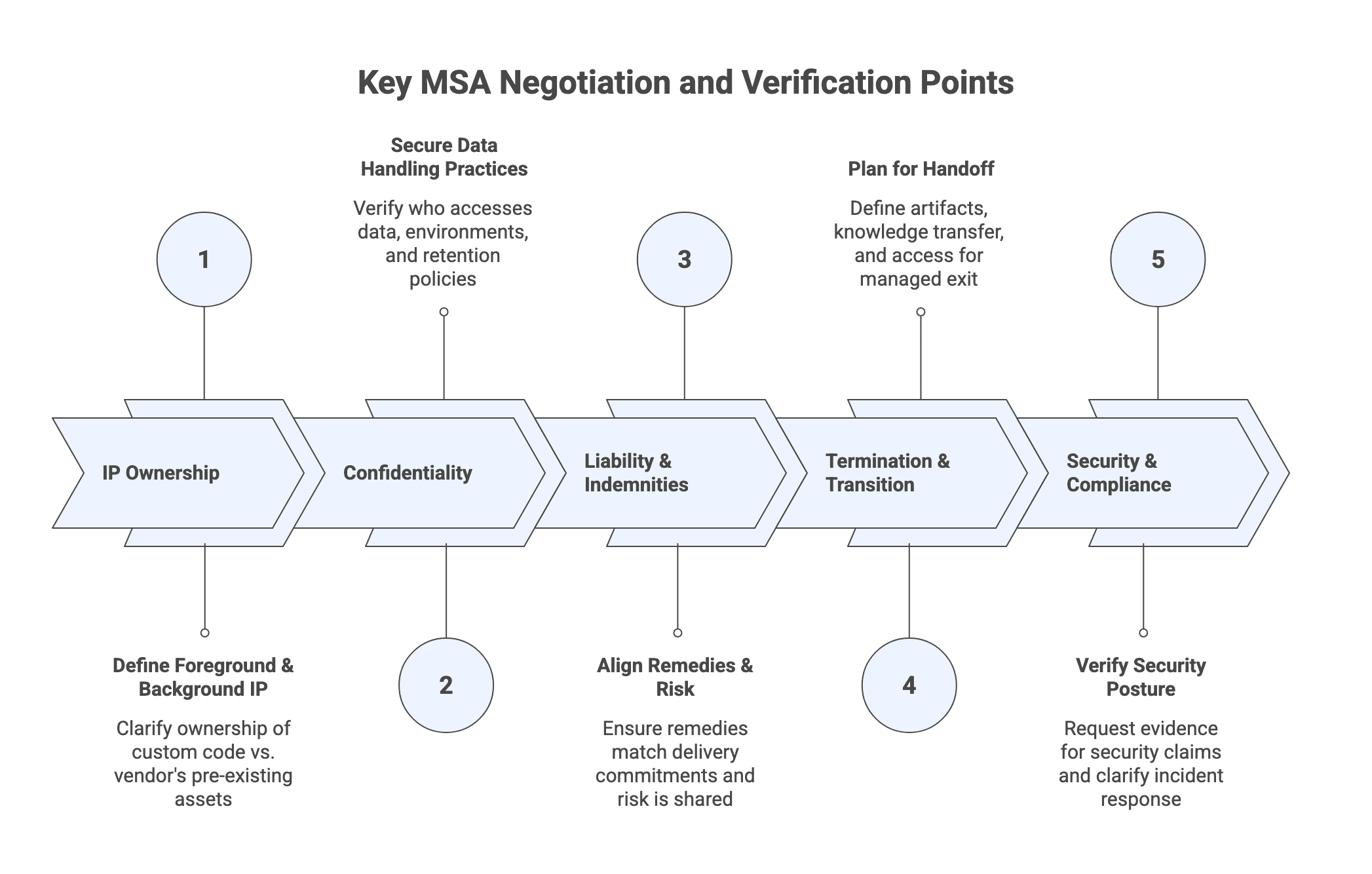
This section supports a negotiation decision: which MSA terms will materially affect delivery outcomes, and what should you verify before relying on them.
Intellectual property (IP) terms define what you will own, what you will license, and what you may be dependent on later.
A common pattern is to distinguish foreground IP from background IP:
Buyer friendly defaults often assign ownership of foreground IP to the customer while allowing the vendor to retain background IP. In practice, contracts may assign rights for custom code but grant licenses for embedded vendor components.
What to verify in practical terms:
Confidentiality determines how your data can be used and who can access it.
Typical confidentiality provisions require each party to protect the other’s confidential information, use it only for contract purposes, and limit disclosure to personnel and contractors with a need to know. Data handling terms often include requirements for return or destruction of information at the end of the engagement.
A practical verification approach:
If these questions feel operational, that is the point. Confidentiality only works when it maps to real access and retention practices.
Many buyers treat liability and indemnity as abstract legal clauses. Operationally, they determine what remedies are realistic when something goes wrong and how risk is shared.
At a practical level, you want alignment between:
If the contract promises remedies that are later limited or excluded elsewhere, you can end up with rights that look strong on paper but are hard to exercise. The best use of this section is to make sure legal terms do not undermine the delivery and support commitments you are relying on.
Termination is a predictable event when priorities shift, budgets change, or you switch vendors.
Transition assistance and handover obligations are what turn termination into a managed transfer instead of a scramble. Practical handover topics include:
If you cannot operate what you paid for without ongoing vendor involvement, you have created dependency risk. Addressing transition mechanics early is one of the simplest ways to reduce that risk.
Security obligations often live in a security addendum or exhibit. The core governance question is whether security requirements are specific, testable, and backed by evidence.
A structured approach is to treat compliance claims as verifiable statements. If a vendor claims a security posture or certification, the pre sign step is to request evidence that the claim is current and relevant to the services you are buying.
Operationally, clarify:
Security clauses that cannot be verified tend to become arguments after an incident.
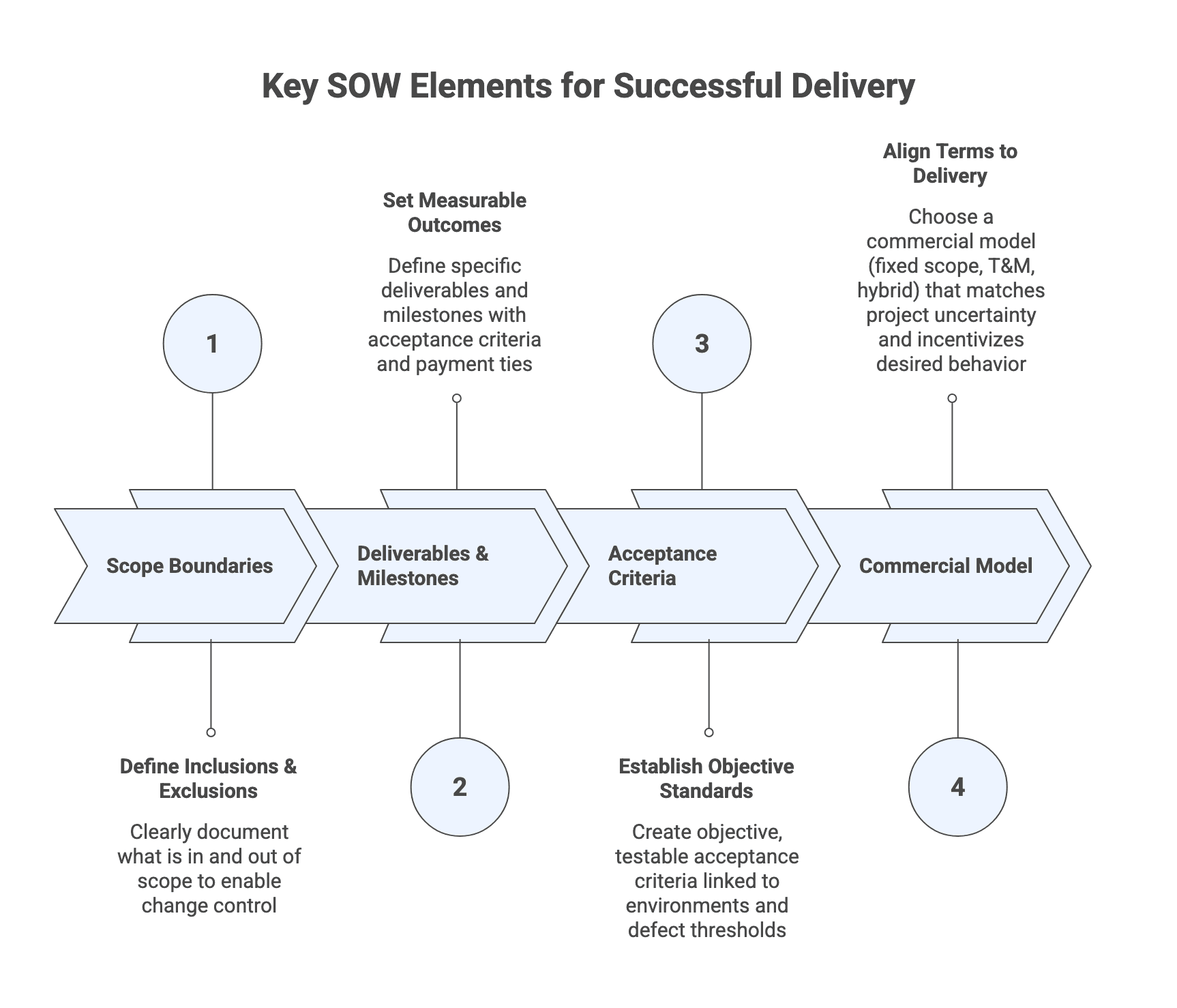
This section supports a drafting decision: can your SOW be executed without constant renegotiation? The focus is on scope boundaries, deliverable definition, acceptance, and aligning commercial terms to the delivery model.
Scope boundaries are what make change control possible. If scope is vague, every discussion becomes a debate about whether something was “included.”
A workable SOW makes assumptions explicit and exclusions clear. That gives both sides a shared reference point when priorities change or new requirements emerge.
To keep this practical, aim to document:
Deliverables and milestones only protect you if they connect to acceptance and payment. Otherwise, you can end up paying for activity rather than outcomes.
When milestones exist, define:
The goal is to avoid the classic argument where one side believes a milestone is complete and the other side believes it is “nearly done.”
Acceptance becomes subjective when environments, data, and test responsibility are unclear.
To keep acceptance objective:
If you only take one action from this section, make acceptance criteria explicit enough that a neutral third party could understand what “done” means.
Commercial terms shape behavior. If the commercial model rewards output volume rather than outcomes, you should expect more scope churn and more disputes.
Common models include:
The key is to match the model to uncertainty. If scope is likely to change, the SOW should make change control and estimation discipline explicit rather than pretending the scope is fully known.
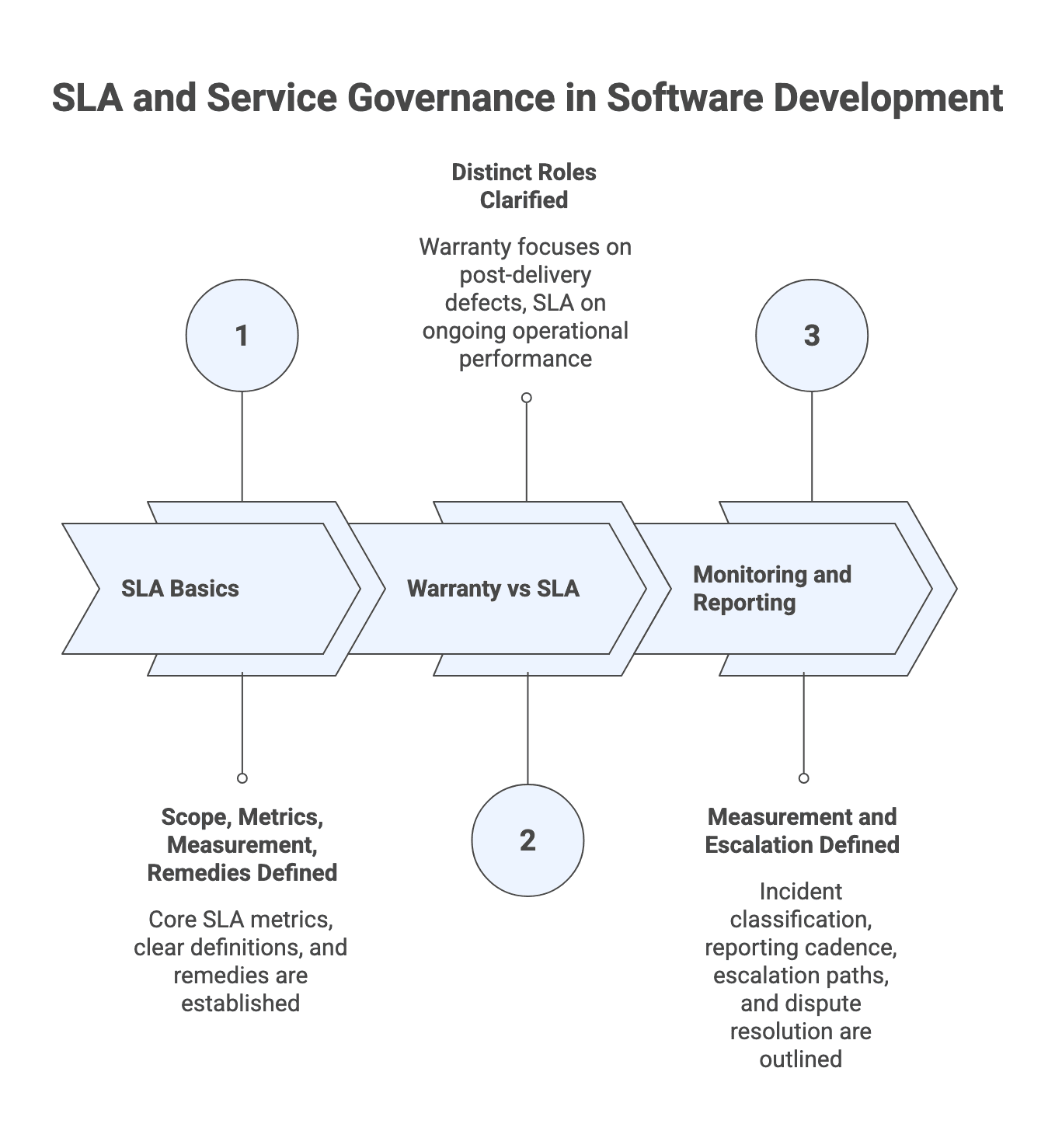
This section supports a scoping decision: do you need an SLA now, and if so, is it measurable and enforceable? If you are only building, focus first on acceptance and warranty terms.
Core SLA metrics in software and cloud services commonly include availability, response time, resolution time, performance measures, and error rates. For these metrics to be useful, definitions must be clear: what counts as downtime, what time basis applies, and how maintenance windows are treated.
Remedies often include service credits, but credits are frequently small relative to business impact. The operational value is usually in performance motivation and clear escalation expectations. Practical remedies can also include enhanced support, root cause analysis, corrective action plans, and in severe or repeated breaches, termination rights.
The most important governance move is to confirm that metrics are measurable with the monitoring and support systems you will actually use, and that both parties agree on the data source.
A warranty period and an SLA solve different problems.
Trying to force SLA style metrics onto build work can create arguments about measurement rather than improving quality. If your engagement does not include operate or support, you may get better outcomes by tightening acceptance criteria, clarifying warranty scope, and defining support terms for the stabilization period.
SLAs only work when measurement is agreed and reporting is routine.
A practical approach includes:
Before you rely on SLA terms, verify the vendor can demonstrate how reporting and escalation work in practice.
This section supports an ownership and dependency decision: will you be able to use, maintain, and evolve what you are buying without hidden licensing or third party constraints?
Foreground versus background IP is only useful if it maps to the deliverables you need to operate the system.
Buyer friendly patterns often look like:
The practical verification step is to review whether the deliverables list in the SOW includes the operational artifacts you will need. If an item is essential to operate or redeploy the system, confirm it is part of the work product you receive.
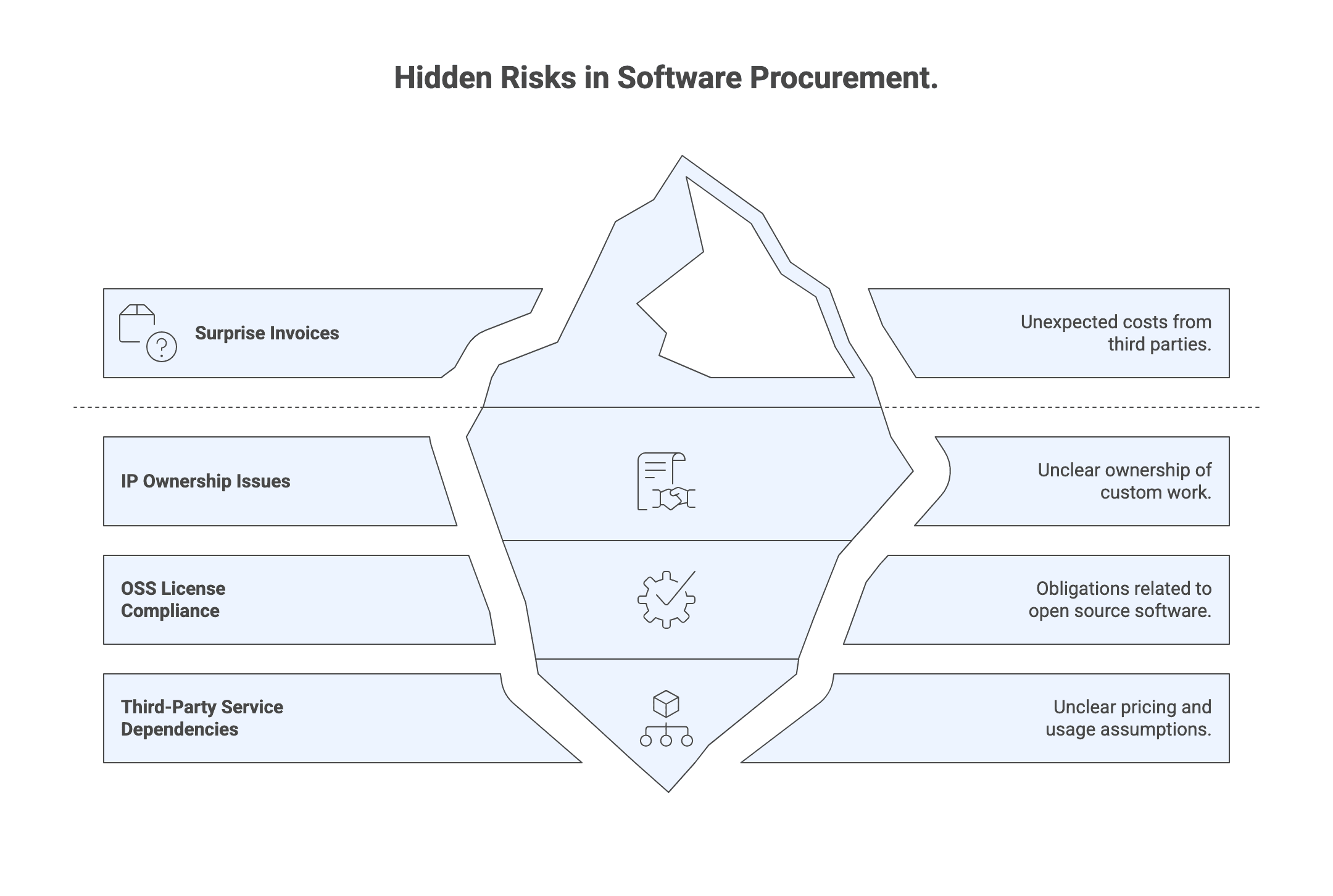
Modern applications often rely heavily on open source software (OSS) and third party services. That can be a strength, but it also introduces license compliance and security obligations.
A robust approach includes:
Contracts can also define which licenses are acceptable, require prior approval for certain copyleft licenses, and obligate the vendor to address security vulnerabilities in included components.
If you want one concrete outcome, request a sample SBOM and the vendor’s OSS policy as part of pre sign verification.
Third party services can create cost and dependency risk when pricing or usage assumptions are unclear.
To reduce surprises:
This is less about controlling every tool choice and more about maintaining budget predictability and reducing hidden dependencies.
This section supports one operational decision: how will changes be evaluated, approved, and documented so the backlog, the SOW, and invoices stay aligned?
A workable change workflow is lightweight but explicit.
A typical pattern:
The key is to avoid a split brain where the contract says one thing and the backlog says another.
Estimation is uncertain, but you can reduce avoidable surprises.
Useful practices include:
Over time, review actuals versus estimates in governance forums. That feedback loop improves estimation quality and builds trust.
Backdoor scope creep happens when changes bypass formal processes through informal agreements, chat messages, or quick tweaks added to sprints without re evaluating impact. This is especially common in flexible delivery models where backlog items change frequently.
Prevention is mostly rules and traceability:
A strong sign of maturity is a vendor who can demonstrate these mechanisms from prior engagements.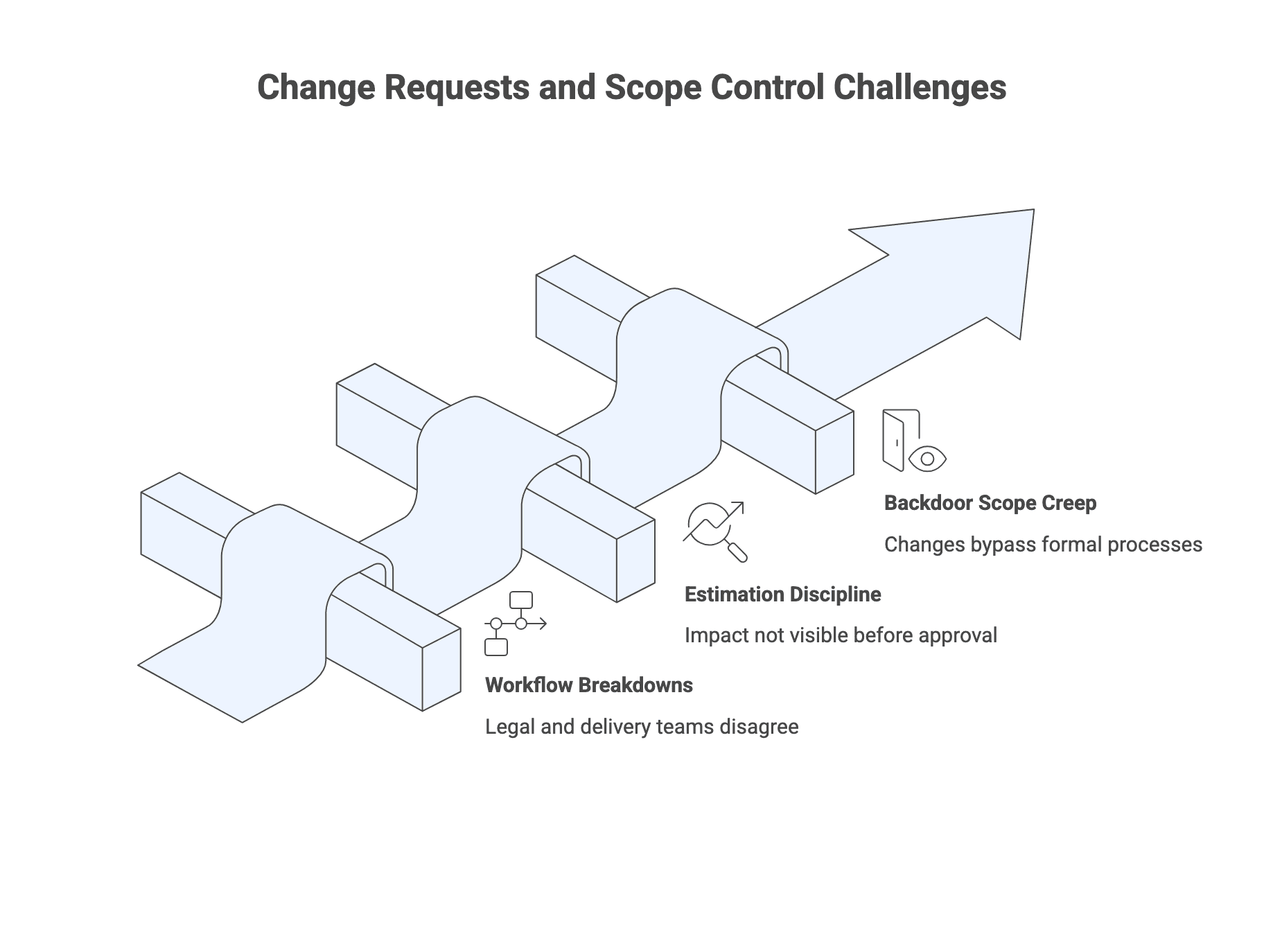
This section supports a readiness decision: do you have evidence that the vendor operates with the delivery discipline, security posture, and governance maturity the contract assumes?
Contracts encode intentions, but artifacts show how work is actually run.
A practical pre sign artifact set can include:
Reviewing these with internal stakeholders (legal, IT, security, operations) often reveals misalignment that would not be visible in marketing material.
Certain patterns correlate strongly with future friction. Watch for:
If you see multiple red flags, the likely outcome is repeated renegotiation during delivery.
Many contract delays are internal, rather than vendor driven.
Before heavy redlining, align on:
You do not need perfect alignment to start negotiation, but you do need a shared definition of success and the risks you will not accept.
A strong contract stack does not guarantee success, but it reduces the most predictable failures: unclear scope boundaries, subjective acceptance, hidden IP dependencies, and unmanaged changes.
The practical goal is simple: make sure the MSA, SOW, any SLA, and the change process form a single operating model. If the documents align and the governance artifacts exist, you can spend status meetings shipping software, instead of renegotiating what was meant.
For the full content cluster on selecting and managing a partner explore our custom software vendor selection hub.


Trusted by top platforms for our transformative solutions and exceptional results: