
 Add as preferred on Google
How to Modernize a Legacy Learning Platform Without a Full RewriteRead More

Most AI vendors are great at demos and pilots. Here's how to screen for the ones that actually run live systems.
Lead the first vendor call with operations questions, not capability questions.
The 88 percent number needs careful handling. IDC and Lenovo research found that 88 percent of artificial intelligence proofs of concept did not reach widescale deployment, roughly four production deployments for every 33 POCs. That is not a direct census of AI vendors.
But it does describe the market buyers now face: most AI activity still happens before production, and many vendors have learned how to sell that stage well.
The screening question is not, "Can this vendor build an impressive demo?" It is: can this AI engineering partner prove they have owned the messy work after the demo becomes a live system?
A vendor cannot prove they ship if the buyer lets them define "shipped" after the sales process begins.
Define production before the first call. In enterprise AI, production means a system is integrated into real workflows, used by real users, monitored under real operating conditions, and owned by named people after launch.
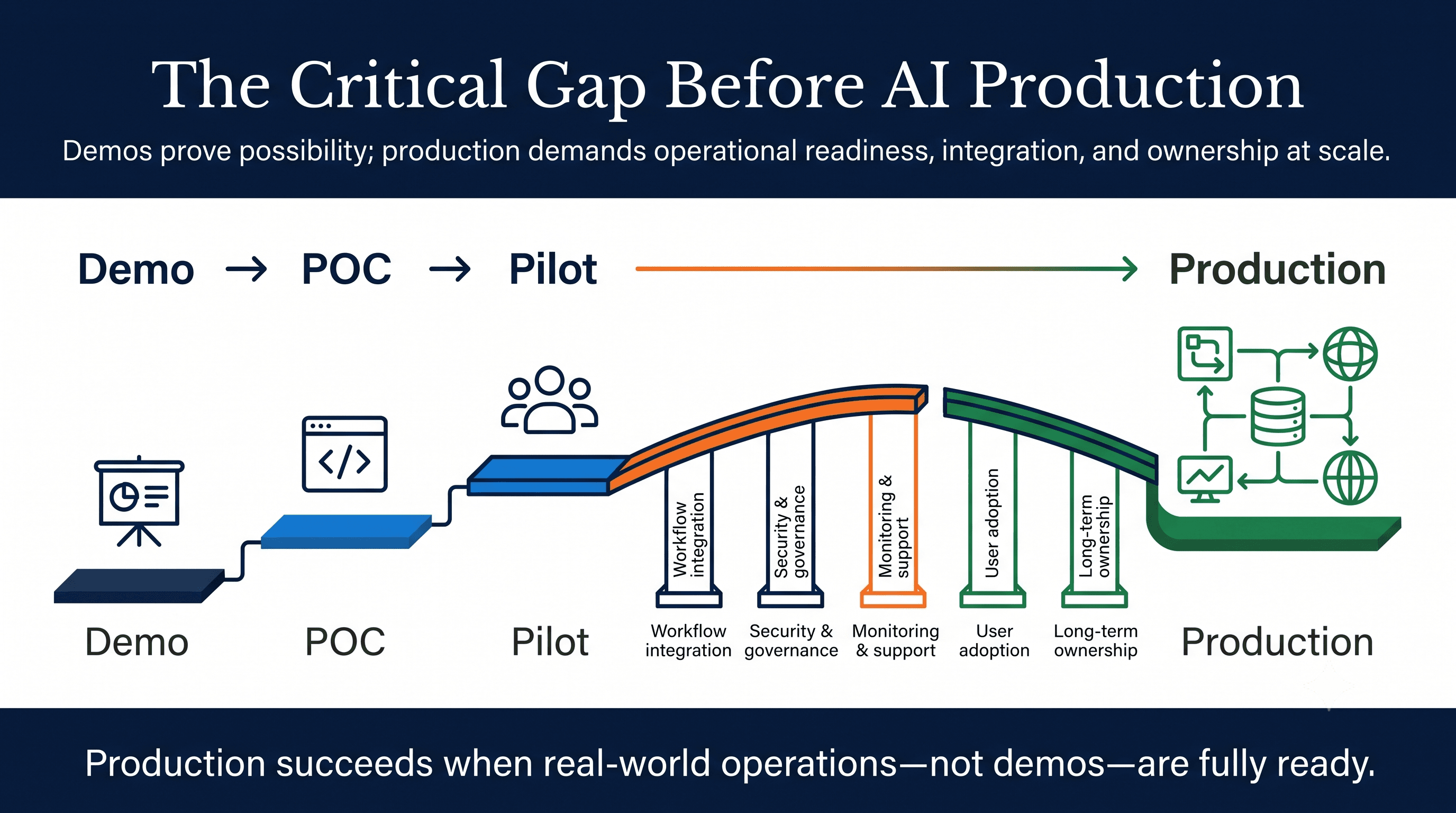
A demo shows what a capability can look like under controlled conditions. It may use curated data, scripted flows, or a narrow success path.
A proof of concept (POC) tests whether a bounded technical idea can work. The goal is feasibility, not operational readiness.
A pilot introduces the system to a limited real-world setting. It may use live or near-live data and a small user group, but it is still controlled, time-boxed, and not yet business-as-usual.
Production deployment is different. It means full or intended user access, live data under governance, workflow integration, monitoring, support, change management, and long-term ownership.
The gap between pilot and production is where many AI initiatives fail. Integration, security review, monitoring, user adoption, exception handling, and maintenance rarely show up in a glossy demo.
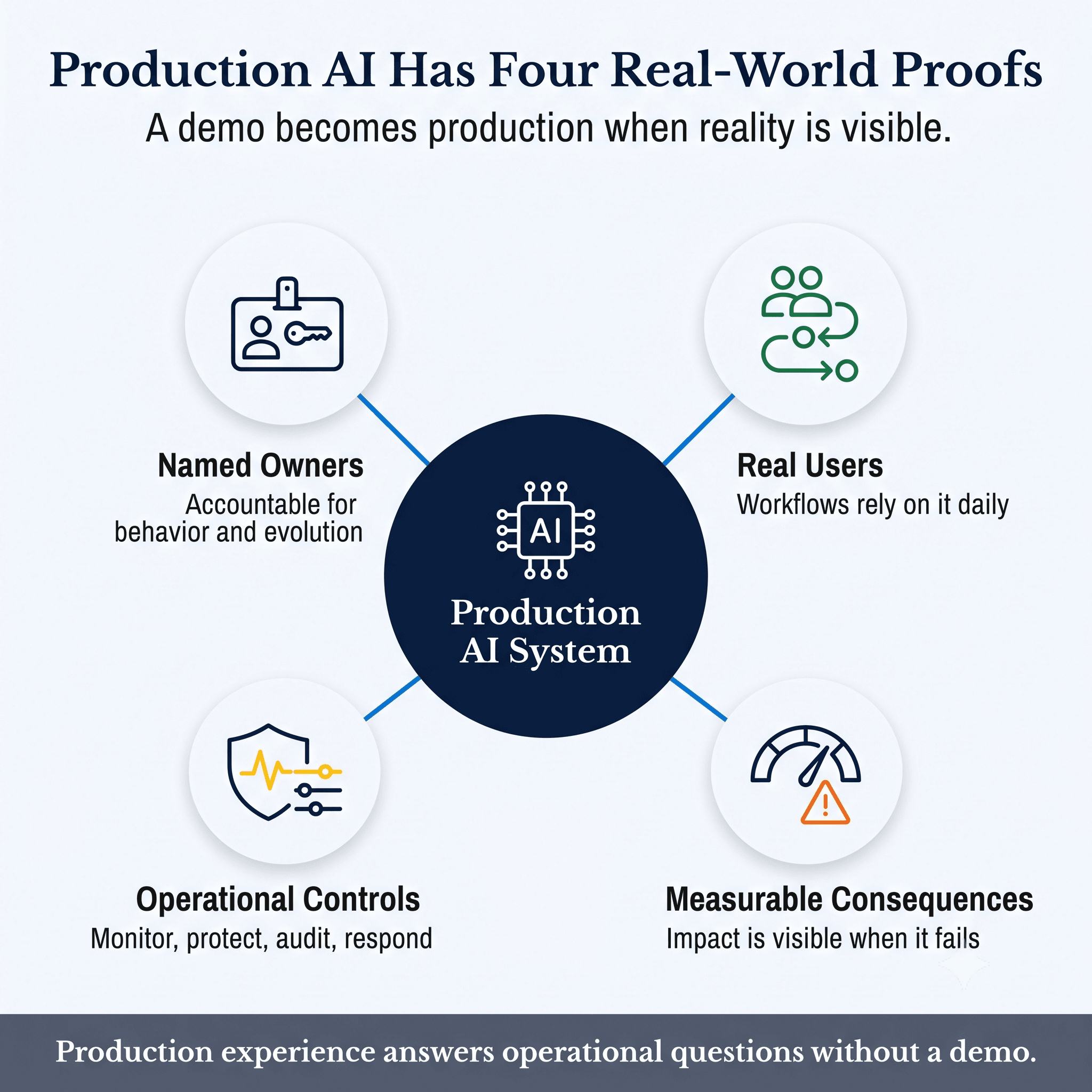
A production AI system has four visible traits.
Owners: named people accountable for system behavior, support, and evolution.
Users: real business users whose workflows depend on the system.
Controls: monitoring, access control, audit logging, incident response, and change management.
Consequences: measurable operational impact when the system works, and real disruption when it fails.
Ask a vendor to name the current system owner for a claimed production deployment. Ask how many users rely on it. Ask what gets monitored and who receives alerts. Ask what happened during the last production incident.
A vendor with production experience can answer without turning the conversation back into a demo.
Most selection processes begin with a demo. That rewards the wrong skill.
A better sequence is simple: ask for production evidence first, then decide whether the vendor earns discovery time.
This is not an unreasonable procurement demand. Vendors that have shipped understand the request. Vendors that mostly sell pilots often respond with case study PDFs, broad claims, or confidentiality objections that avoid every specific question.
Ask for anonymized artifacts from recent production deployments. The vendor may need to remove client names, data fields, diagrams, or security details, but they should still be able to show the shape of real operational work.
Strong evidence includes:
The phrasing matters: "Share what you can without client-identifying details. We are looking for evidence that the system was operated, not private data."
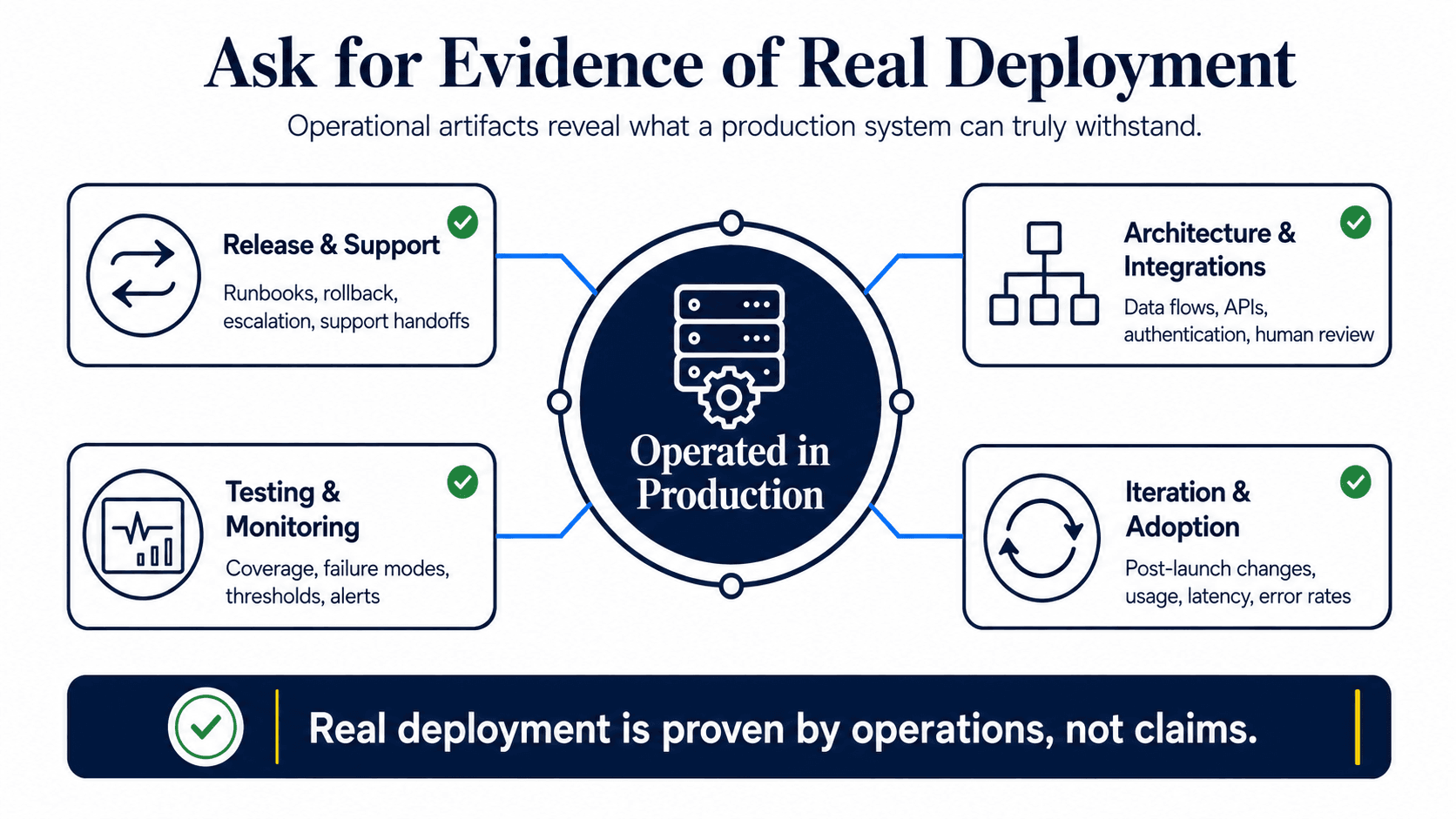
The fastest way to test production maturity is to ask operational questions.
Use these in the first serious vendor conversation:
Strong answers include specific roles, examples, timelines, and artifacts. Weak answers sound hypothetical: "We would normally..." or "The client handled that."
A vendor may intentionally hand off operations to the buyer. That is acceptable only if the handoff is evidenced through training, documentation, support terms, and references from the team that inherited the system.
Do not apply one proof standard to every AI project.
For an internal knowledge assistant, you may accept lighter evidence: a couple of production references, a basic monitoring description, and a clear data boundary.
For a customer-facing workflow, require stronger proof: post-launch owner references, evaluation summaries, incident response documentation, and security review evidence.
For regulated data workflows or revenue-critical automation, the bar should be higher still: formal evaluation evidence, monitoring and escalation paths, security documentation, explicit acceptance criteria, and proof of post-launch support.
The higher the consequence of failure, the less patience you should have for demo-only evidence.
Evaluation evidence is one of the clearest differences between pilot vendors and production vendors.
A serious AI vendor does not treat evaluation suite coverage as a one-time launch formality. They test behavior before release, monitor behavior after release, and use failure patterns to improve the system. That is especially important for large language model applications, retrieval augmented generation systems, and agentic workflows where production inputs may diverge from test conditions.
A vendor does not need to expose private client data to show evaluation maturity.
They can share:
Be cautious with accuracy claims that lack definitions. "95 percent accurate" means little unless the vendor explains the task, test set, sample size, threshold, and measurement method.
A case study is marketing evidence. A production reference is operational evidence.
Both can be useful, but only one tells you whether the system still works after the announcement.
Use case studies to understand the story. Use references to verify the system.
The most useful reference is rarely the executive sponsor. Ask for the person who inherited operational responsibility after launch: the product owner, platform owner, operations lead, or business user who has lived with the system.
Ask them:
A vendor that can only produce sales-friendly sponsors may still have satisfied customers. But they have not yet proven production durability.
A case study may describe a system that launched, stalled, or was replaced.
Ask whether the system is currently active, how many users rely on it, when it was last updated, and what measurable workflow outcome it supports.
Material production work has operational weight. It affects processing time, ticket volume, compliance review, customer experience, revenue workflows, or internal productivity. A screenshot and a launch quote are not enough.
The pilot-agency pattern appears before delivery begins. It shows up in scope, ownership, evidence, and contract language.
This is where buyers should slow down. Once the statement of work is signed, vague production responsibility becomes expensive ambiguity.
A statement of work can quietly cap the engagement at prototype quality.
Watch for these patterns:
You do not need to prescribe every tool the vendor must use. You do need production obligations in plain terms: what must work, how it will be measured, who owns it, and what happens when it fails.
A wrapper is not automatically bad. Many durable AI systems use foundation model APIs.
The risk appears when the vendor has little beyond a prompt, a user interface, and generic model access. A thin wrapper may look impressive until pricing changes, model behavior shifts, data quality degrades, or production users expose edge cases.
Ask what the vendor owns beyond the foundation model: retrieval logic, data integration, evaluation, orchestration, monitoring, governance, or domain-specific workflows.
The issue is not whether the system uses a large language model. The issue is whether the vendor can explain, measure, operate, and improve the system's behavior.
By the final selection stage, the strongest vendor should not be the one with the most fluent AI vocabulary. It should be the one with the best production evidence.
Use a simple scorecard to force the discussion back to artifacts.
Score each category from 0 to 3.
0 means no evidence. 1 means a claim without verification. 3 means specific evidence, artifacts, or reference confirmation. Avoid false precision. The point is to separate proof from narrative.
Criterion | What earns a strong score | Weight |
Live deployment proof | Current production references and operational artifacts from past deployments | 30% |
Integration depth | Real integration maps and examples of enterprise system connections | 15% |
Eval discipline | Evaluation summaries, failure taxonomy, regression tests, and release gates | 15% |
Monitoring and incident response | Specific signals, thresholds, escalation paths, and incident examples | 15% |
Security posture | Relevant documentation, security review process, and AI-specific risk controls | 10% |
Reference quality | Post-launch operational owners who can discuss real system behavior | 10% |
Post-launch ownership | Handoff plan, support terms, training, and knowledge transfer | 5% |
A vendor weak on live deployment proof should not be rescued by a strong demo. That category carries the most weight because it is the hardest to fake.
Some signals should end the evaluation before scoring continues:
Treat these as hard stops for high-risk work. A vendor can be skilled at prototypes and still be the wrong partner for production.
When two vendors pass the production screen, use tie-breakers tied to your operating context.
Domain fit matters when workflows, regulations, or data constraints are specific, a place where the choice between boutique and larger firms often comes into focus. Architecture transparency matters when you need long-term control. Internal team enablement matters if your goal is to build capability, not vendor dependency.
Governance maturity matters for sensitive data. Cost visibility matters when monitoring, retraining, support, and infrastructure will continue after launch. A willingness to define measurable production milestones matters because it turns promises into a go/no-go structure.
The better vendor is the one that leaves you with a stronger operating model, not just a working first version.
The market's pilot problem is not just a technology issue. It is an evaluation issue.
Buyers invite demo-first behavior when they begin with broad capability questions. They invite production evidence when they ask about operations first.
A practical first sequence looks like this:
The 88 percent figure should not be used as a direct claim about vendors. It is better understood as a warning about the environment vendors sell into: most AI initiatives struggle to cross the production gap.
The twelve percent are the vendors that can talk about that gap without hiding behind a demo. They can show artifacts. They can name owners. They can explain incidents. They can describe evals. They can connect production claims to live systems.
That is the standard worth buying against.
For the rest of the workflow, return to the complete AI engineering partner selection guide.
It means 88% of AI proofs of concept never reach widescale deployment, according to IDC and Lenovo. That works out to about four production deployments for every 33 POCs, and it describes the market, not a vendor census.
Production means the system is integrated into real workflows, used by real users, monitored under live conditions, and owned by named people after launch. A pilot is still controlled, time-boxed, and run with a small user group.
Ask for anonymized production artifacts first, then decide if the vendor earns discovery time. Starting with a demo rewards the wrong skill and lets the vendor define what "shipped" means.
Deployment runbooks, architecture diagrams, integration maps, evaluation summaries, monitoring dashboards, and incident response procedures all prove real operational work. Vendors can strip client names and still show the shape of the work.
Ask who owned incident response, what broke after launch, and what regression tests ran before updates went live. Strong answers name specific roles, timelines, and artifacts.
Production readiness depends on the system around the model more than on the model itself. Business-aligned success metrics need defining before the build starts, and an evaluation plan with held-out test sets and acceptance thresholds should arrive as an early deliverable. Data pipelines have to survive nulls, schema shifts, and upstream changes. Monitoring, drift alerts, retraining triggers, and rollback procedures handle the slow decay that follows launch. High-stakes outputs need defined human review. A demo runs on clean data, while production faces messy inputs and brittle integrations.
Deliverables labeled "prototype" or "proof of concept," no post-launch support SLA, and acceptance criteria like "acceptable accuracy" with no measurement. Missing owners for integrations and monitoring are also red flags.
A wrapper is fine if the vendor owns retrieval, data integration, evaluation, monitoring, and governance around it. The risk is when they have little beyond a prompt, a UI, and generic model access.
...Loading Related Blogs
Trusted by top platforms for our transformative solutions and exceptional results: