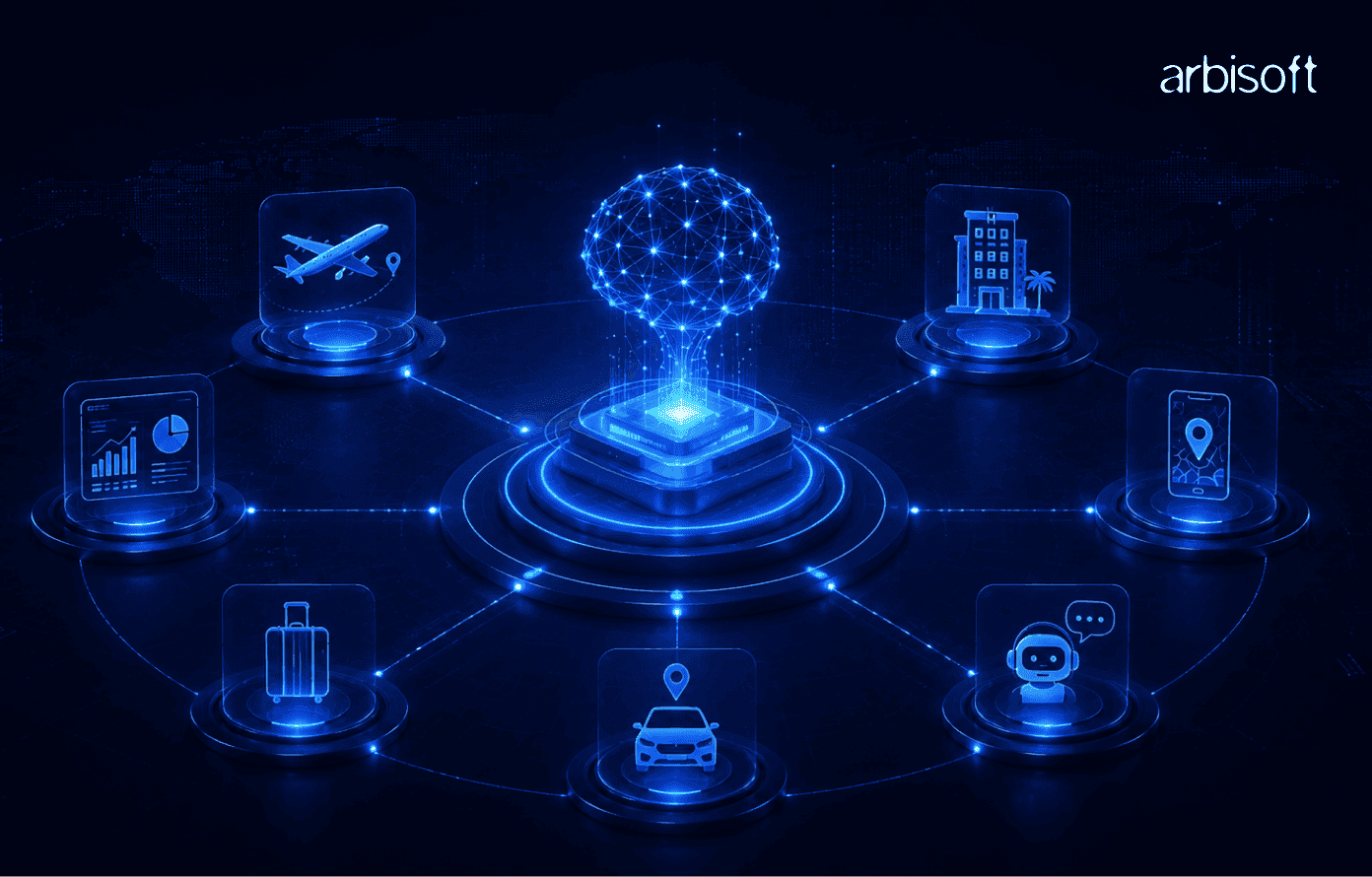
Artificial intelligence credentials alone do not identify a capable travel technology partner. A vendor may show broad model expertise and recognizable logos without proving it can connect AI to live booking inventory, passenger data, loyalty systems, or disruption workflows.
This ranking gives the most weight to named travel-sector evidence and documented production work. It is designed for buyers building a shortlist, not for declaring one company universally superior. For the wider evaluation framework, use the complete AI engineering partner selection guide.
The 2026 List of Top AI Development Companies for Travel Tech
How Companies Qualified for This Travel AI Ranking
A company needed at least one publicly traceable travel engagement involving an airline, hotel group, online travel agency, global distribution system, travel management company, or travel platform.
The Evaluation Criteria for the List
The list reflects five dimensions:
Travel relevance: depth, recency, and variety of named travel relationships
AI engineering specificity: clear evidence of AI work rather than adjacent software services
Production readiness: integrations, evaluation, monitoring, reliability, and post-launch support
Security and governance: current, precisely scoped controls and certifications
Delivery fit: team access, knowledge transfer, geographic coverage, and ownership model
Company Profiles
1. Arbisoft
Arbisoft has extensive experience building and supporting travel platforms, including a long-term engineering relationship with KAYAK. Its strongest evidence comes from travel search, airline-disruption accommodation, mobile applications, testing, and travel-data systems.
Founding Year: 2007
Company Size: 750+ specialists
Headquarters: Plano, Texas, United States
AI Focus for Travel: Natural language processing, machine learning, travel-data automation, and search experiences
Best fit for: Developing or modernizing enterprise or scale-up travel and hospitality businesses; travel-search, booking, mobile, testing, or airline-disruption platform
Primary specialization: AI Development, Custom software development, Open source strategy/modernization, UI/UX, Data Intelligence (Databricks), Enterprise Solutions (Odoo ERP Implementation)
Prominent Clients in Travel: KAYAK, Travelliance, TripScanner, SastaTicket
2. Onix
Onix has delivered accommodation marketplaces, booking platforms, and travel applications for startups and growing businesses. Its travel work includes personalization, fraud detection, recommendation features, and integrations with booking and property-management platforms.
Founding Year: 2000
Company Size: 250–999 employees
Headquarters: Kropyvnytskyi, Ukraine
AI Focus for Travel: Personalized search, recommendation systems, fraud detection, and dynamic offers
Best fit for: Accommodation marketplaces, booking platforms, and travel marketplace products
Prominent Clients in Travel: Misterb&b, TravelBid, Kozystay
3. TeaCode
TeaCode focuses on consumer-facing travel products that use AI to simplify trip discovery and itinerary planning. Its work for Plannin and Trava includes content analysis, personalized recommendations, group preferences, and itinerary optimization.
Founding Year: 2017
Company Size: 50–249 employees
Headquarters: Warsaw, Poland
AI Focus for Travel: Itinerary generation, recommendation systems, content analysis, and preference matching
Best fit for: AI trip planners, social travel discovery, and group-planning applications
Primary specialization: AI development and custom software development
Prominent Clients in Travel: Plannin, Trava
4. DataArt
DataArt combines enterprise travel engineering with experience in airline content, search, booking, and customer-service systems. Its public work includes AI assistants, natural-language flight search, NDC applications, and Sabre-related integrations.
Founding Year: 1997
Company Size: 6,000+ professionals
Headquarters: New York, United States
AI Focus for Travel: Generative AI assistants, natural-language search, case prioritization, and NDC chatbots
Best fit for: Enterprise travel search, airline retailing, NDC, GDS, and customer-service modernization
Primary specialization: Custom software engineering with travel-platform modernization, data/cloud and AI development.
EPAM supports large travel organizations with cloud, product, data, and digital transformation programs. Its travel-specific AI evidence includes a generative-AI destination planner connected to proprietary hotel inventory.
Founding Year: 1993
Company Size: 62,000+ professionals
Headquarters: Newtown, Pennsylvania, United States
AI Focus for Travel: Generative trip planning, personalization, conversational search, and enterprise data platforms
Best fit for: Large airline, hotel, airport, or online travel transformation programs
Primary specialization: Enterprise digital engineering, product development, cloud, data and AI transformation.
Prominent Clients in Travel: Priceline, Southwest Airlines, Connect@Changi, global hotel groups
6. Globant
Globant combines AI, digital experience, cloud, and customer-service transformation for enterprise travel organizations. Its strongest measurable evidence comes from AI-assisted travel contact-center operations.
Founding Year: 2003
Company Size: 28,000+ employees
Headquarters: Buenos Aires, Argentina
AI Focus for Travel: Sentiment analysis, call summarization, personalization, intelligent voice response, and customer-service automation
Best fit for: Airline, destination, and travel contact-center transformation
Primary specialization: Digital product engineering, AI, cloud, design and customer-experience transformation.
Prominent Clients in Travel: Red Sea Global, LATAM Airlines, Avianca
7. LeewayHertz
LeewayHertz provides custom application development alongside generative AI and AI-agent services. Its verified travel experience is strongest in mobile applications and destination-guide products, while public travel-specific AI evidence remains limited.
Founding Year: 2007
Company Size: 50–249 employees
Headquarters: Gurugram, India
AI Focus for Travel: AI agents, chatbots, itinerary planning, recommendations, and operational automation
Best fit for: AI-oriented travel applications, destination guides, and booking interfaces
Primary specialization: AI agents, AI development, generative AI and custom application development.
Prominent Clients in Travel: Hawaii Revealed, confidential cruise travel agency
8. Idea Usher
Idea Usher develops mobile and marketplace products for startups and mid-market companies. Its strongest travel example is GPS Journeys, which combines AI recommendations with navigation, booking, multilingual content, and offline access.
Founding Year: 2013–2014
Company Size: 250–999 employees
Headquarters: Mohali, India
AI Focus for Travel: Personalized recommendations, itinerary support, and location-aware travel experiences
Best fit for: Travel mobile MVPs, destination guides, and booking marketplaces
Primary specialization: Mobile applications, blockchain, custom software, AI development and generative AI.
Prominent Clients in Travel: GPS Journeys, Prio Ticket
9. Thoughtworks
Thoughtworks has strong evidence in airport, airline, and aviation operations. Its AI work has produced measurable improvements in stand allocation, workforce scheduling, delay reduction, and operational planning.
Founding Year: 1993
Company Size: 10,000+ employees
Headquarters: Chicago, Illinois, United States
AI Focus for Travel: Operational forecasting, optimization, workforce planning, and decision automation
Best fit for: Airport operations, airline planning, workforce scheduling, and aviation data platforms
Primary specialization: software delivery, data engineering, enterprise modernization and digital product development.
Prominent Clients in Travel: Finavia, Airpro, Delta, confidential airline clients
10. Amadeus
Amadeus is a major travel technology and distribution provider rather than a conventional software development agency. Its AI products operate close to live airline, hotel, inventory, pricing, and booking systems.
Founding Year: 1987
Company Size: 20,000+ professionals
Headquarters: Madrid, Spain
AI Focus for Travel: Agentic booking, fare analysis, seller automation, personalization, and operational assistance
Best fit for: Travel businesses requiring native distribution, airline, hotel, or booking-system capabilities
Prominent Clients in Travel: IHG, Avinor, SkyLink, Air France–KLM, Accor, Scandic Hotels, AirSial
Reduce the Longlist to Two or Three Credible Candidates
A shortlist should reflect the buyer's workflow, architecture, risk profile, and ownership model. Ranking position alone is not enough.
Match Each Vendor's Proof to Your Highest-Priority Travel Workflow
Start with the operational problem. An airline disruption agent needs passenger, crew, inventory, and notification integrations. An online travel agency planner needs live inventory access and low-latency booking flows. A hotel personalization system needs production model pipelines and monitoring.
Map each vendor's named evidence against that environment. Treat adjacent experience as an inference, then ask the vendor to close the gap with artifacts and references.
Mapping vendor evidence against your booking stack? Explore how our travel technology development work covers travel search, booking flows, airline-disruption handling, travel-data automation, and mobile platforms.
Request Production Evidence Before Scheduling a Showcase Demo
Request these items in writing:
A production architecture diagram with integration boundaries
A map of booking, inventory, loyalty, pricing, or operational systems
Model evaluation criteria and go-live thresholds
Monitoring examples for quality, drift, latency, cost, and incidents
Security scope, data terms, and model-training restrictions
A named reference from a comparable travel organization
Strong vendors discuss failure modes as readily as success. Generic assurances should not replace documentation.
Compare Delivery Fit, Not Just Technical Capability
Confirm named delivery roles, senior access, subcontractors, time-zone coverage, escalation paths, intellectual-property terms, knowledge transfer, and post-launch ownership; the delivery model and geographic coverage shape all of these.
A large system integrator may offer scale but more governance layers. A smaller engineering firm may provide direct access but fewer comparable references. The contract should make those trade-offs explicit before work begins.
Red Flags That Outweigh a Polished Travel AI Demo
Pause an evaluation when client claims cannot be verified, AI scope remains vague, or production status is described only through pilot language. Hidden subcontracting, absent monitoring, unclear data ownership, and evasive reference processes are also material concerns.
The most useful question is direct: Which model is live, what does it do, and how is its performance measured?
When a Travel-Specialist AI Firm Is Not the Best Category
Vertical AI Partner Versus Horizontal Platform
A travel specialist adds value when the buyer needs custom models, proprietary data, and deep travel-system integration. A horizontal platform may deploy faster through existing infrastructure, but usually offers less customization and control.
The choice depends on integration burden, operating ownership, platform dependence, and the need for domain-specific behavior.
Broader Custom AI Engineering Firms
Programs that connect travel operations to enterprise resource planning, workforce systems, or large modernization efforts may require broader transformation capacity. In that case, compare the vertical candidates here with broader custom AI development companies.
Non-AI Travel and Lifestyle App Development
Some projects are primarily about booking applications, mobile products, platform modernization, or user experience. When AI is not central to the business case, a travel application developer may be the better category.
A separate ranking of Top Travel & Lifestyle App Development Companies covers that need. Its verified destination was not available, so no slug is added here.
Make the Final Shortlist Defensible
Use a documented sequence:
Define the use case, integration environment, data sensitivity, latency needs, and post-launch owner.
Request production evidence and eliminate vendors that cannot substantiate comparable work.
Hold a technical workshop around a real system, not a sandbox demonstration.
Conduct a client reference call covering delivery quality, team stability, and support.
Score finalists against the five published criteria.
Record unresolved risks, accepted trade-offs, and the reason for selection.
A defensible choice is one that another stakeholder can reconstruct from evidence.
Need an AI transformation specialist? Explore how our enterprise AI development work spans model development, data pipelines, MLOps, monitoring, and post-launch ownership.


 Add as preferred on Google