
 Add as preferred on Google
How to Modernize a Legacy Learning Platform Without a Full RewriteRead More
For growing companies, an enterprise resource planning (ERP) decision is rarely just a software decision. It is a decision about how the business will control data, run processes, support growth, and avoid operational drag as complexity increases.
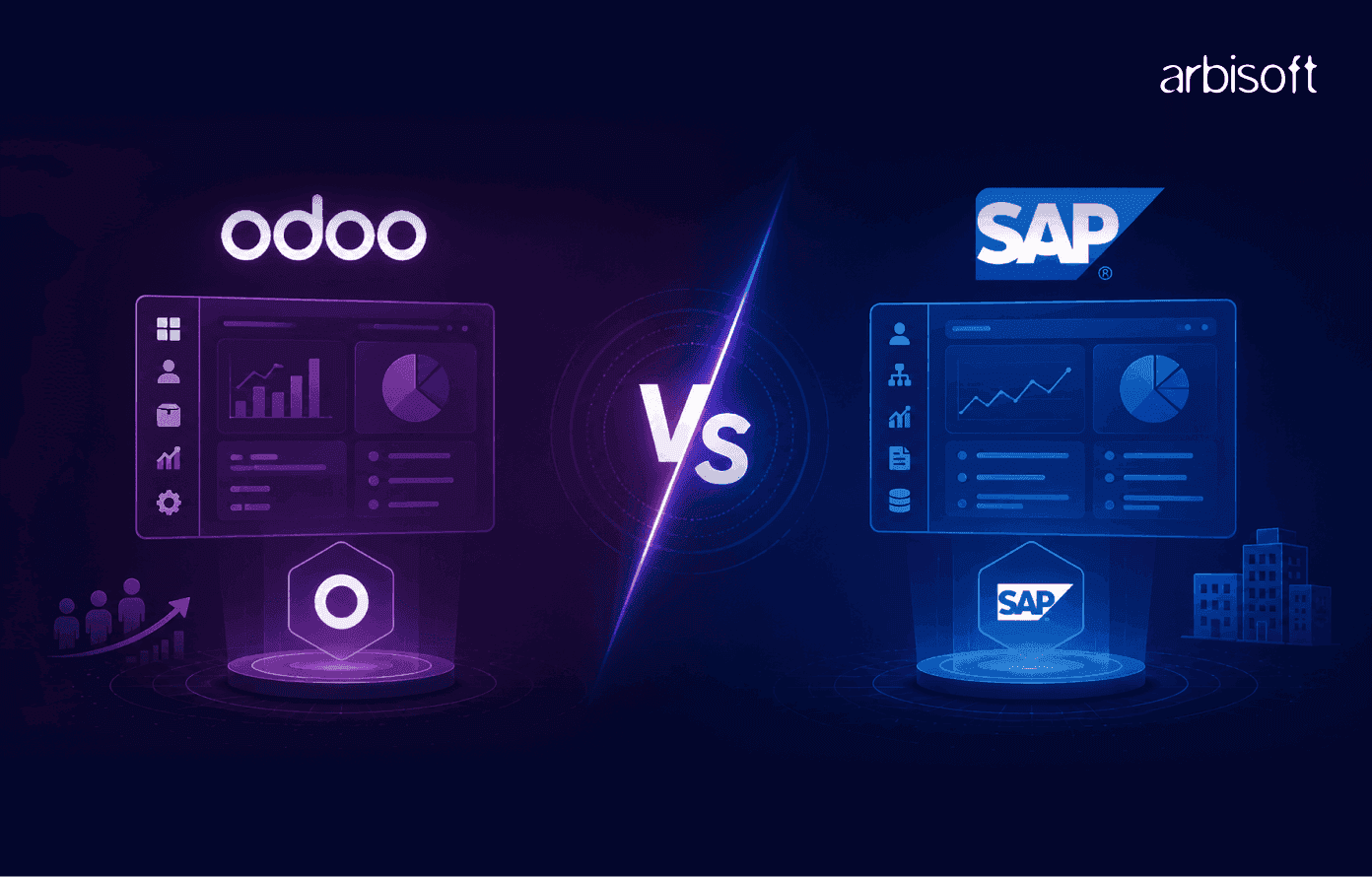
That is why Odoo vs. SAP has become a more serious comparison for mid-market teams. SAP is often seen as the enterprise default. Odoo is often seen as the flexible, modular alternative. But for companies that are scaling past spreadsheets, disconnected systems, or aging software, the better question is not which platform is bigger or cheaper. It is which platform fits the company’s operating reality.
Growing companies usually reach the ERP decision after workarounds stop working. Finance may be closing the books through spreadsheets. Inventory may live in one system while billing lives in another. Leadership may not trust reports because every department defines data differently.
The pressure rises when growth adds new complexity: more entities, more stock keeping units, more locations, acquisitions, new regulatory needs, or heavier reporting demands. At that point, the ERP decision becomes urgent. That urgency can create risk if leaders move straight into vendor demos before defining processes, ownership, and budget.
This is why Odoo and SAP now appear on the same shortlist. SAP Business One and SAP S/4HANA Cloud are both relevant to different parts of the mid-market. Odoo Enterprise has also matured into a modular ERP platform that can support finance, inventory, manufacturing, customer relationship management (CRM), and operations in one environment.
The risk is choosing by category instead of fit. A platform that is too complex can create consulting dependency and slow adoption. A platform that is too light can create rework when the business outgrows it. A platform chosen only on license cost can become expensive once implementation, customization, integrations, data migration, training, and support are included.
Before comparing Odoo vs SAP ERP, leadership should document the business trigger. Is the problem reporting, process control, inventory accuracy, finance close, integration debt, compliance, or all of the above? The clearer the trigger, the more useful the comparison becomes.
The first comparison point is product scope. “SAP” is not one product. SAP Business One is designed for small and mid-sized businesses with moderate operational complexity. SAP S/4HANA is a broader enterprise ERP platform with deeper process standardization, governance, and scale.
Odoo also has distinctions that matter. Odoo Community is open source and self-managed. Odoo Enterprise is subscription-based and includes more official features, support, hosting options, and enterprise apps. Partner-customized Odoo deployments add another layer because custom modules and integrations affect maintainability and upgrades.
A simplified comparison looks like this:
Dimension | Odoo | SAP Business One | SAP S/4HANA |
| Typical fit | Growing small to mid-market companies | SMEs with structured operations | Mid-market to enterprise complexity |
| Strength | Flexibility and modular rollout | SME-focused ERP depth | Standardization, scale, governance |
| Implementation style | Often phased and partner-led | Partner-led with defined scope | More formal transformation program |
| Main risk | Unmanaged customization | Scope growth and partner dependency | Complexity, cost, and change burden |
This does not mean one platform is automatically stronger. Odoo can be a better fit when adaptability and phased adoption matter. SAP can be a better fit when process depth, controls, multi-entity governance, and standardization are more important than flexibility.
Total cost of ownership (TCO) is where many ERP comparisons become misleading. License or subscription pricing is only one part of the cost. The full picture includes implementation services, configuration, customization, data migration, integrations, hosting, user training, support, upgrades, and internal team time.
Odoo often gives growing companies more room to start smaller and expand module by module. That can support faster initial value, especially when the first rollout focuses on finance, inventory, CRM, or a defined operational workflow. The trade-off is that flexibility needs governance. Heavy customization, poorly selected third-party apps, or weak documentation can create technical debt.
SAP often brings more structure into the implementation process. That can help companies standardize processes and strengthen controls. But structure requires readiness. Companies need process owners, clean data, executive sponsorship, and the budget to support a broader implementation effort.
Operational control also differs. With Odoo, companies may gain more ability to tailor workflows and extend the system. With SAP, especially SAP S/4HANA Public Cloud, companies may be encouraged to adopt standard processes and preserve a cleaner core system. One gives more adaptability. The other can reduce long-term variation if the organization is ready to standardize.
When comparing cost and speed, ask for a phased roadmap, scope assumptions, change request rules, integration plan, and post-go-live support model. Without those artifacts, the estimate is not decision-ready.
Odoo tends to fit better when a growing company needs flexibility, faster phased rollout, and room to adapt workflows without committing to a large enterprise transformation. It can be especially useful for companies with lean teams, evolving processes, and a need to bring finance, inventory, sales, purchasing, or operations into a more unified system.
Odoo may also fit companies that want to modernize incrementally. A business can start with core modules, prove adoption, then expand into manufacturing, ecommerce, CRM, or other workflows as the operating model matures.
SAP Business One tends to fit better when an SME needs a more structured ERP environment for finance, inventory, purchasing, production, and reporting, but does not need the full scope of SAP S/4HANA. It can be relevant for companies that want SAP ecosystem alignment without taking on a large enterprise program.
SAP S/4HANA tends to fit better when complexity justifies the investment. Multi-entity operations, global expansion, advanced financial consolidation, complex manufacturing, stricter role-based access control (RBAC), and deeper governance needs may point toward SAP’s broader ERP model.
The fit question is not “Can the platform do it?” Many ERP platforms can be extended to cover a requirement. The better question is “Can your organization implement, govern, and maintain this platform well?”
Odoo’s main strength, flexibility, can also become its risk. Customization can support differentiated workflows, but unmanaged customization can complicate upgrades, increase partner dependency, and make reporting inconsistent. Third-party modules can extend the platform, but module quality, support, and long-term maintainability need review.
SAP’s main strength, structure, can also become its risk. SAP implementations can expose process gaps, data quality issues, and change management weaknesses early. That is useful, but it can increase cost and timeline if the organization is not prepared. SAP S/4HANA also tends to require stronger internal governance and more disciplined process ownership.
Hidden costs often appear in the same places for both platforms:
A lower initial estimate should not be dismissed, but it should be tested. Ask what is excluded, what assumptions drive the price, what triggers a change request, and who owns each workstream. A detailed proposal may look heavier, but it can reduce risk by exposing complexity before the contract is signed.
The right ERP choice is the one that fits your company’s processes, people, data, budget, and growth path. A polished demo can hide weak readiness. A strong brand can hide poor fit. A flexible platform can still fail if governance is weak.
A practical decision framework should compare Odoo and SAP across five dimensions:
Decision factor | What to evaluate | Why it matters |
| Process maturity | Are workflows documented and owned? | ERP projects fail when process ownership is unclear |
| Budget tolerance | Can the company fund implementation, support, and internal time? | Software cost is only one part of TCO |
| Internal capacity | Who will own the system after go-live? | ERP success depends on business and IT ownership |
| Complexity | How many entities, locations, currencies, and controls are needed? | Complexity determines whether flexibility or standardization matters more |
| Growth path | Is growth organic, acquisitive, local, or international? | The platform must match the next stage, not just today’s pain |
For a single-country business with lean teams and evolving processes, Odoo may offer a more practical path. For a multi-entity organization with formal controls, complex reporting, and global operations, SAP may be more defensible. For many companies in between, the answer depends on implementation scope, partner quality, and readiness.
Before shortlisting vendors, leadership should align on the questions that define fit.
Finance should answer: What breaks during month-end close? How many entities, currencies, and reporting standards must the ERP support? What level of auditability and approval control is required?
Operations should answer: Which workflows create the most friction today? Are processes standard enough to adopt predefined models, or are they differentiated enough to require careful customization? Which inventory, purchasing, manufacturing, or order workflows are non-negotiable?
IT should answer: What systems must integrate with the ERP? Is there an application programming interface (API) or middleware strategy? Who will own data migration, access control, integrations, and post-go-live support?
Executives should answer: What business outcomes define success 12 months after go-live? Who makes final decisions when standard ERP processes conflict with current practice? Is change management funded and owned?
These questions help prevent a common mistake: selecting a platform before the organization agrees on how it wants to operate.
Vendor presentations are useful, but they are not enough. Before committing to Odoo, SAP Business One, or SAP S/4HANA, ask vendors and implementation partners for written evidence.
At minimum, request:
Also ask direct questions. What assumptions could materially change the estimate? How are change requests priced and approved? Who owns data quality? What happens after go-live? How will customizations be documented? Can the partner explain upgrade implications before development begins?
A good ERP partner should help you make trade-offs visible. A weak partner may focus only on closing scope quickly, leaving complexity to surface later.
Once Odoo or SAP looks like the better fit, do not move straight from shortlist to contract. Move into implementation readiness.
Start with stakeholder alignment. Define the business outcomes the ERP must support, such as faster close, better inventory accuracy, cleaner reporting, fewer manual handoffs, or stronger approval controls. Then run a structured discovery phase before finalizing scope.
That discovery should produce current-state process maps, future-state requirements, an integration inventory, a data readiness review, a risk register, and a phased implementation plan. It should also clarify which requirements are must-have, which are should-have, and which can wait.
Data deserves early attention. ERP platforms depend on clean master data, consistent product records, accurate customer and vendor data, and a chart of accounts that supports reporting. Poor data quality can undermine confidence in the system even when the software is configured correctly.
Finally, start change management before kickoff. Identify business owners, super users, training needs, and communication plans early. Adoption is not a technical afterthought. It is one of the main reasons ERP projects succeed or struggle.
Odoo and SAP can both be credible choices for growing companies. The defensible decision is the one tied to your operating model, implementation capacity, governance maturity, and growth plan. Compare the platforms, but evaluate the decision through the work your organization must do to make either platform succeed.
...Loading Related Blogs
Trusted by top platforms for our transformative solutions and exceptional results: