
 Add as preferred on Google
US Buyer’s Guide: How to Choose a Custom Software Development Partner (2026)Read More

If you are a VP Engineering or Head of Product at a US mid market company, choosing an engagement model is not paperwork. It sets the operating system for delivery: who makes which decisions, how changes get handled, and where risk actually sits.
This guide compares Dedicated Team vs Staff Augmentation vs Fixed Scope (often fixed scope fixed price) using a trade off lens. If you want the broader end to end selection flow, start with the buyer's guide.
This section helps you understand the stakes so you can treat the engagement model as a delivery decision. The right choice reduces rework, renegotiations, and internal friction. The wrong choice can lock you into slow change control or expose you to more management load than you planned.
In practice, procurement and legal will negotiate very differently depending on whether you are buying deliverables, capacity, or individual people. Security and compliance will also care, especially when external engineers need deep access to your environments and Software Development Life Cycle (SDLC).
By the end of this section, you should be able to explain to stakeholders why the model choice affects budget predictability, time to first release, and how painful mid project learning will be.
Most failure patterns come from mismatch on either side:
Fixed scope projects with fuzzy or evolving requirements tend to degrade into scope creep and change order battles. Every new insight becomes a negotiation instead of a backlog decision, which can stall delivery and erode trust.
The inverse shows up with Staff Augmentation. If you add people but lack strong product ownership or delivery management, augmented engineers can be busy but misaligned. You carry the full burden of coordination, and output can drift into “hours consumed” reporting instead of outcomes.
Dedicated teams bring more vendor side delivery structure, but they still fail without governance. If you do not have a clear product owner, decision latency and ambiguous acceptance criteria can show up quickly.
Early warning signs in the first two to six weeks often include:
Corrective actions tend to be straightforward, but they must be explicit:
If you already recognize these patterns internally, treat them as input into model choice, not as issues you will “fix later” after signing.
A clean mental model is: what you pay for, and who owns delivery.
One recurring issue in US RFPs is “label drift.” Vendors sometimes call a capacity arrangement “fixed scope” or a managed team “staff aug.” The sanity check is simple: are you paying for named individuals, a reserved team, or specific deliverables, and who is actually responsible for day to day delivery?
At this point, you should be able to state the model choice in one sentence: “We are buying deliverables” or “We are buying capacity” or “We are buying people.”
This section helps you compare what changes in practice: governance, change handling, accountability, and management load. The goal is to find the best fit for your specific project reality.
As you read, keep one question open: do you need flexibility most, or predictability most, and do you have the internal bandwidth to run delivery?
Dedicated Team
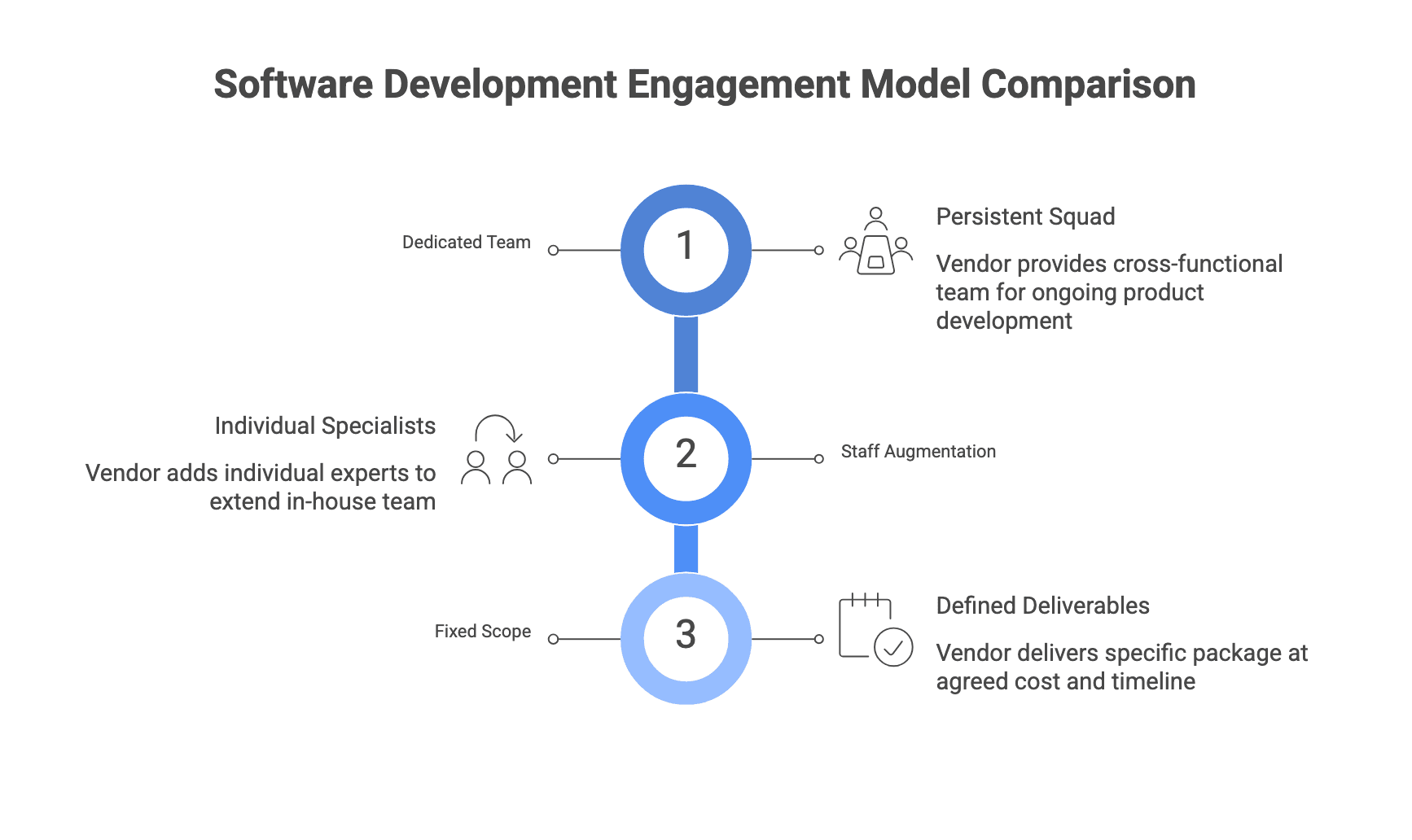
You pay for a persistent, cross functional squad allocated primarily or exclusively to your product. The vendor typically supplies delivery roles like a delivery manager, Scrum Master, Quality Assurance (QA) lead, and engineering leadership. You provide a product owner and stakeholders. Commercially this is often T&M or a monthly retainer tied to team capacity, with governance and ways of working defined, but deliverables.
Staff Augmentation
You pay for individual people days or full time equivalents to extend your in house team. Augmented staff work inside your processes, tools, and ceremonies under your managers. The contract is usually role definitions, rate cards, and assignment terms more than a feature level SOW. You supply product management and technical leadership, and accountability remains internal.
Fixed Scope (fixed scope fixed price)
You pay for specific deliverables at an agreed cost and timeline. The SOW typically includes functional and non functional requirements, Acceptance Criteria, acceptance testing process, a change order mechanism, and defect or warranty terms. You participate in reviews and acceptance and provide subject matter expertise, but the vendor is contractually responsible for delivering the agreed package.
If a proposal feels ambiguous, ask the vendor to walk through a real example of how a Change Request is initiated, estimated, approved, and accepted under their model.
This comparison is a shortcut for stakeholder alignment. Use it to surface where your team will spend time and where risk concentrates.
Model | You pay for | Who runs delivery | How changes work |
| Dedicated Team | Team capacity over time | Vendor runs execution; you steer product | Reprioritize backlog; cost driven by time and team size |
| Staff Augmentation | Individual specialists | You run delivery | You reprioritize; you manage coordination and quality |
| Fixed Scope | Defined deliverables | Vendor runs execution to SOW | Change Requests become change orders with cost and schedule impact |
Two practical implications often surprise buyers:
If your stakeholders disagree on “who owns quality” or “who owns delivery,” resolve that before comparing rate cards or timelines.
This section helps you map real situations to the model that tends to fit, including counterexamples so you do not over apply a pattern.
Dedicated Team tends to fit when:
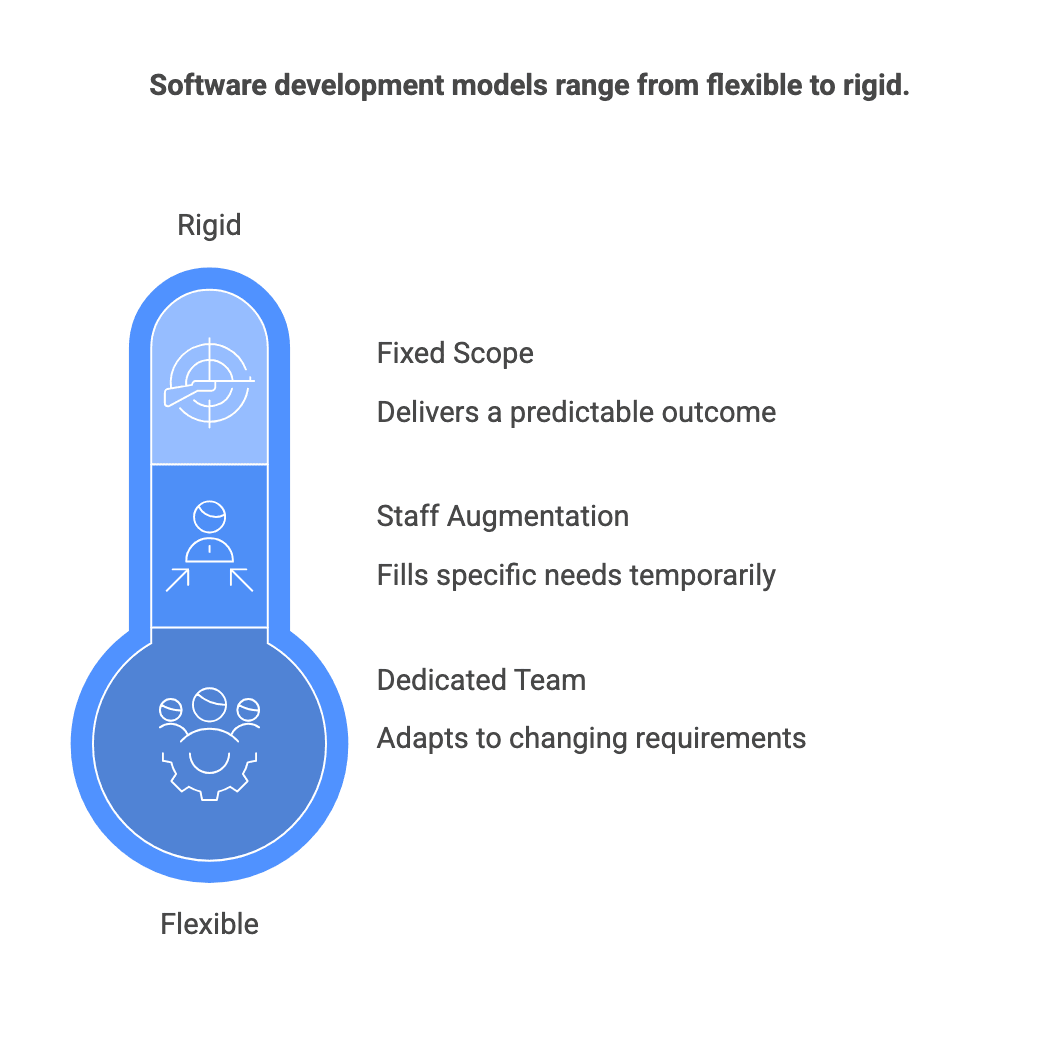
Micro scenario: a mid market SaaS platform modernizing a core workflow while learning from user feedback each sprint. Requirements will change. You need steady throughput and fast reprioritization.
Counterexample: a one off, tightly constrained build with no planned evolution, where a long lived team would be under utilized after delivery.
Staff Augmentation tends to fit when:
Micro scenario: an internal platform team needs a cloud specialist and a mobile engineer for a set of milestones, but wants to keep full control of architecture and release decisions.
Counterexample: using staff aug as a substitute for product ownership or delivery management. If your internal leadership is already stretched, adding more people can increase coordination cost and slow decisions.
Fixed Scope tends to fit when:
Micro scenario: a compliance related module with stable requirements and a clear acceptance test plan, where the definition of “done” can be written in testable terms.
Counterexample: a build that touches legacy systems with unknown complexity and shifting stakeholder opinions. “Predictability” on paper can become a sequence of change orders and tense renegotiations.
If you cannot describe your project as “evolving product” or “well specified package,” treat that ambiguity as a signal to consider a discovery first approach.
This section helps you evaluate fit based on project reality.
These criteria show up consistently across practical guidance.
A useful way to use these criteria is to score your project honestly, then pick the model that matches your strongest constraints rather than your preferred contract type.
This section helps you avoid “model theater,” where the contract says one thing but delivery runs like another. Each model has predictable ways it fails.
Dedicated Team failure modes
Early signs include sporadic backlog grooming and sprint reviews that defer acceptance repeatedly.
Staff Augmentation failure modes
Mitigations include defining a RACI matrix (Responsible, Accountable, Consulted, Informed), standardizing coding and review practices, and ensuring an internal lead owns outcomes.
Fixed Scope failure modes
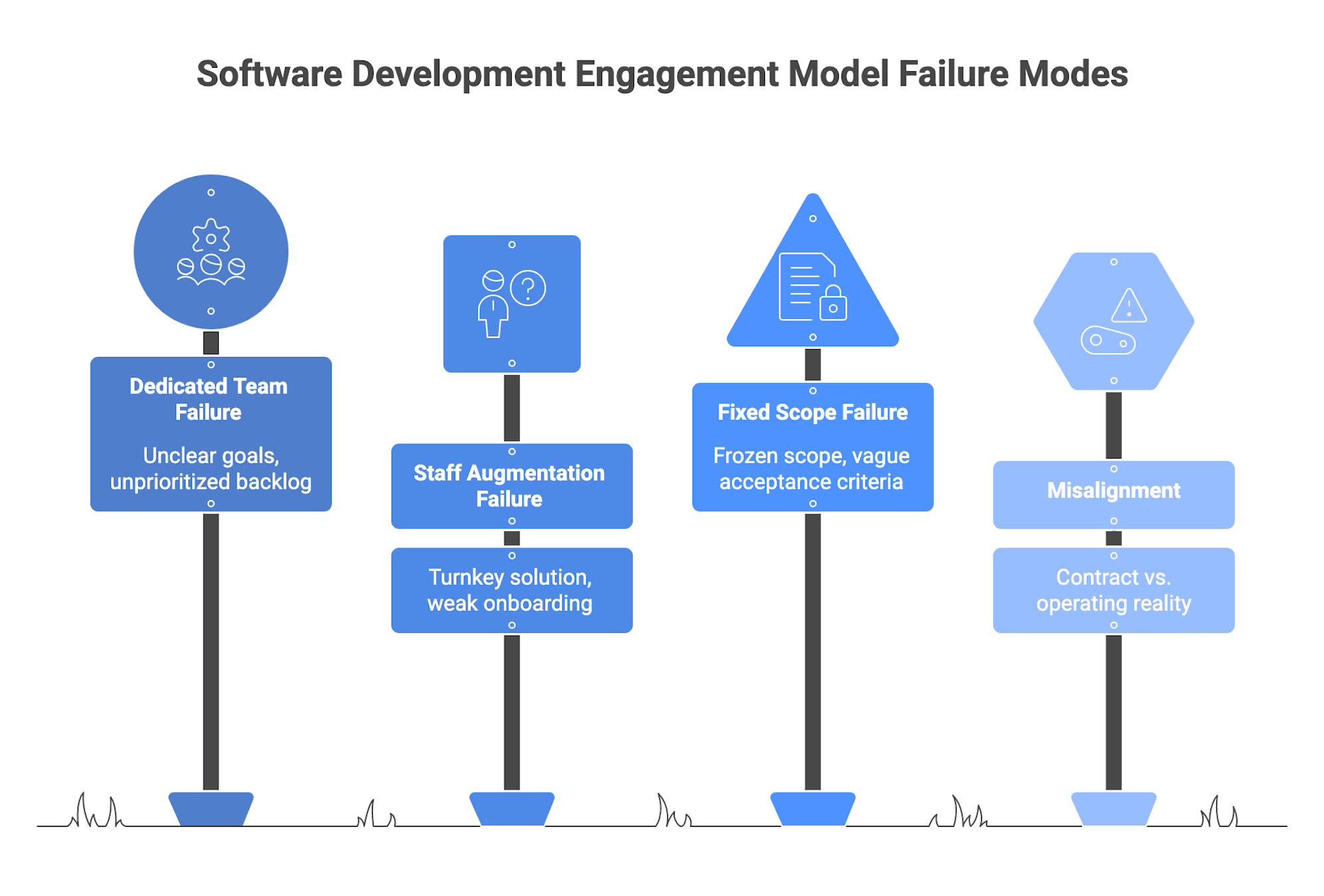
Early signs include long debates about requirement interpretation, rapid emergence of “must have” changes, and pressure to squeeze in extra work without formal change orders.
Across all three, the most common cross cutting failure is misalignment between contract mechanics and operating reality. The fix is to align contract language, governance, and expectations so they describe the same model.
If you can only fix one thing to reduce failure risk, fix decision rights: who can approve scope changes, who can accept work, and how fast decisions will happen.
This section gives conditional rules you can use to make a defensible choice.
Notice what is not in these rules: “fixed scope is safest” or “dedicated team is always better.” The model is only as strong as its prerequisites.
Before you lock in, write down which prerequisites you are confident you already have, and which you still need to establish.
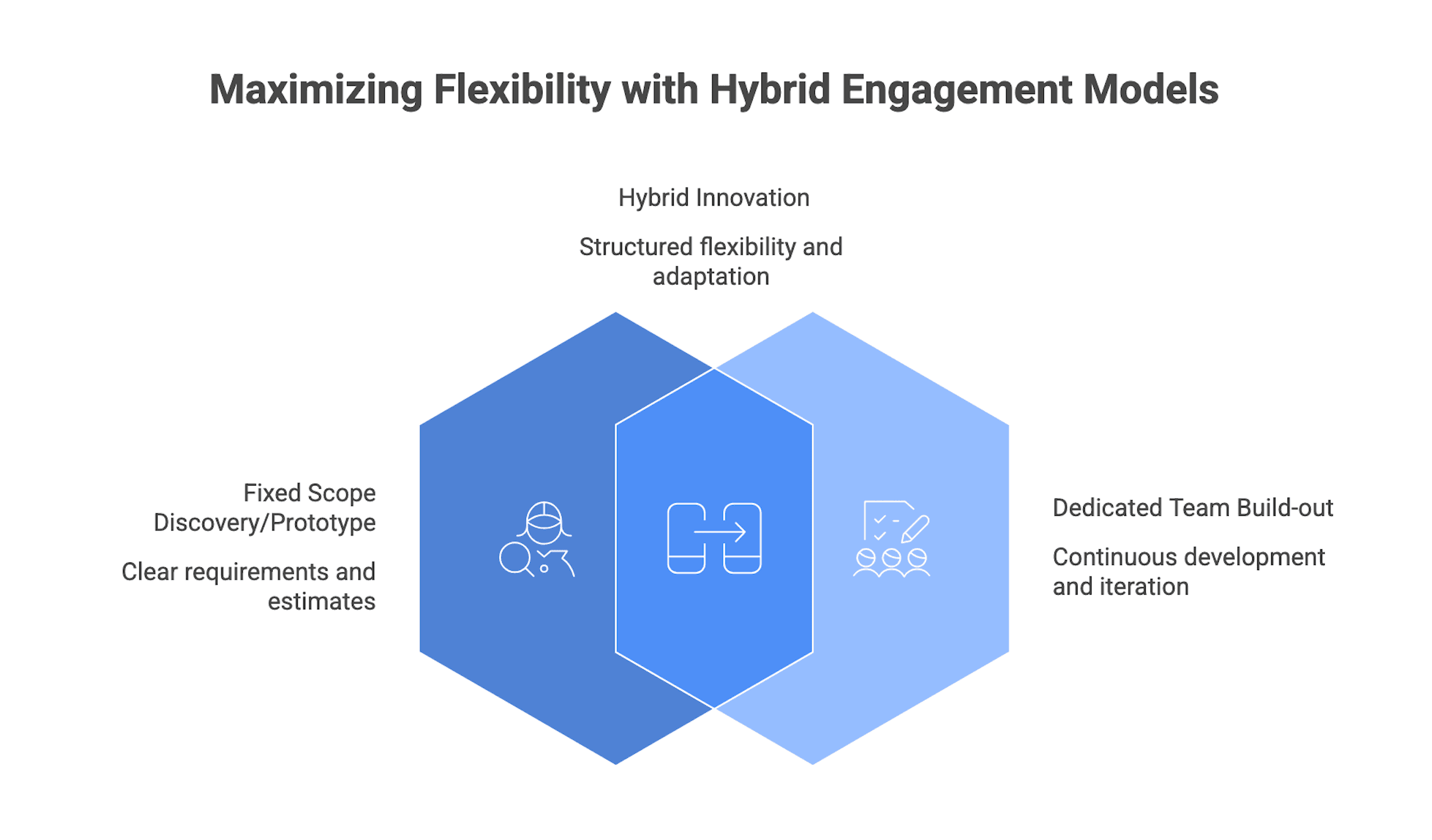
This section helps you use hybrids intentionally.
Two patterns show up often:
Hybrids create friction when accountability is unclear. If one vendor delivers a fixed scope pilot while another runs a dedicated team, integration defects can trigger finger pointing unless handover responsibilities are explicit.
If you plan a hybrid, consider structuring phases as separate SOWs under a Master Services Agreement (MSA), with clear acceptance criteria, exit conditions, and a governance plan that ties phases together. Also plan for coordination cost: integrated backlogs, cross vendor alignment on standards, and a named internal owner to manage the whole system.
A hybrid should make the decision more reversible.
This section helps you diagnose your reality before you pick a model. The fastest way to make a bad choice is to assume you have stable scope, or assume you have management bandwidth, without evidence.
Treat these as internal alignment questions you can answer in a single working session with product, engineering, and a procurement or legal partner.
This is the first gate because fixed scope only works when “fixed” is realistic.
Indicators you are closer to stable scope:
Indicators scope is volatile:
When uncertainty is high, structured discovery can help. Common discovery activities include stakeholder interviews, process mapping, technical spikes, and prototyping. Typical outputs are a scoped backlog, architecture options, a risk register, and more grounded estimates. Those outputs can then support either a better fixed scope SOW or a more confident dedicated team plan.
If you cannot write Acceptance Criteria that are testable, assume you are not ready for full fixed scope.
This gate determines whether staff augmentation is realistic, and how much leverage a dedicated team will actually provide.
Reality by model:
If your product owner and engineering leads are already overburdened, staff augmentation can worsen decision latency and create idle or misdirected work. In that case, a dedicated team or a discovery first phase may be safer.
A simple internal test is to estimate weekly time commitment for product ownership and delivery decisions. If you cannot staff that time, the model will suffer.
This gate is about operational reality: access, onboarding, and the cost of integrating external engineers into your SDLC.
In staff augmentation and dedicated team models, external personnel often need:
That implies onboarding into identity and access management, least privilege access, and alignment with standards like branching strategy, code review practices, and testing expectations.
Fixed scope can sometimes be structured with the vendor using their own tooling and handing off at milestones, but integration projects eventually need shared interfaces and test environments. In regulated contexts, security and compliance often impose controls regardless of model.
If your organization has constrained access patterns or slow onboarding, factor that into ramp up time and delivery risk.
Before choosing, align on “ways of working” basics: Definition of Done, testing expectations, code review, and release criteria.
This gate translates contract mechanics into outcomes. It matters because “risk transfer” is often assumed, but rarely free.
In fixed scope agreements, change order provisions are central:
Acceptance clauses typically specify objective criteria, testing procedures, acceptance periods, and remediation steps if defects are found. Some contracts include deemed acceptance if you do not respond within a defined window.
In capacity based models (dedicated team and staff augmentation), contracts focus more on roles, rates, time tracking, termination or notice periods, and responsibilities. Change control is less rigid because scope is expected to evolve. Risk is managed through transparency, governance, and the ability to adjust team size.
Across all models, pay attention to:
If you cannot explain how a Change Request updates acceptance criteria and timeline, assume you have a contract ambiguity that will surface later.
This gate helps you set expectations with finance and procurement.
Fixed scope often provides high predictability at the outset: you know the contracted cost for the defined scope. But total cost can rise when requirements evolve, because each change becomes a negotiation with fees and schedule impact. There is also a risk that a vendor protects margin by cutting corners if estimates prove optimistic, which can show up later as technical debt and higher maintenance cost.
Time and Materials models (dedicated team and staff augmentation) have more variable total cost because spend depends on duration and team size. They can be more efficient when you need to adapt scope frequently because you are not renegotiating every change, but you need budget guardrails and outcome based reporting.
At minimum, align internally on what “predictability” means: predictable monthly burn, predictable delivery milestones, or predictable total project cost. Different models optimize different versions of predictability.
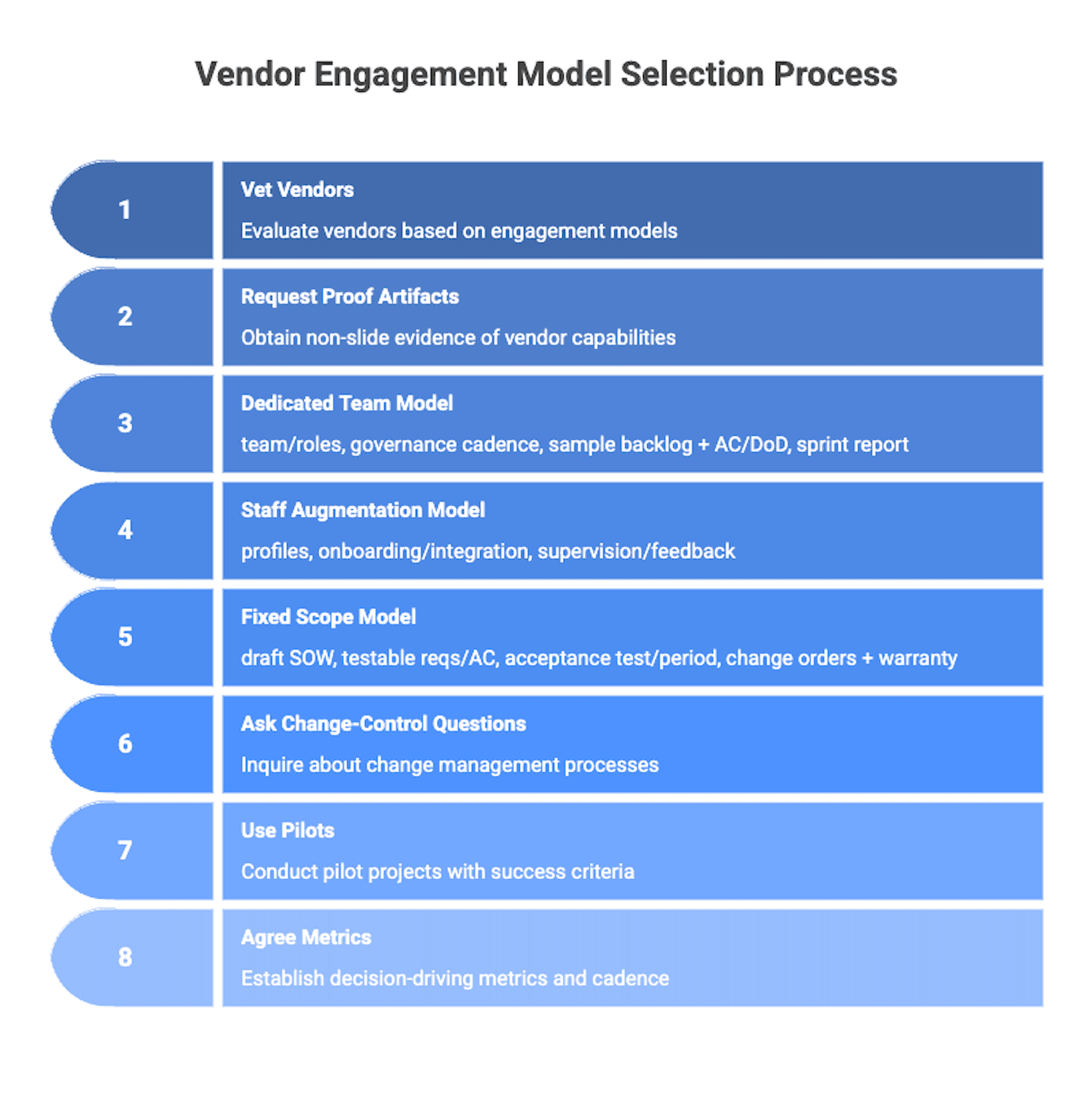
This section helps you turn preference into verification. Most model failures are visible early if you request the right artifacts and ask the right questions.
The goal is to confirm they actually run the model they are selling, and that you can support it with your governance and access realities.
Ask for artifacts that prove operating capability instead of marketing slides.
Dedicated Team:
Staff Augmentation:
Fixed Scope:
Across all models, ask for QA artifacts: test strategy outline, release criteria, and how defects are handled after acceptance or release.
If a vendor cannot provide model appropriate artifacts early, treat that as a risk signal.
Use questions that force a walkthrough of real process.
On change control:
Good answers reference a disciplined written process, impact analysis, and options.
On delivery ownership:
Good answers include clear decision rights and a governance cadence.
On transparency and quality:
Strong answers talk about incremental demos, defect trends, and quality gates.
If the vendor’s answers are vague, assume the model will drift in execution.
If uncertainty is high or collaboration risk feels meaningful, a small pilot can reduce lock in.
Examples of pilots by model:
A thoughtful pilot has:
US buyers often negotiate termination for convenience with notice periods, plus handover obligations such as repository transfer, runbooks, architecture diagrams, and transition sessions. These terms matter more in long term engagements, but they are also useful in shorter pilots.
If you cannot design a reversible first step, you are taking more lock in risk than you need.
Metrics are only useful if they drive decisions. Agree upfront on what will be reported, how often, and who interprets it.
For agile team based delivery (dedicated team and staff augmentation), commonly useful signals include:
For fixed scope, milestone tracking matters, but it is not enough without quality visibility. Status that only reports percent complete can hide risk until acceptance.
Avoid vanity dashboards. If a metric does not lead to a decision, replace it.
Once you align on reporting cadence and success signals, you can spot drift early and adjust team size, scope, or governance before problems compound.
This section is a fast path to a defensible choice. It is designed for an internal alignment session where engineering, product, and procurement want a clear recommendation and a short list of verification actions.
Use this framework to narrow to a likely model, then validate with artifacts and a pilot where needed.
Start with three questions: scope stability, delivery ownership, and integration depth.
Edge case rule: if uncertainty is high across scope and technical risk, start with discovery first, then re evaluate.
Once you pick a likely model, convert it into concrete requests: governance plan, SOW detail, onboarding plan, and clear decision rights.
This section prevents obvious misfits.
Fixed Scope red flags:
Staff Augmentation red flags:
Dedicated Team red flags:
If any disqualifier applies, either choose a different model or fix the prerequisite first.
When uncertainty remains high, the safest next step is usually to start smaller and make the decision reversible.
A common approach is a time boxed discovery or proof of concept that focuses on:
During this phase, observe how decisions get made, how transparent reporting is, and how quality is handled. Then re apply the criteria with better information. If the evidence points to a longer build, move from discovery into a dedicated team or staff augmentation plan. If scope stabilizes, a better fixed scope SOW may become realistic.
The goal is to avoid committing to a long term model before you have enough evidence.
The core trade off is consistent: you are balancing predictability vs flexibility, and internal governance capacity vs outsourced delivery risk. Dedicated teams and staff augmentation give adaptability and tighter integration, but require sustained product ownership and management attention. Fixed scope offers upfront budget certainty and clearer risk transfer on a defined package, but demands mature requirements and disciplined change control.
A defensible next step is to pick a likely model using the decision tree, then verify fit before signing. Concretely, that means requesting model appropriate artifacts (SOW detail, governance plan, backlog with Acceptance Criteria), asking process questions about change control and delivery ownership, and using a small pilot or discovery phase when uncertainty is high. In parallel, align internally on who will act as product owner, who will manage the vendor day to day, and how success will be measured.
...Loading Related Blogs
Trusted by top platforms for our transformative solutions and exceptional results: