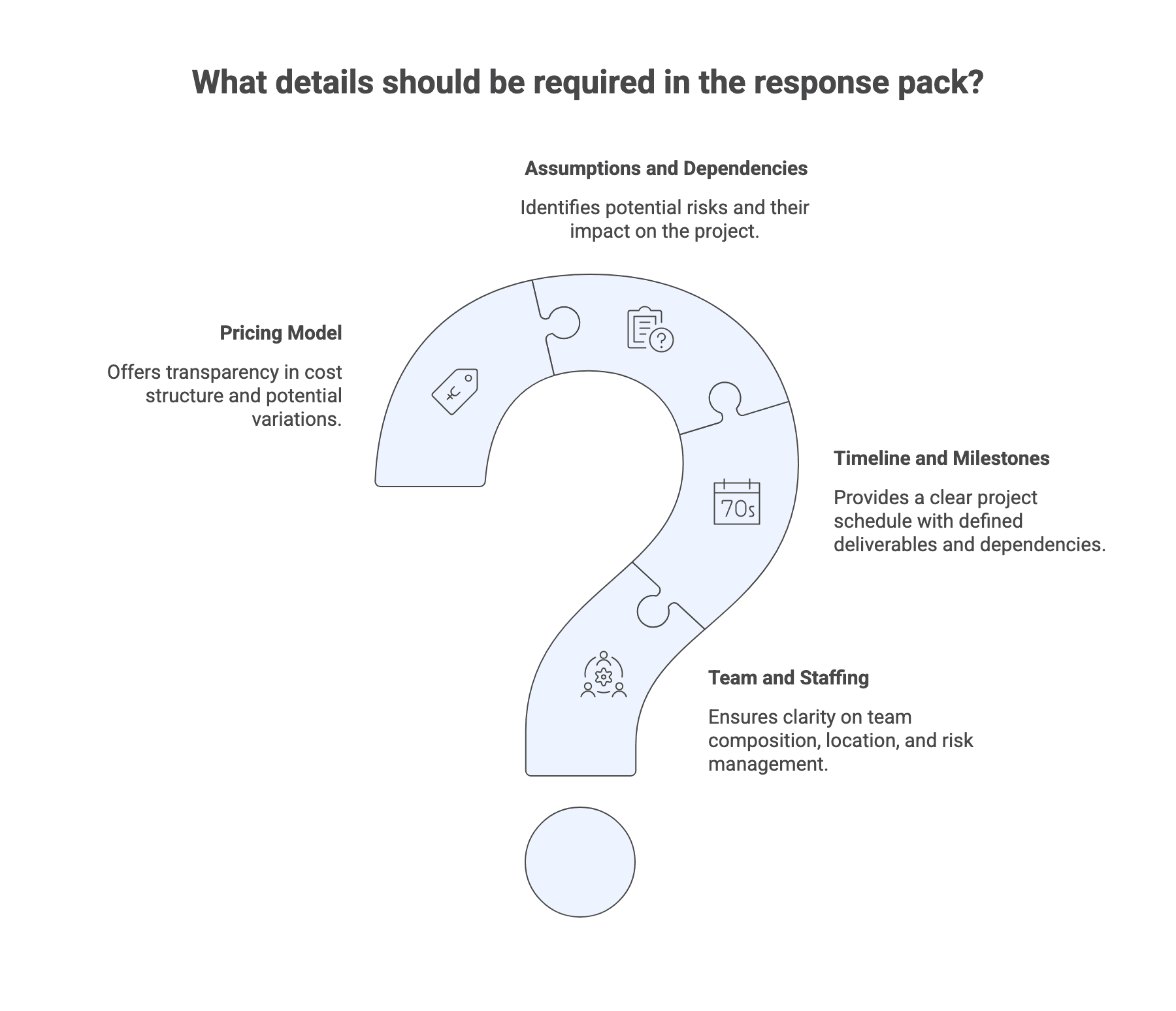
Use a custom software development RFP by first aligning internally on the problem, measurable objectives, scope boundaries, constraints, stakeholders, budget posture, and decision timeline. Assign one owner for deadlines and vendor communication, then define section owners for business, technical, security, legal, and commercial content. Structure the RFP so every vendor answers the same questions on functional and non-functional requirements, integrations, delivery governance, team structure, security, pricing, legal expectations, evaluation criteria, and deadlines. Require a standardized response pack covering staffing, milestones, assumptions, dependencies, and pricing. Give vendors a structured Q&A window, publish consolidated answers to all participants, and evaluate proposals with consistent criteria, proof artifacts, reference checks, finalist reviews, and a controlled finalist refinement round when appropriate.
Introduction
If you are selecting a custom software development partner, the fastest way to improve proposal quality is to stop asking vendors for “a quote” and start asking for comparable answers. A Request for Proposal (RFP) does that by turning your business need into a structured set of questions, formats, and proof requests that multiple vendors can respond to consistently.
This page gives you a copy and paste RFP template for custom software development plus a vendor response structure, so you can evaluate proposals with less guesswork and fewer clarification cycles. For the broader process around shortlisting, evaluation, and governance, use the buyer’s guide to choose the right custom software development partner.
What the RFP template is and who it’s for
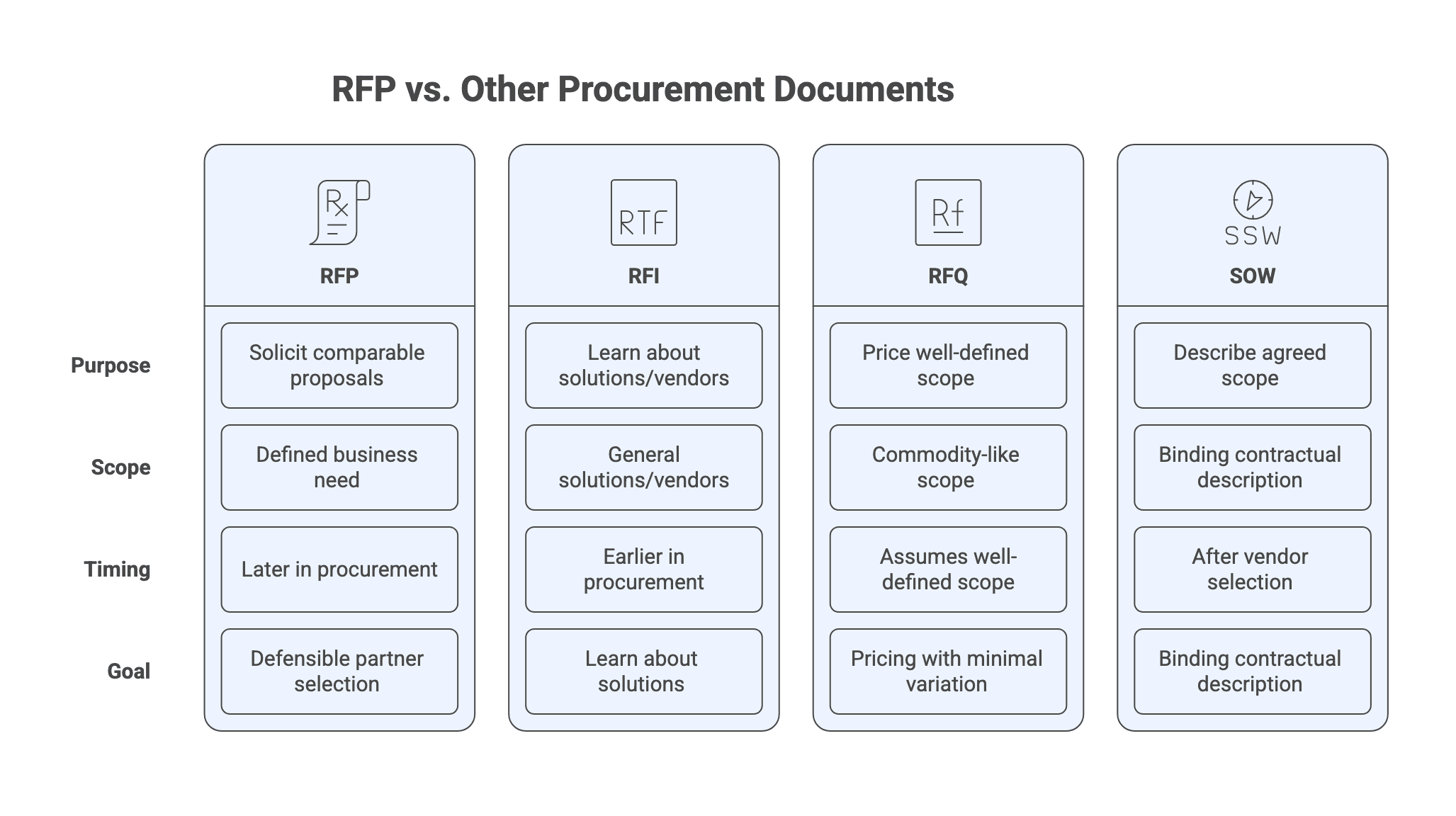
A Request for Proposal (RFP) is a structured document used to solicit comparable proposals from multiple vendors for a defined business need.
It is different from:
A Request for Information (RFI), which is typically shorter and used earlier to learn what solutions or vendors exist.
A Request for Quotation (RFQ), which assumes a well-defined, commodity-like scope that can be priced with minimal variation.
A Statement of Work (SOW), which is usually a binding contractual description of scope, deliverables, and responsibilities agreed with the selected vendor.
The goal of a custom software development RFP is a defensible partner and approach selection.
This template is a fit when at least one of these is true:
The project is complex or strategic, like a new customer platform, modernization of a core system, or a multi system integration effort.
Spend is material, risk is high, or the solution will be business critical for years.
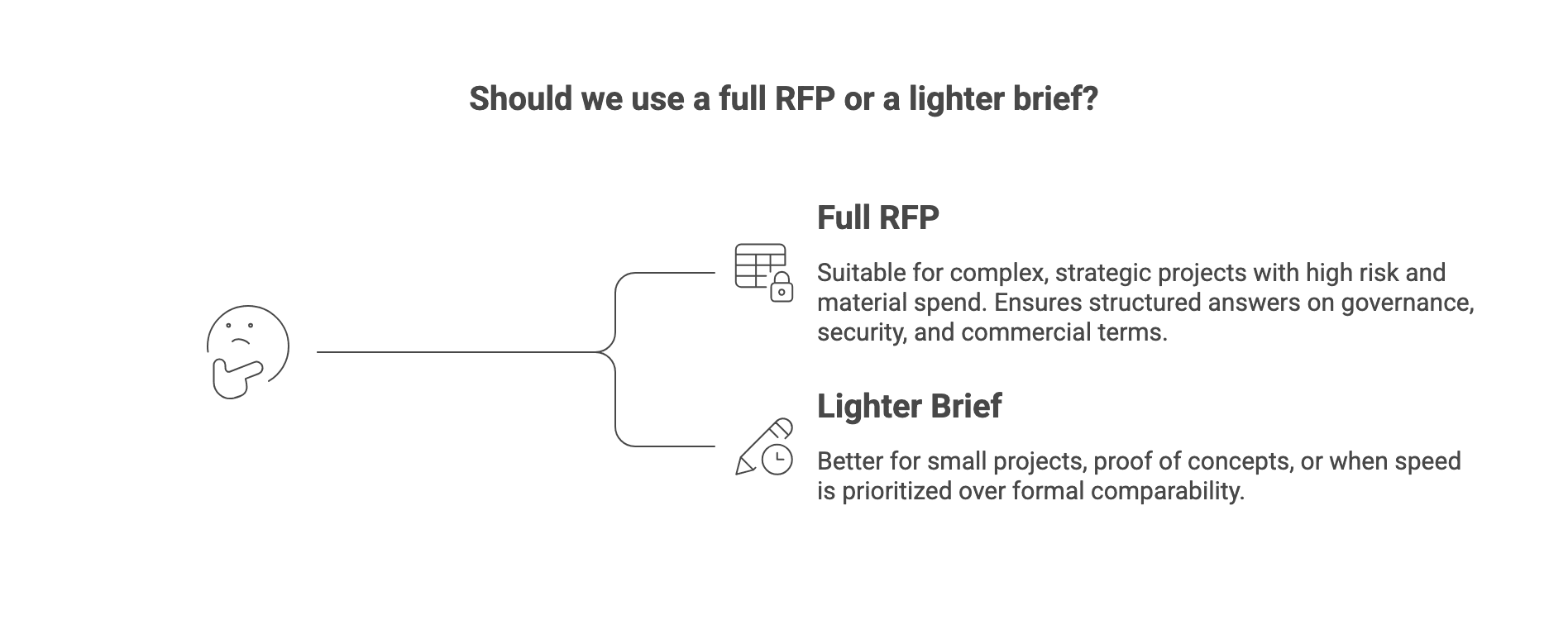
You need structured answers on delivery governance, security expectations, and commercial terms.
You want to compare options side by side, like build vs buy or onshore vs offshore.
A lighter artifact is usually better when:
You are validating a narrow proof of concept, or doing a short discovery engagement before committing to a full build.
Spend is modest, the software is non critical, or you already have a near preferred vendor.
Speed matters more than formal comparability, such as a small internal tool with low data sensitivity.
Typical stakeholders for a US focused software services RFP:
Product and business owners: goals, user journeys, success metrics, roadmap.
Engineering or IT: technical constraints, integrations, architecture principles, operational expectations.
Security and compliance: data classification, control expectations, evidence thresholds.
Procurement or sourcing: process, fairness, competitive bidding requirements.
Legal: IP, data protection, warranties, liability, and other contract topics to address later.
Finance: budget posture, total cost of ownership, funding constraints.
Common failure patterns when teams skip an RFP or run a weak one include choosing based on presentations, discovering late that a vendor cannot meet security needs, under scoping integrations and non functional requirements, and lacking a documented evaluation framework.
Next step: Decide whether you need a full RFP or a lighter brief by checking spend, risk, and how many vendors you truly want to compare.
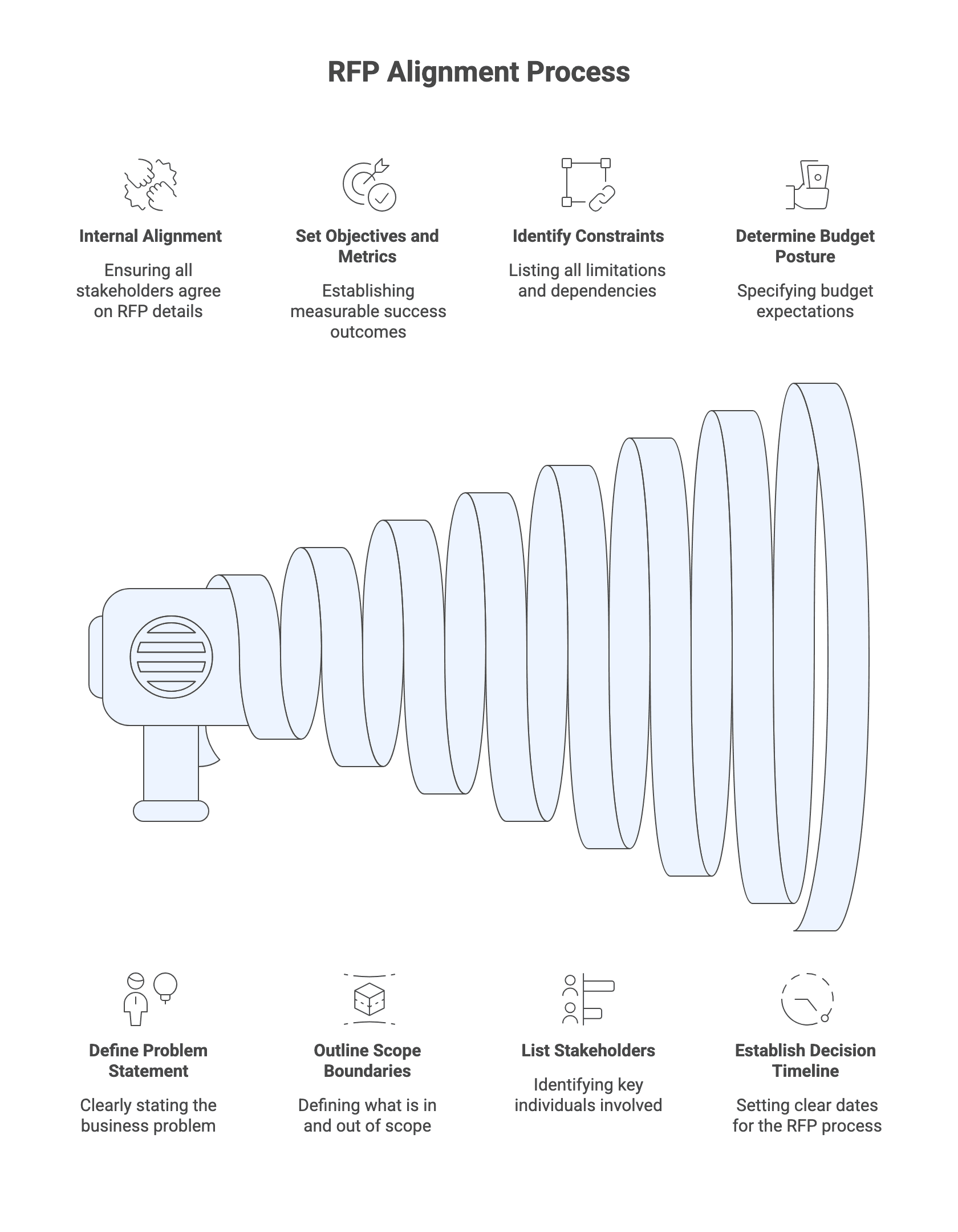
Before you copy/paste: align internally on the minimum inputs
An RFP only produces priceable, comparable responses if you provide enough context and constraints. If you skip internal alignment, you will get proposals that are full of assumptions and impossible to compare.
Minimum inputs to align before you send anything:
Problem statement: What business problem or opportunity are you addressing, in plain language.
Objectives and success metrics: Three to five measurable outcomes, framed as ranges when uncertain.
Scope boundaries: What is in scope vs out of scope for this RFP, plus the biggest assumptions.
Constraints: Stack constraints, integration dependencies, data classification, compliance expectations, data residency needs.
Stakeholders and approvers: Sponsor, product owner, technical lead, security contact, procurement lead, legal reviewer, final decision group.
Budget posture: A range, a ceiling with trade offs, or “vendor propose options” with minimum vs recommended scope.
Decision timeline: RFP dates, Q&A window, proposal deadline, evaluation window, finalist activities, and whether you plan a BAFO process.
A practical way to force alignment is a one page internal brief. Keep it simple:
Problem and why now
Target users and key workflows
Outcomes and success metrics
In scope, out of scope, assumptions
Constraints and integrations
Data sensitivity and security baseline
Budget posture
Decision timeline and who approves
Two details that most improve proposal comparability:
Testable scope boundaries: “Integrate with X API and deliver production ready environment” is testable. “Modernize our platform” is not.
Standardized timeline and Q&A: Vendors price risk partly based on how clear and fair your process is. If your timeline is vague, proposals will be heavily qualified.
Next step: Create the one page internal brief and confirm engineering and product can support vendor Q&A during the response window.
The custom software development RFP template
How to use it (when + who owns it)
In many US organizations, procurement or sourcing owns the process while product and engineering own the technical content. The most reliable pattern is to assign section owners and make one person accountable for deadlines and vendor communications.
Recommended ownership model:
RFP owner: procurement lead or senior product or IT leader who owns timeline and vendor communication
Business context owner: product or business sponsor
Technical owner: engineering or IT lead
Security owner: security lead
Legal owner: in house counsel or contracts lead
Commercial owner: procurement plus finance input
A realistic workflow for software services RFPs:
Internal alignment and draft
Stakeholder review and approvals
Issue to a shortlist of vendors
Structured Q&A window
Proposal review and first pass scoring
Shortlist finalists
Finalist presentations and technical deep dives
Reference checks
BAFO for two to four finalists when appropriate
Selection and contracting handoff
A baseline response window often cited for complex scopes is about 15 to 20 business days. Shorter windows tend to produce generic proposals or reduce participation.
To keep fairness and comparability in vendor Q&A:
Publish a single point of contact for questions.
Set a firm question deadline.
Publish consolidated, anonymized answers to all invited vendors.
Avoid one off clarifications shared with only one vendor.
To reduce “proposal theater” and get evidence based responses:
Ask for artifacts: sample project plan, architecture example, governance templates.
Ask vendors to tie answers to relevant past projects and outcomes when possible.
Require “yes or no plus explanation” for critical requirements.
Next step: Assign section owners and publish the Q&A rules and response format before you send the RFP.
Custom software development RFP template breakdown (US-focused)
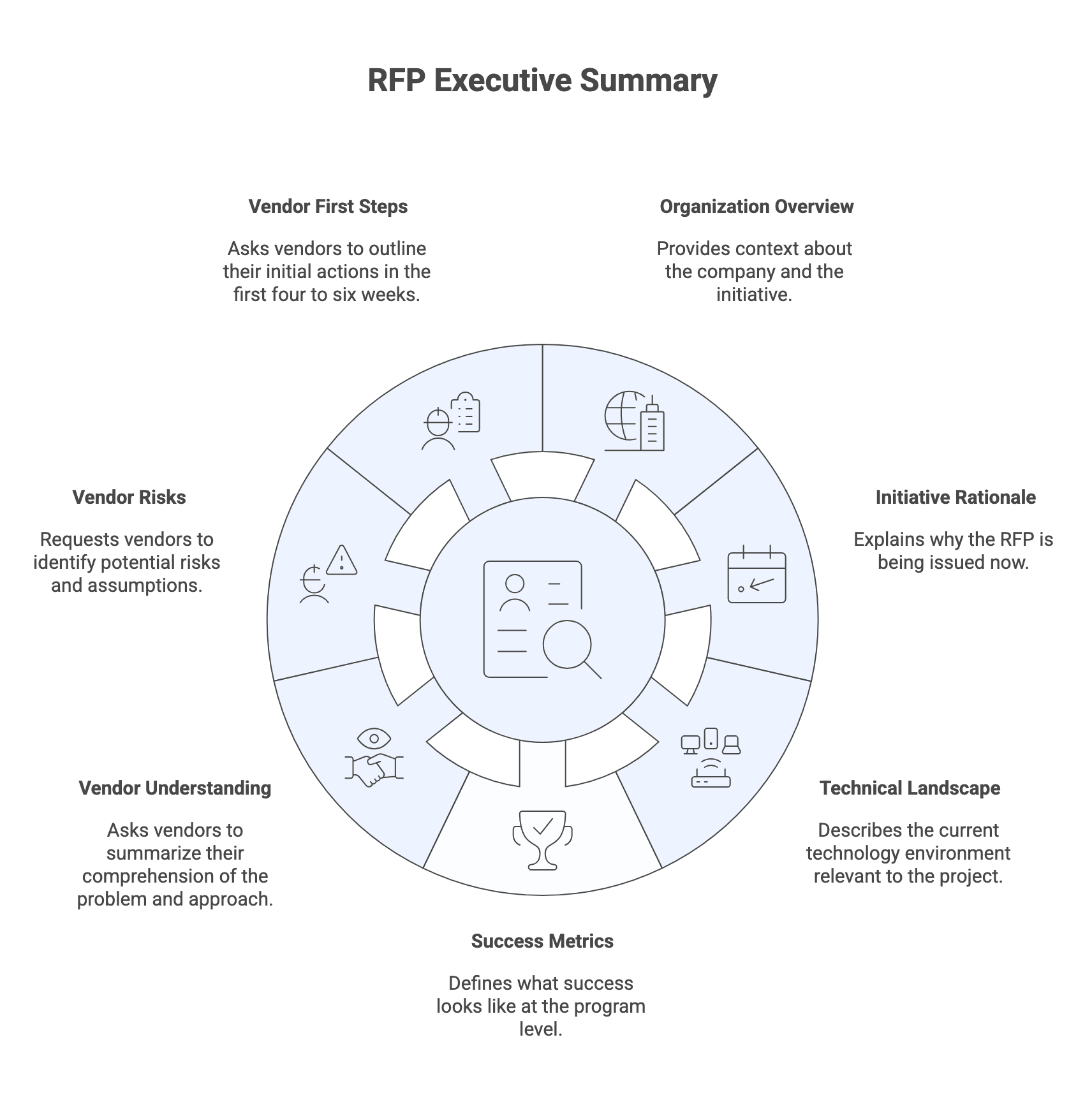
1) Executive summary and background
Include:
Organization overview and business context for the initiative
Why you are issuing this RFP now
High level description of current technical landscape that matters to this scope
What success looks like at the program level
Ask vendors to provide:
A short summary of understanding of the problem and the approach they recommend
Key risks and assumptions they see upfront
What they would do in the first four to six weeks
2) Project scope and objectives
Include:
Problem statement in business terms
Target users and key workflows
Objectives with indicative success metrics
In scope list
Out of scope list
Assumptions and dependencies you already know
Ask vendors to provide:
Confirmation of scope understanding and any clarifying assumptions
Risks created by unclear scope areas and how they would reduce them
Options if you want “minimum viable” vs “recommended” scope
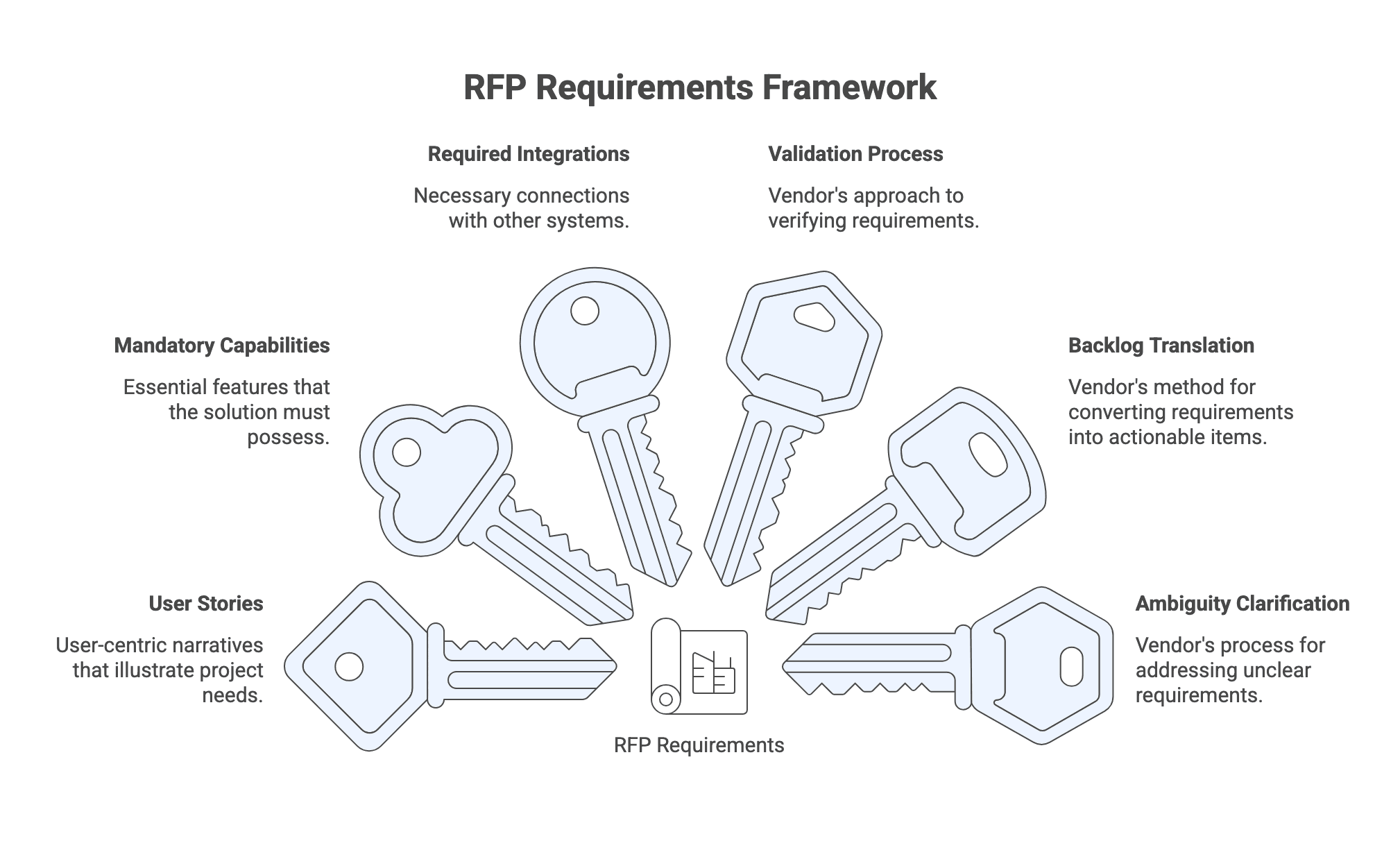
3) Functional requirements
Include:
User stories or use cases grouped by workflow or persona
Mandatory capabilities called out explicitly
Any required integrations from the user perspective
Ask vendors to provide:
How they would validate requirements during discovery
How they translate requirements into backlog items and acceptance criteria
Any requirements they believe are ambiguous or non priceable and what they need to clarify
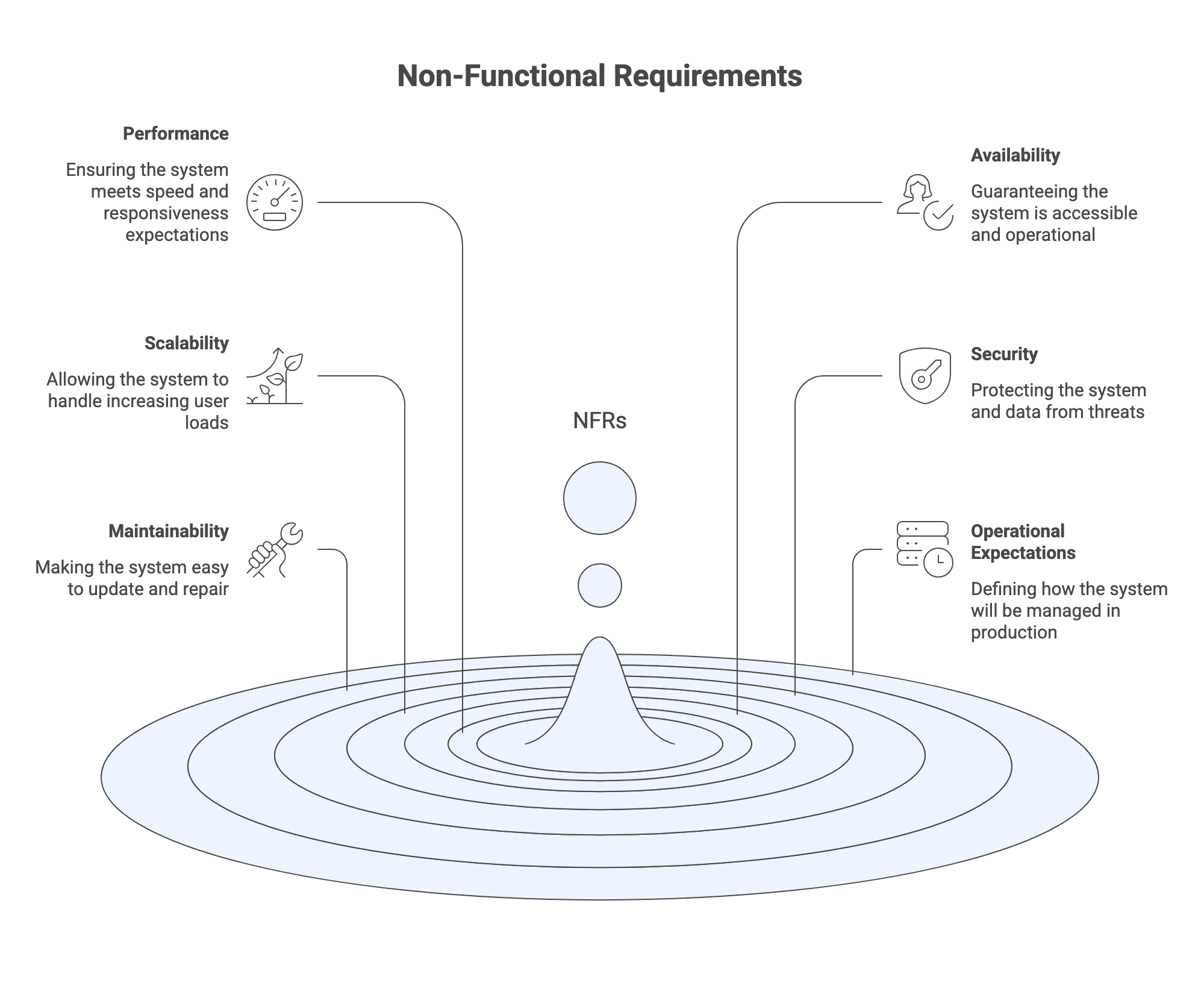
4) Non-functional requirements (NFRs)
Define non-functional requirements (NFRs) as performance, availability, scalability, security, maintainability, and operational expectations that shape delivery and cost.
Include:
Performance expectations as ranges when uncertain
Availability expectations and whether 24 by 7 support is required
Expected user volumes and data growth assumptions
Operational requirements: logging, monitoring, deployment practices, incident response expectations for production
Ask vendors to provide:
How they test and validate NFRs
What they would instrument and monitor in production
The biggest cost and timeline drivers tied to NFRs
5) Technical environment and integrations
Include:
Current stack and platforms in scope
Required integrations, identity provider, CRM, ERP, data sources, and any constraints
Expectations for where the solution runs and who owns cloud operations
Any standards you follow internally
Ask vendors to provide:
Proposed architecture approach that fits your environment
Integration approach and major risks
How they handle environment setup, CI or CD, and release management
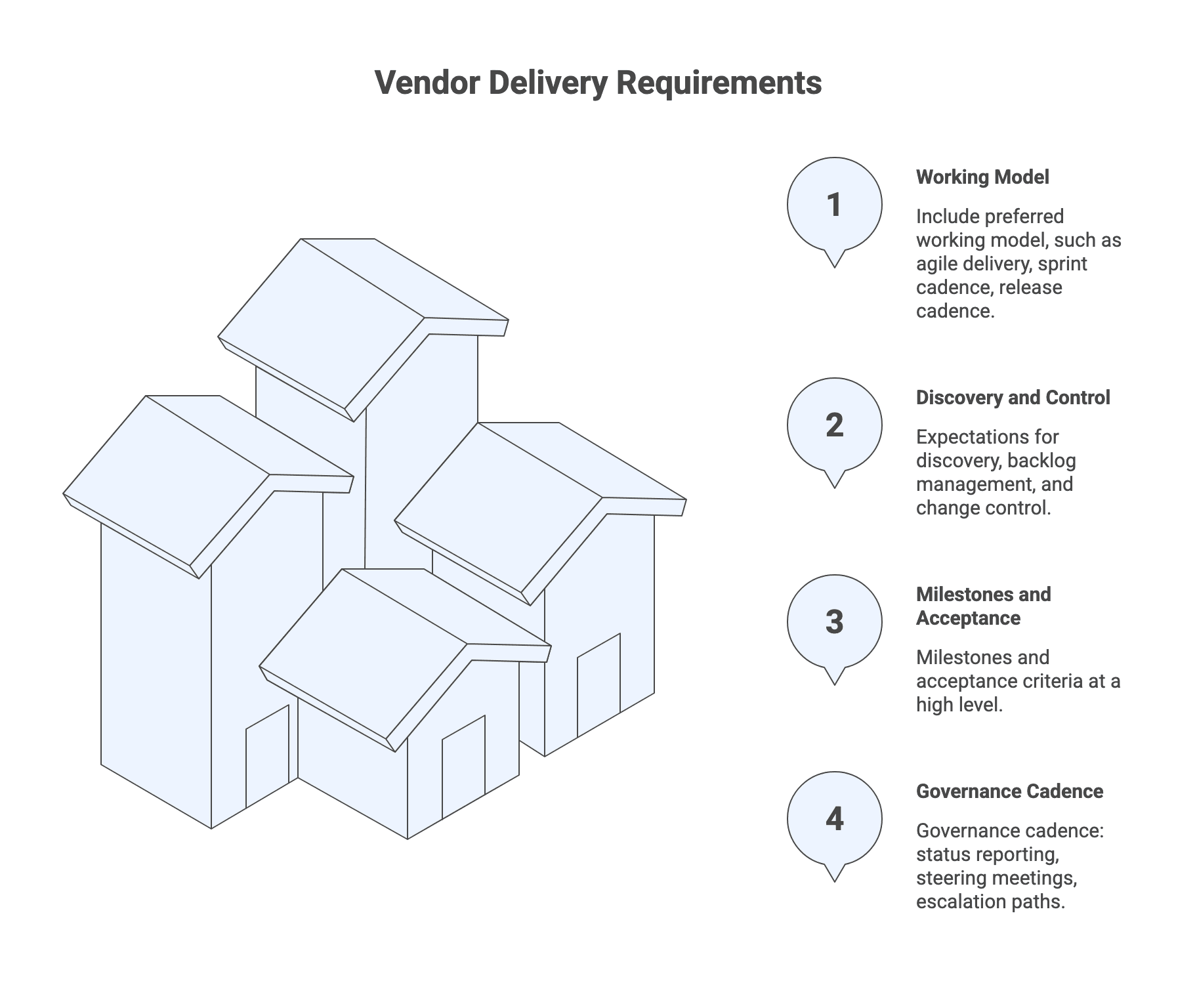
6) Delivery approach and governance
Include:
Preferred working model, such as agile delivery, sprint cadence, release cadence
Expectations for discovery, backlog management, and change control
Milestones and acceptance criteria at a high level
Governance cadence: status reporting, steering meetings, escalation paths
Ask vendors to provide:
A sample delivery plan with phases, milestones, and acceptance criteria
Their change control approach and how they handle scope shifts
How they report progress and manage risks
7) Team structure and experience
Include:
Roles you expect: tech lead, product or delivery lead, engineers, QA, UX if needed
Expectations on allocation and availability for key roles
Expectations for continuity and knowledge transfer
Ask vendors to provide:
Proposed team structure with allocation by role
Bios or CV summaries for key roles
Onshore, offshore, or hybrid mix and how they manage time zones
Subcontractor disclosure and how they manage key person risk and substitutions
8) Security, privacy, and compliance
Keep this section practical. You want enough up front to screen vendors and avoid late stage surprises, without turning the RFP into a full security audit.
Include:
Data classification and sensitivity
Any control expectations aligned to frameworks you use, for example SOC 2 oriented controls or NIST SP 800 53 inspired control families
High level expectations for access control, logging, incident response, secure development, and data handling
Ask vendors to provide:
Security program overview and how they manage security in delivery
Incident response outline and ownership
High level summary of external assessments when applicable
Any limits or exceptions they want you to know early
9) Pricing and commercial model
Your goal is pricing that is comparable, transparent about assumptions, and tied to scope and risk.
Include:
Whether you will accept fixed price, time and materials (T&M), or hybrid models
Whether you want vendors to propose options, such as a minimum viable phase and a recommended phase
Ask vendors to provide:
For T&M: rate card by role, estimated hours by phase, and assumptions
For fixed price: pricing by phase or deliverable, plus assumptions and exclusions
A clear list of what is not included and what would trigger change control
Any optional items priced separately
10) Legal and contractual expectations
This section flags topics that will be handled in contracts later. It is not contract language.
Include:
What you expect to use: Master Services Agreement (MSA), Statement of
Work (SOW), and Service Level Agreement (SLA) where applicable
High level expectations on IP ownership, open source policy, warranties, and indemnification
Whether you require a Non-Disclosure Agreement (NDA) pre award
Ask vendors to provide:
Any standard positions that diverge from common market expectations
Confirmation they can support your general approach to IP ownership of custom deliverables
Subcontractor policies and disclosure expectations
11) Evaluation criteria and process
Vendors respond better when they know what you will value.
Include:
Evaluation categories: technical fit, delivery approach, security posture, commercial value, team and references
Relative importance or weighting ranges, especially for complex builds where approach and technical fit may matter more than price
High level timeline for evaluation and finalist steps
Whether you plan a BAFO round
Ask vendors to provide:
Evidence tied to each category
References for similar scope projects
12) Proposal instructions and deadlines
This is where you force comparability and reduce rework.
Include:
Submission format, maximum length guidance, and required structure
Deadline for questions and proposal submission
Required acknowledgements and compliance statements
Disqualification criteria, such as late submission or missing required sections
Ask vendors to provide:
A completed response format pack, using your required fields
A list of assumptions, exclusions, and dependencies in the required format
Next step: Copy the template into your document, delete sections you do not need, and add “what good looks like” prompts to every section you keep.
This RFP is designed to generate the inputs a vendor evaluation scorecard needs: structured responses on requirements, delivery approach, pricing assumptions, security posture, and proof artifacts
Need an RFP Template?
Download this ready-to-fill Request for Proposal (RFP) template to get comparable vendor answers, improve proposal quality, and confidently select the right custom software development partner, with fewer clarification cycles.
Optional: response format to force comparability
Standardizing response format is one of the most effective ways to compare vendors objectively. You can still allow creative proposals, but you want a baseline response that is structured.
Below is a simple “response pack” you can include in your RFP. Vendors can answer in your document or attach a separate response following the same structure.
Employment status, employee vs contractor vs subcontractor
Key person risk plan and substitution approach
Timeline and milestones
Phases and key activities
Deliverables by phase
Indicative start and end windows
Dependencies on your team or third parties
Acceptance criteria or “definition of done” at milestone level
Assumptions and dependencies
Assumption
Impact if false
Who owns mitigation
Whether it affects cost, timeline, or scope
Pricing model
Model type: T&M, fixed price, hybrid
Rate card by role for T&M
Fixed fee breakdown by phase or deliverable for fixed price
Optional items priced separately
One time vs recurring costs if applicable
To preserve optionality without destroying comparability:
Require a baseline response that meets your stated scope.
Allow a separate “options” section where vendors propose improvements or alternative phasing.
Require options to be clearly labeled as deviations from baseline.
Next step: Attach the response pack and state that proposals that do not follow the structure may be treated as non compliant.
Common mistakes and how to fix them
Most low signal RFPs fail for predictable reasons. Fixing them before you issue the RFP saves weeks later.
Mistake: Scope is too broad or multi year without phases Why it hurts: vendors cannot price, so they add heavy assumptions and risk premiums. Fix: run the RFP for a concrete near term phase, such as discovery plus an initial release, and ask for a high level view of later stages.
Mistake: Missing non-functional requirements (NFRs) Why it hurts: you get feature heavy proposals that ignore performance, availability, and operational realities. Fix: add NFR ranges and operational expectations, then ask vendors how they test and validate them.
Mistake: Unclear decision process and what matters most Why it hurts: vendors fill proposals with generic content to hedge. Fix: publish evaluation categories and relative weighting guidance.
Mistake: Unrealistic timelines Why it hurts: vendors respond with generic material or under estimate, leading to disputes later. Fix: allow a realistic response window for complex scopes, and ensure internal stakeholders can support Q&A.
Mistake: Security and legal omissions Why it hurts: you discover late that a vendor cannot meet data handling expectations or has non negotiable contract positions. Fix: include baseline security asks and high level legal expectations, plus requests for early disclosure of exceptions.
A fast internal quality check is an “ambiguity audit”:
Have an engineer or PM who did not draft the RFP read it as if they were a vendor.
Highlight any requirement that is not testable or is open to interpretation.
Rewrite vague statements into concrete, reviewable asks.
Next step: Run the ambiguity audit and revise before you send the RFP to any vendor.
What to evaluate (criteria + trade-offs)
Your evaluation criteria should predict delivery success, instead of just selecting the lowest price. Most effective evaluation models group criteria into technical fit, delivery approach, security posture, vendor experience and references, and commercial value.
Core evaluation criteria to consider:
Technical fit and solution approach: alignment with your stack, integrations, and NFRs.
Key trade-offs to make explicit in your scoring discussion:
Fixed price vs T&M: fixed price can improve budget predictability but requires stable scope and often includes risk premium. T&M improves flexibility but requires stronger governance to control cost.
Onshore vs offshore or hybrid: onshore can reduce coordination friction but costs more. offshore can reduce upfront cost but may require more structure to manage time zones, quality, and legal considerations. Total cost of ownership depends on complexity and process maturity.
Dedicated team vs project staffing: dedicated teams improve continuity but can be less flexible on utilization. project staffing can be cost effective for narrow scopes but increases ramp up and turnover risk.
Build vs buy constraints: when commercial options exist, custom build may still win for unique workflows, tight integrations, or differentiation, but you must account for maintenance and ownership.
Common disqualifiers you can state up front:
Failure to meet mandatory security requirements
Inability to provide relevant references
Very low pricing combined with vague delivery detail, suggesting under estimation or change order risk
Proposals that ignore your required format and leave critical sections incomplete
Next step: Define five to ten must pass criteria, publish them in the RFP, and map them to your evaluation rubric.
Practical verification steps (what to request/check)
An RFP is the start of verification. Use artifacts and structured activities to validate how a vendor really works.
Artifacts to request as part of a proposal “proof pack”:
Sample project plan and roadmap from a similar engagement, redacted as needed
Discovery and backlog management templates, including how acceptance criteria are written
Architecture diagram or design excerpt for a comparable system, redacted as needed
Governance examples: status report format, risk log, decision log
Security program overview and incident response outline at a high level
Open source policy summary and how they handle third party components
How to run reference checks that produce signal:
Request two to three references for similar scope and complexity.
Use a consistent script across vendors:
Delivery quality and predictability
Communication and issue handling
Change control and how scope shifts were managed
Team stability and turnover
Documentation and handover quality
What the client would do differently next time
How to validate team reality and reduce surprises:
Ask whether key roles are employees, contractors, or subcontractors.
Ask for allocation commitments for key roles.
Ask how substitutions are handled and how knowledge is retained.
Security evidence requests that are usually reasonable early:
Security program overview and governance ownership
Incident response process outline
High level summary of external assessments when relevant to your risk profile
Confirmation of alignment to control families you care about, such as access control, logging, and incident response categories
Next step: Decide your proof pack requirements and reference check script before you issue the RFP, then apply them consistently to every vendor.
Conclusion: next steps after you issue the RFP
Once the RFP is out, the win is disciplined execution. A practical post RFP flow:
Manage Q&A: consolidate questions, anonymize, publish answers to all vendors.
Validate proposals: check completeness and basic compliance with instructions.
First pass scoring: evaluators score independently, then consolidate and discuss.
Shortlist: select a manageable set of finalists, often two to four.
Finalist activities: structured presentations, technical deep dives, and reference checks.
BAFO when appropriate: ask finalists to refine pricing, timeline, or assumptions in a controlled, consistent way.
Handoff to contracting: align the SOW and MSA to the selected proposal, then complete security and legal review before signing.
If proposals are not comparable:
Run a clarification round to normalize assumptions.
Ask vendors to resubmit specific sections using a tighter response format.
Re scope into a smaller phase, such as discovery or a pilot, if the initial scope was too broad to price.


 Add as preferred on Google