

 Add as preferred on Google
Custom Software Development Vendor Shortlisting Framework: From 30 Vendors → 5 → 1Read More

Create the vendor evaluation scorecard before the next sales call by agreeing on criteria, category weights, scoring anchors, disqualifiers, evidence requests, and one evaluation owner. Score each shortlisted custom software development vendor from 1 to 5 across delivery and governance, architecture fit, quality and reliability, security readiness, team continuity, and commercial or contract realities. Have evaluators score independently after each touchpoint, record confidence levels and evidence, then reconcile the largest differences. Use weighted totals with narrative strengths, risks, and an advance, hold, or drop recommendation. Carry unresolved risks into the Statement of Work, Master Services Agreement, staffing protections, security validation, change control, and ongoing governance.
If you are selecting a custom software development vendor, the hardest part is rarely finding options. It is comparing them consistently across delivery, technical fit, and risk, with enough evidence to defend the decision later.
This guide gives you a practical vendor evaluation scorecard template you can copy into a spreadsheet, plus a straightforward way to use it with a shortlist so your buying committee can agree on a finalist without relying on gut feel, the slickest demo, or the lowest day rate.
This vendor choice has long tail consequences. The wrong fit can mean months of scope churn, missed windows, painful rewrites, and multi year spend that becomes hard to unwind. The risk is governance, continuity, and the realities of how the vendor plans, reports, tests, and escalates when delivery gets messy.
A scorecard prevents the most common failure mode in vendor selection: evaluating vendors tactically and inconsistently. Without a shared rubric, teams tend to optimize for what is easiest to compare early, like day rates or a confident presentation. Meanwhile, the factors that predict outcomes, like delivery maturity, quality discipline, security posture, and team continuity, get evaluated too late, when leverage is lower and switching costs are higher.
A good scorecard also reduces committee bias. When product, engineering, security, and procurement bring different priorities, it is easy to end up “horse trading” across opinions instead of aligning on evidence. A shared rating scale, documented rationale, and agreed weights help keep the decision anchored in what matters for your project.
One more benefit is continuity. If you select a vendor based on delivery reliability, defect trends, responsiveness, and governance quality, those same dimensions can later become your recurring KPIs and quarterly review topics. That connection helps you detect drift early and act before performance problems become entrenched.
If you already have two to five vendors in mind, the most useful next step is to lock your criteria, weights, and disqualifiers now, before the next sales call influences what “good” looks like. If you are still building your shortlist, review the top custom software development companies shortlist to identify vendors that meet baseline delivery, technical, and governance standards before applying this scorecard.
This scorecard is a structured evaluation tool for assessing custom software development vendors across criteria that tend to predict real world outcomes. It uses an E-A-V style rubric:
Because software projects also fail on operational realities, the scorecard explicitly calls out quality, security, and team continuity as first class criteria rather than footnotes.
Who it is for:
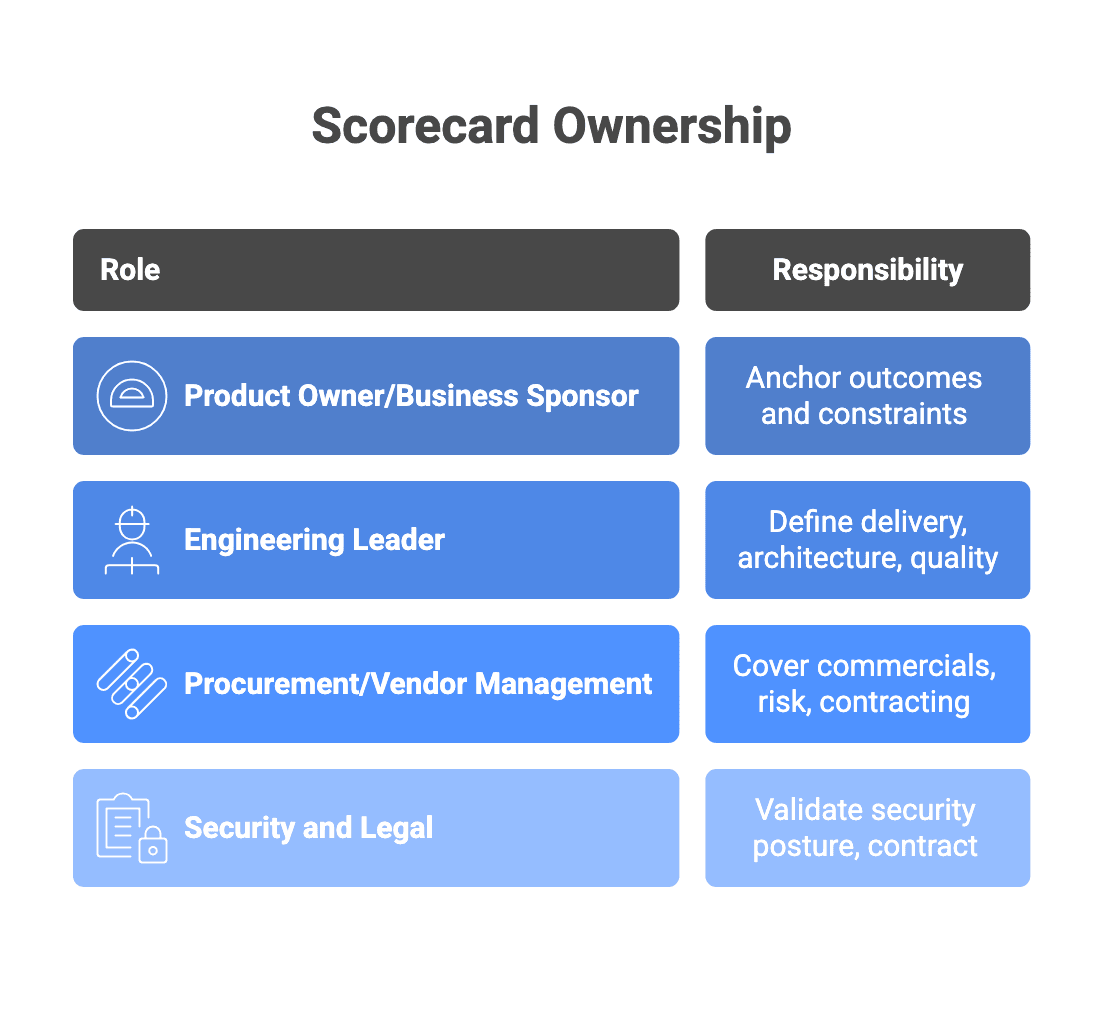
Who should own it:
Pick one evaluation owner. That person manages the template, runs scoring calibration, consolidates inputs, and keeps the process consistent.
Timing matters. Introduce the scorecard early, before an RFP (Request for Proposal) or discovery workshops, so you agree on criteria and weights before you see pitches. If you want the full end to end selection context, start with the the guide to choose a custom software development partner and then return here for the operational rubric.
Before you contact vendors again, assign ownership and run a quick calibration using a sample vendor so everyone applies the scale the same way.
You can implement this template in Google Sheets or Excel in about 15 minutes.
Create these columns in your spreadsheet:
Tip: Keep the rubric stable across vendors. If you change criteria midstream, you will lose comparability.
Use descriptive anchors so evaluators do not invent their own meanings.
For critical criteria, write brief “what a 1, 3, and 5 look like” notes directly in your sheet so scoring stays consistent.
Below is a starter set of rows. It is intentionally compact. Add more only when it improves decision clarity.
Criterion group | Criterion | What good looks like | Evidence to request |
| Delivery execution and governance | Planning and estimation discipline | Clear approach to backlog grooming, sprint planning, and handling uncertainty without hiding it | Sample delivery plan, sprint plan, estimation approach, examples of how scope changes were managed |
| Delivery execution and governance | Progress reporting and transparency | Regular reporting that surfaces risks early, with clear escalation paths and governance forums | Status report template, sample sprint report, risk register, governance cadence and attendees |
| Technical capability and architecture fit | Architecture approach and fit | Can explain trade offs and align architecture to your stack, constraints, and operational capabilities | Anonymized architecture diagram, decision records, integration approach |
| Technical capability and architecture fit | Relevant experience | Demonstrated experience in similar domains or platforms, with evidence beyond marketing | Case studies with comparable scale, reference context, proposed approach for your scenario |
| Quality and reliability | Test strategy | Documented testing approach across unit, integration, and end to end testing, tied to acceptance criteria | Test plan or QA strategy, example test reports, definition of done |
| Quality and reliability | CI/CD discipline | Continuous Integration and Continuous Delivery (CI/CD) pipeline with automated checks to prevent regressions | Pipeline overview, release workflow, rollback strategy, defect triage process |
| Security and compliance readiness | Secure development practices | Security built into discovery and delivery | Secure SDLC description, access control approach, vulnerability management, incident response overview |
| Security and compliance readiness | Data protection and access control | Clear handling of sensitive data, least privilege access, and secrets management | Security questionnaire responses, access control model, data handling practices |
| Team structure and continuity | Proposed team and seniority mix | The staffed team matches complexity, and the vendor can protect continuity | Team bios for proposed delivery team, role definitions, backfill plan |
| Team structure and continuity | Knowledge management | Documentation and knowledge sharing reduce dependency on single individuals | Documentation examples, runbook outline, onboarding plan, ownership model |
| Commercials and contract realities | Pricing model fit | Commercial model matches scope certainty and risk appetite | Pricing structure, assumptions, change control process, rate transparency |
| Commercials and contract realities | IP and exit readiness | Clear IP ownership and a practical handover path to reduce lock in | Contract term summary, IP approach, transition plan, documentation commitments |
Add a summary area that includes:
This template gives you a ready-to-run scorecard (with demo data) to align on criteria, weights, and evidence so your vendor decision holds up before pitches shape the narrative.

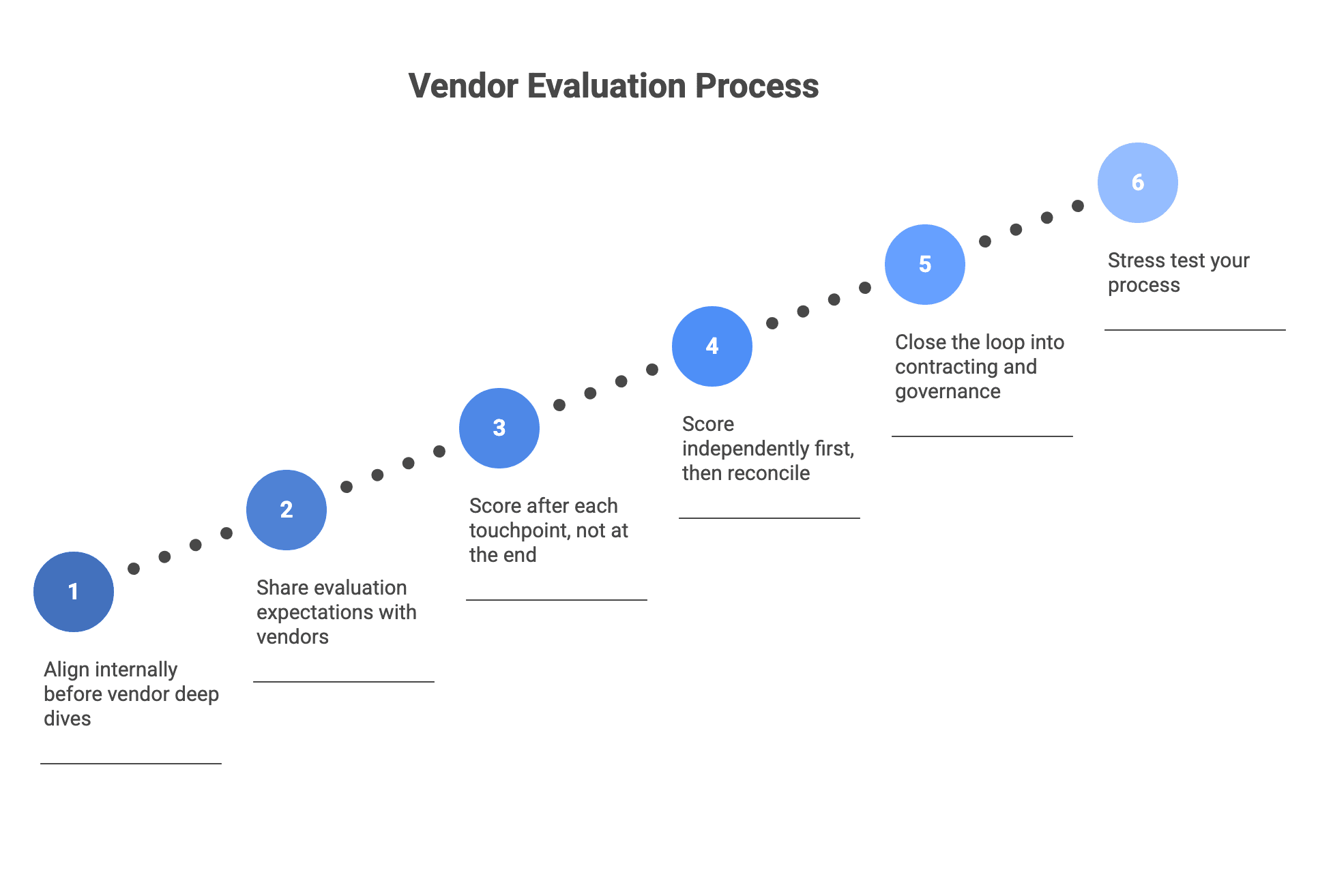
Treat the scorecard as the backbone of the process.
A quick way to stress test your process is to run two vendors in parallel through the same steps and see whether the scorecard makes trade offs clearer or exposes missing criteria.
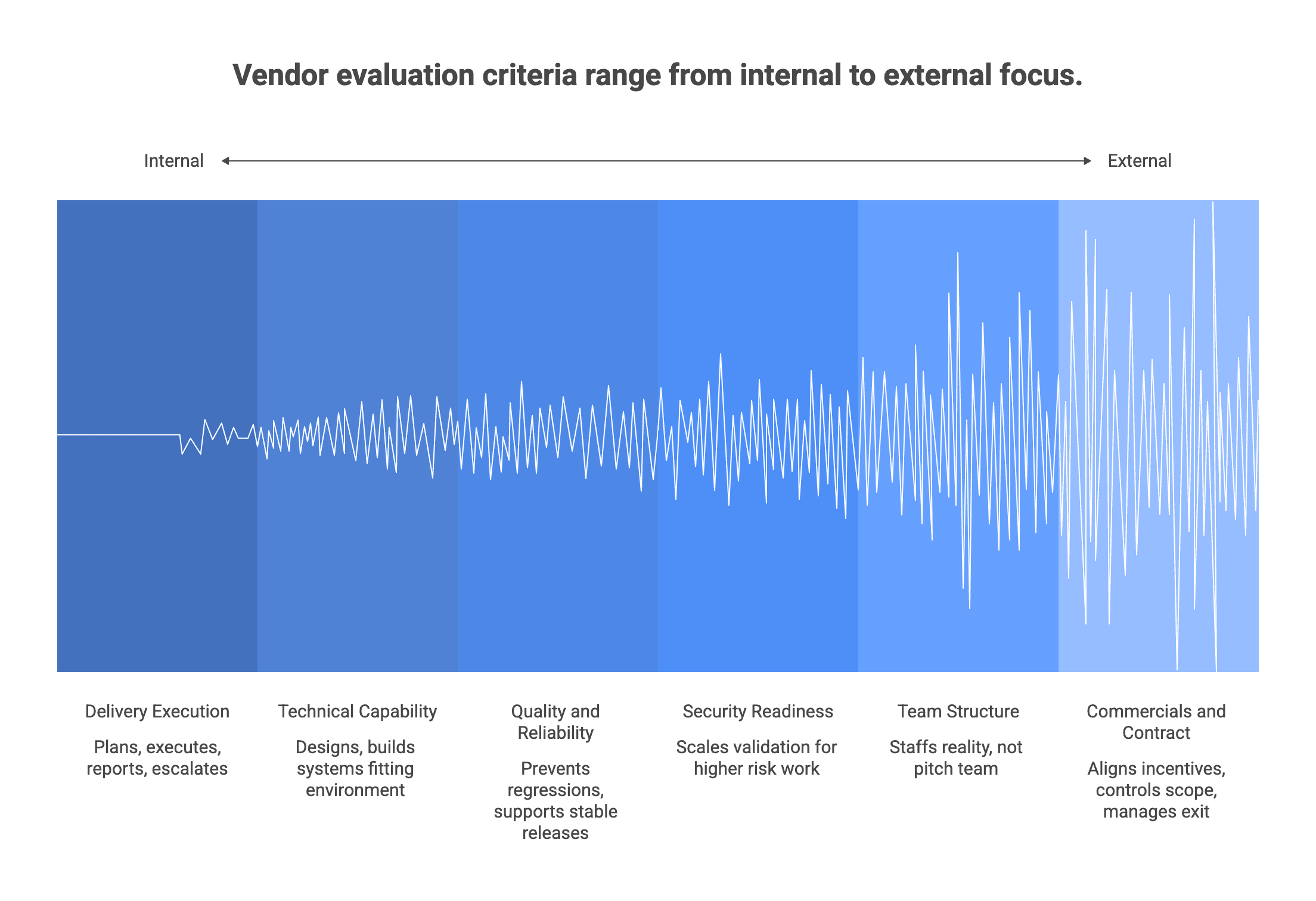
Use these categories as your spine. Keep sub criteria specific, observable, and tied to artifacts.
Delivery execution and governance
You are scoring how the vendor plans, executes, reports, and escalates.
What to look for:
Evidence artifacts:
Technical capability and architecture fit
You are scoring whether the vendor can design and build systems that fit your environment.
What to look for:
Evidence artifacts:
Quality and reliability
You are scoring whether the vendor prevents regressions and supports stable releases.
What to look for:
Evidence artifacts:
Security and compliance readiness (right sized)
You are scoring baseline security maturity and the ability to scale validation for higher risk work.
What to look for:
Evidence artifacts:
Team structure and continuity
You are scoring the reality of staffing.
What to look for:
Evidence artifacts:
Commercials and contract realities
You are scoring incentive alignment, scope control, and exit risk.
What to look for:
Evidence artifacts:
If a criterion cannot be scored with evidence, record a lower confidence level and make it a follow up item rather than guessing.
Weights should reflect your project’s risk profile.
Start by weighting at the category level, then refine within categories. The important rule is to agree on weights before scoring vendors.
Disqualifiers protect you from being seduced by a high total score that hides a critical gap. Common disqualifiers include:
Use confidence levels to capture uncertainty. A vendor might score “4” on security based on documentation, but with medium confidence until security reviews the evidence or you complete deeper validation. Confidence makes it easier to decide what to verify next instead of treating all scores as equally proven.
Keep the math simple: weighted sum by criterion, rolled into category totals, rolled into an overall score. Then add narrative: top risks, mitigations, and the recommended action.
If you need to decide quickly, focus on whether the top two vendors differ on the highest weighted categories. That is where the decision usually lives.
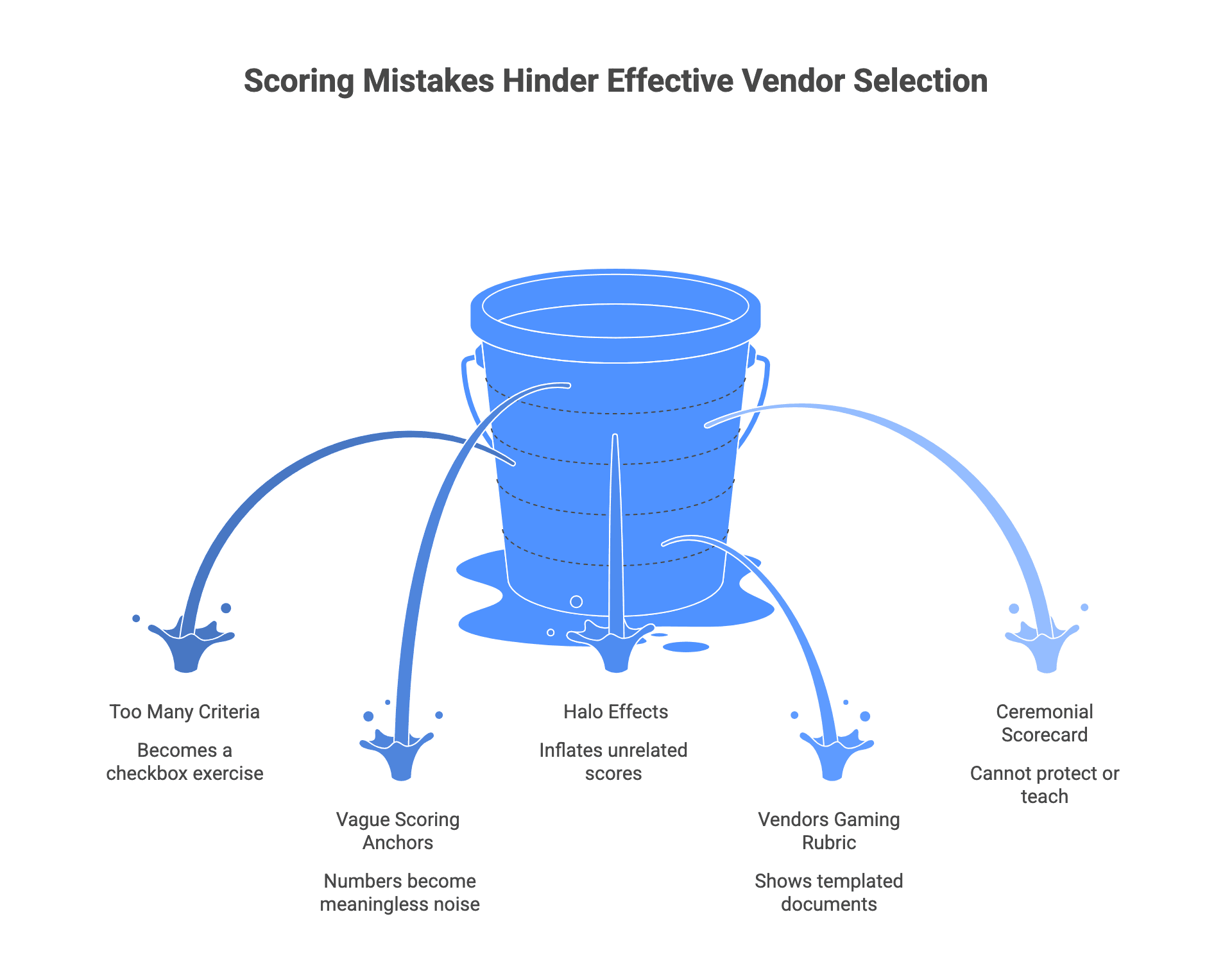
Mistake: Too many criteria
A 200 line scorecard becomes a checkbox exercise. Fix it by pruning to the criteria that truly drive outcomes, and keep specialist checklists separate.
Mistake: Vague scoring anchors
If a “4” means different things to different evaluators, the numbers are noise. Fix it by defining anchors for critical fields and running a quick calibration.
Mistake: Halo effects and brand bias
A polished demo can inflate unrelated scores. Fix it by scoring independently, requiring evidence for high scores, and triangulating with artifacts and references.
Mistake: Vendors gaming the rubric
Vendors may show templated documents or present an A team that will not staff your project. Fix it by meeting the proposed delivery team, requesting live walkthroughs where appropriate, and validating with small exercises.
Mistake: Treating the scorecard as ceremonial
If you fill it out after deciding, it cannot protect you or teach you. Fix it by making scorecard completion a gate before finalist selection and using it to drive contract and governance decisions.
A healthy sign is when the scorecard changes your shortlist order. That usually means it surfaced risks that a pitch would have hidden.
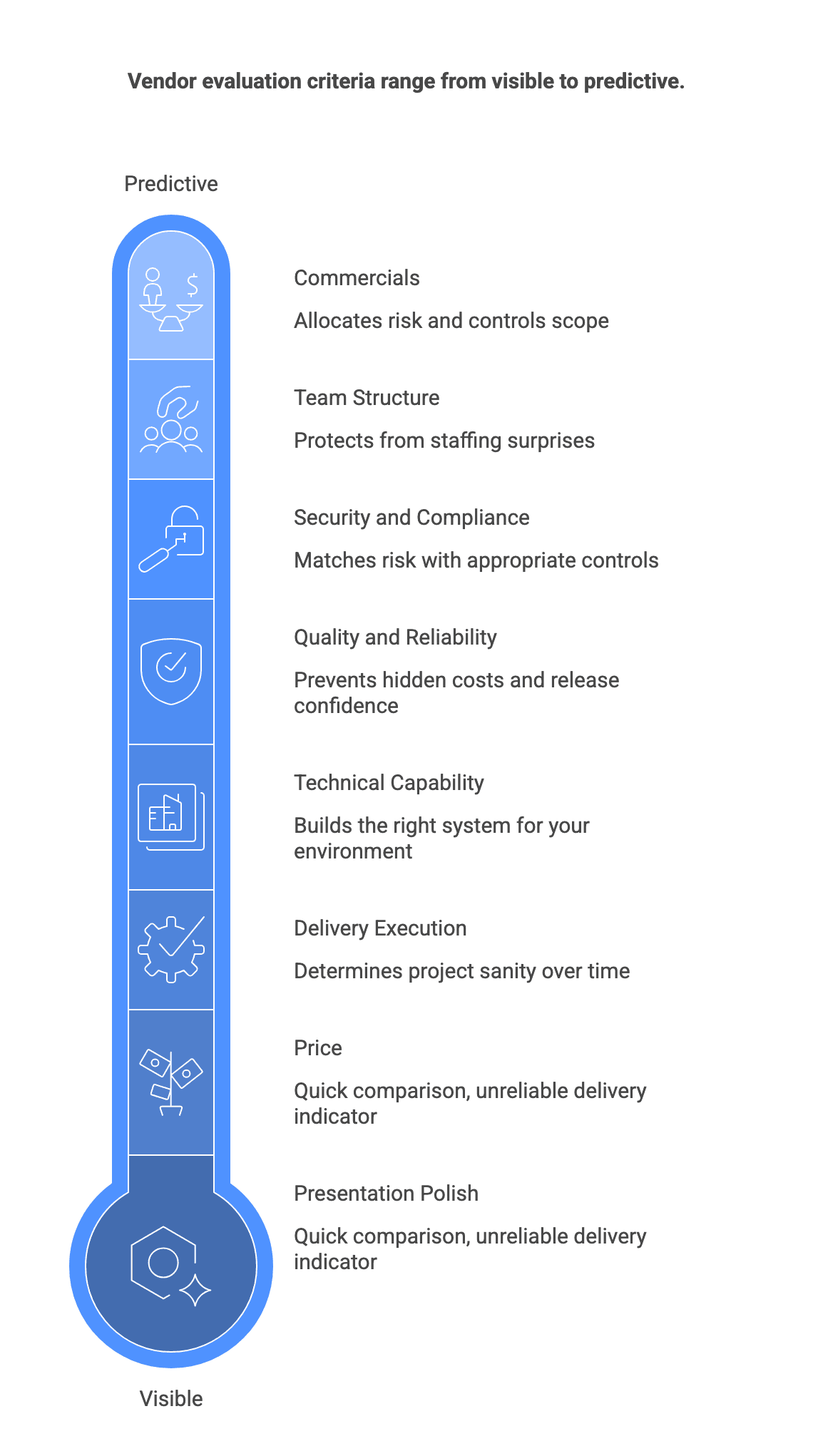
The most predictive criteria are rarely the most visible in early sales conversations. Presentation polish and price can be compared quickly, but they do not reliably indicate delivery success, maintainability, or risk control.
Focus on criteria that reflect:
Expect trade offs. A vendor optimized for speed might accept higher architectural risk. A vendor optimized for reliability might be slower but safer for core systems. Your scorecard makes those trade offs explicit and helps you decide intentionally.
Also separate lagging from leading indicators:
Tailor sub criteria to your project type. Data heavy systems may need more on data architecture. Consumer mobile apps may need explicit UX and performance fields. Keep the spine consistent so you can compare vendors fairly.
If you cannot explain why a criterion predicts success for your project, it probably does not belong in the scorecard.
This category often determines whether a project stays sane over time.
Score the vendor on:
Verification steps:
Red flags:
If governance is weak, your team will end up carrying hidden program management load. Score it accordingly.
Architecture fit is about building the right system for your environment, instead of building a system that looks impressive in a demo.
Score the vendor on:
Verification steps:
Red flags:
If the vendor cannot explain how their design will be operated, supported, and evolved, it is a fit risk even if they can build quickly.
Quality is where hidden costs accumulate. It affects defect rates, release confidence, and how expensive change becomes.
Score the vendor on:
Verification steps:
Red flags:
If you plan to ship regularly, this category should rarely be lightly weighted.
Security evaluation should match the risk of the system. A small internal tool still needs baseline controls. A regulated or data sensitive system needs deeper due diligence.
Score the vendor on:
Verification steps:
Red flags:
Mentions of SOC 2 or ISO 27001 can help you orient, but the score should still be driven by concrete process evidence and how the vendor will work inside your constraints.
This category protects you from staffing surprises.
Score the vendor on:
Verification steps:
Red flags:
If continuity is a risk, negotiate it explicitly and set expectations early.
Commercial structure isn't just price. It is risk allocation, scope control, and your ability to exit if the relationship fails.
Score the vendor on:
Useful terms to align on:
Verification steps:
Red flags:
A vendor that is easy to exit is often a vendor that is safer to start with.
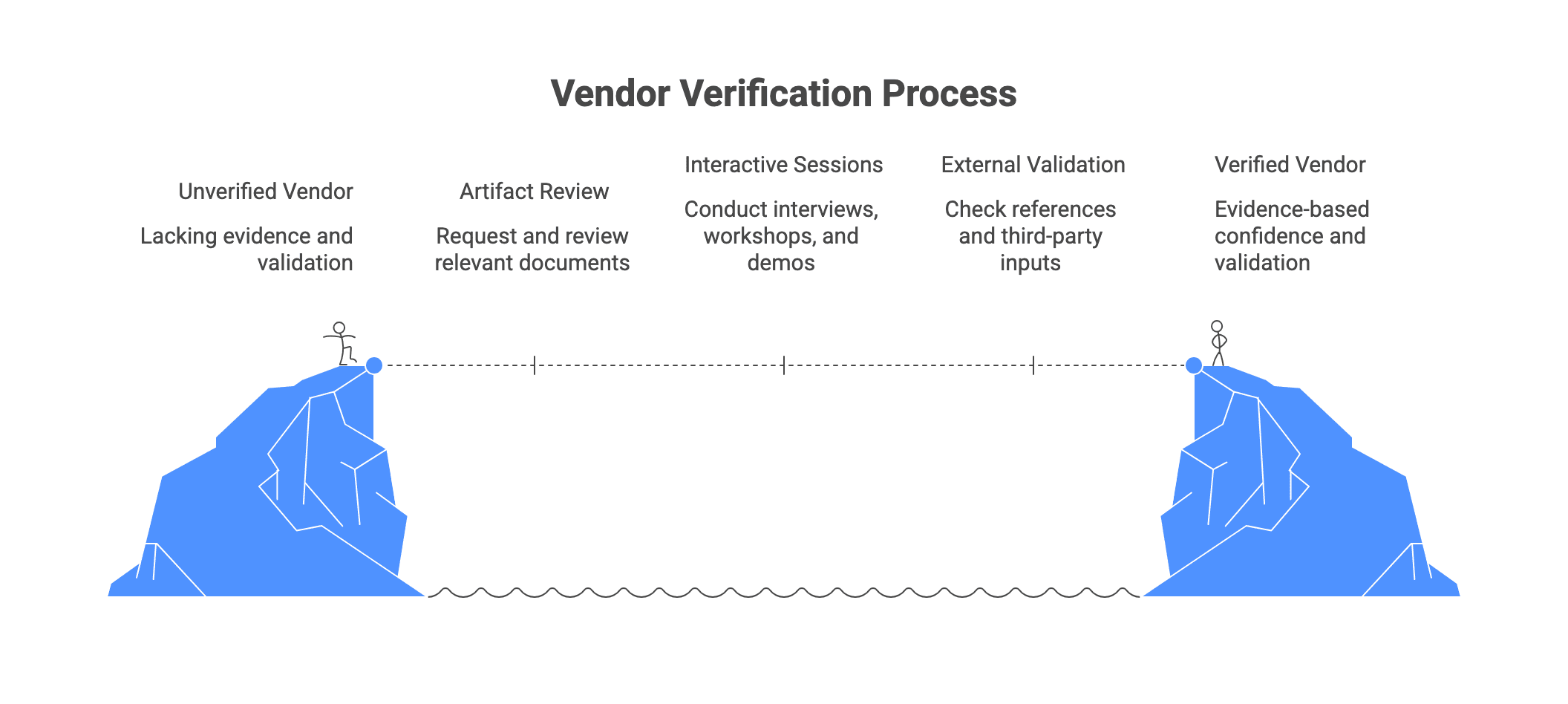
Scores should be grounded in evidence. The most efficient approach is to combine three layers:
Keep verification proportional. Use lighter checks to narrow the field, then invest deeper effort with finalists. For each scorecard category, pick two or three high signal artifacts and one interaction that reveals how the vendor really works.
A simple way to keep the process manageable is to pre define your evidence requests and schedule them in the same order for every vendor. That reduces variability and makes comparisons fair.
Ask for a targeted set of artifacts that map directly to the scorecard. Avoid demanding exhaustive documentation from every vendor up front.
High signal artifacts include:
What “good” looks like is clarity and relevance. Documents should connect to the scenarios you care about and avoid generic boilerplate that says little about real practice.
If a vendor cannot share any tangible artifacts, score confidence low and treat it as a material risk.
Reference checks should not be a formality. Use them as a software development vendor due diligence checklist that probes delivery reality.
A short reference check script:
Interpret feedback in patterns. One negative comment is not always decisive. Repeated themes across references are. Triangulate reference feedback against what you saw in workshops and artifacts, and follow up on discrepancies.
If references consistently describe strong engineering but weak communication, score delivery governance accordingly and decide whether you can mitigate that risk internally.
When the project is high stakes, a small validation exercise can reveal what documents cannot.
Options that work well:
How to make these exercises decision useful:
Avoid misleading pilots. A demo built by a hand picked team that will not be assigned later can create false confidence. Make staffing and quality expectations explicit.
After the exercise, update scores and confidence levels. The goal is to reduce uncertainty where it matters.
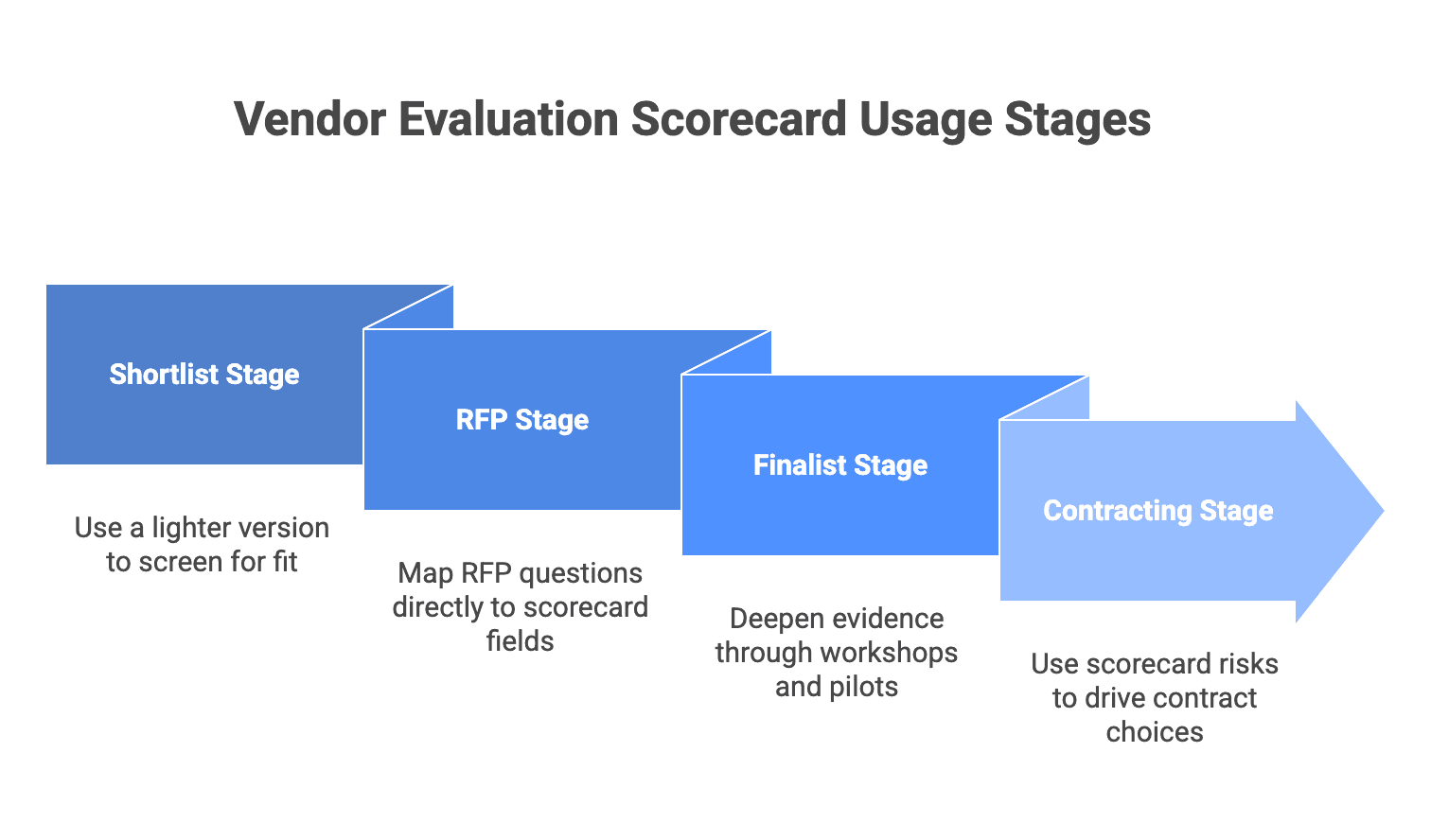
Use the scorecard across four stages, keeping criteria stable while evidence depth increases.
Shortlist stage
Use a lighter version to screen for fit and eliminate obvious mismatches. Keep scoring mostly qualitative and focus on disqualifiers.
RFP stage
Map RFP questions directly to scorecard fields so responses translate into scores cleanly. Score independently to reduce bias.
Finalist stage
Deepen evidence through workshops, reference checks, and a small pilot or paid discovery. Update scores and confidence based on what you observed.
Contracting stage
Use scorecard risks to drive contract and governance choices. If continuity is a risk, negotiate staffing protections. If security is uncertain, require stronger validation steps. If change control is unclear, define it tightly in the SOW.
A scorecard is most valuable when it influences what you negotiate and how you govern.
The fastest way to make this real is to copy the template into a spreadsheet, tailor weights to your risk profile, and run a parallel evaluation of two vendors. You will learn quickly which criteria are most diagnostic for your context and where you need clearer anchors or additional evidence requests.
When stakeholders disagree, use the scorecard to force the conversation back to evidence. Review the biggest scoring deltas, decide whether weights reflect true priorities, and document which risks you are accepting versus mitigating in the contract.


Trusted by top platforms for our transformative solutions and exceptional results: