Moving Sozie to Weekly Releases with Claude Code and Cowork
Arbisoft set up Claude Code for Sozie's developers and Claude Cowork for its founders, connecting both into one spec-driven delivery workflow through Jira. What used to be 2-week sprints with no defined goal is now a weekly release cycle, with 246 tickets shipped in 13 weeks and about 2% returned.
- Tickets shipped in 13 weeks by 3 developers
246
- Of shipped tickets returned after release
~2%
- Jira stories a week written by the founders
~20

Client/Partner
Sozie
Industry
E-commerce and Retail Tech
Service Offered
AI Adoption and Workflow Enablement
Tech Stack Used
Sozie is an e-commerce and retail-tech startup of under 20 people that runs a seller cash-back platform, with a Django REST API backend, an iOS app, a Retailer Dashboard, and an admin panel.
Arbisoft led Sozie's AI adoption from a standing start: a Claude Team account, Claude Code with a spec-driven skill chain for the developers, Claude Cowork workflows for the founders, and the training, governance, and telemetry around them.
Between July and September 2026, the team held a weekly release cycle for 13 weeks and shipped 246 tickets, with about 2% returned after release.
Introduction
Sozie is an e-commerce and retail-tech startup of under 20 people that runs a seller cash-back platform. Its product spans a Django REST API backend, an iOS app, a Retailer Dashboard, and a Django Admin Panel, built by a small team of developers working closely with the company's two founders.
The team had no defined sprint goals and no shared way of working with AI. AI tools were used ad hoc, and nobody on the team had used Claude before. Sozie wanted a real AI workflow that the whole team would adopt, from the founders who define the product to the developers who ship it, and that's where Arbisoft stepped in.
The Challenge
Sozie's team was small and moving fast, but the path from product idea to release had gaps at every stage:
- No defined sprint goals: Work ran in 2-week sprints with no defined goal, and it started from loosely defined tickets.
- Thin user stories: Stories arrived thin, so developers went back and forth with the founders to pin down requirements.
- Product questions without an owner: Most of the developers' questions were product questions, and the answers had to come from the founders.
- No shared AI workflow: AI use was ad hoc, with no shared workflow, rules, or codebase context for the team to build on.
- A codebase with its own vocabulary: Sozie's UI and Jira terms don't match its model names (a Retailer is a Brand in the code, a Campaign is a ProductBatch), which any AI assistant had to learn.
The Approach
We set Sozie up on a Claude Team account and built one connected workflow on it: Claude Cowork for the founders at the start of the pipeline, Claude Code for the developers who build and ship, and the governance and training that hold both together:
One Workflow from Product Idea to Weekly Release
Founder-Authored StoriesProduct intent reaches Jira as detailed, test-checked stories
Spec-Driven DeliveryEvery non-trivial ticket goes through a spec, a plan, and tests first
Codebase ContextCLAUDE.md files that carry Sozie's rules and business logic
Regular Self-AuditsBackend, frontend, and mobile reviewed on a set cycle
Usage GovernanceSpend caps, session reviews, and live usage dashboards
Enablement and HandoverWorkshops, Loom videos, and coaching in a shared Slack channel
What We Built
- Founders as story authors in Cowork: The developers told us their main problem was a lack of clarity on tickets, and most of their questions could only be answered by the founders. So we made the founders the authors of every user story. They draft stories and epics in Claude Cowork from Sozie's product definitions and push them to Jira through the Atlassian connector, and each story carries Sozie's vocabulary, field mapping, and user journeys.
- Stories checked against tests: Claude marks proposed changes to a user story in a Corrected section, and developers check each correction against the end-to-end test cases. When regenerated stories drifted from the latest product definitions, we made one definitions file in the Cowork folder the single source of truth, so corrections go there first and stories are regenerated from it.
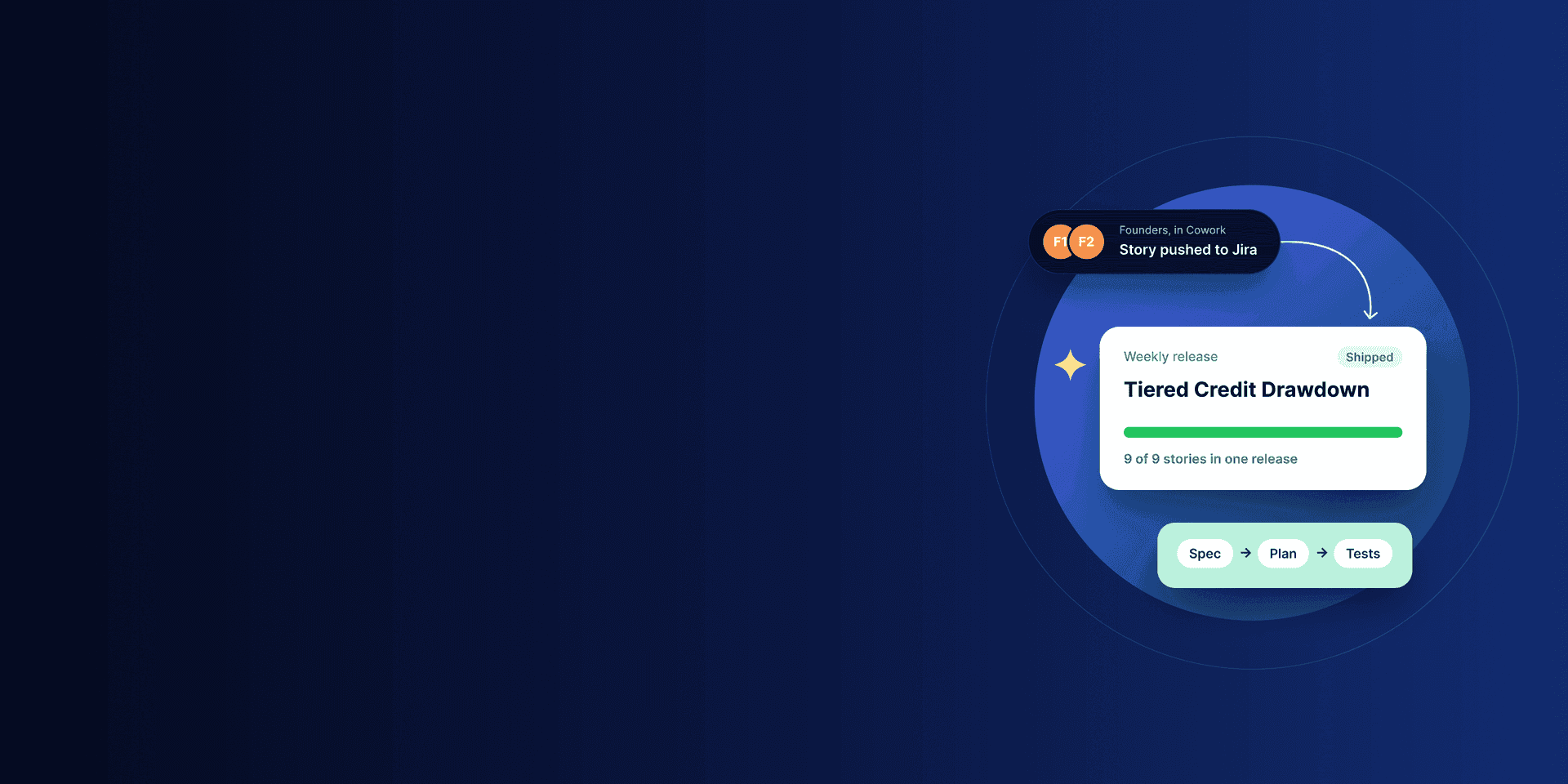
- A spec-driven skill chain in Claude Code: A Jira skill fetches the ticket and everything linked to it. Spec and planning skills turn it into an agreed spec and plan, and implementation runs through subagents, test first. The chain builds on the open-source Superpowers skill set, extended for Sozie. It is the default for non-trivial tickets, while bug fixes with a clear cause go straight to the fix.
- Quality gates built into the flow: Every change needs unit, API, and integration tests, and the full suite runs in CI. Production and source changes are never auto-committed: Claude shows the diff and waits for the developer's approval. Risky work, such as security changes and data migrations, gets a two-stage adversarial review.
- Context that knows Sozie's codebase: Each repo has a root CLAUDE.md with locked working practices, plus nested files for complex modules that hold Sozie's cash-back, credit, and ledger rules, each tagged with the ticket that introduced it. A vocabulary skill maps product and Jira terms to model names before Claude searches the code, and a docs-sync pass on each release branch keeps the files current.
- Regular self-audits: A self-audit workflow reviews the backend, frontend, and mobile apps every two months or in the last week of the month, and its findings become Jira tickets. Three of those tickets together resolved 33 findings, and Claude-assisted audits also fixed security and privacy issues in the code.
- Usage governance and telemetry: We sized org-wide and per-user spend caps from observed usage rather than guessing up front. When usage climbed in August, our session-review skills traced it to prompting: developers were leaving the workflow to self-correct instead of giving direction up front. We updated the skills and CLAUDE.md to require upfront context, coached the team, and enabled OpenTelemetry export into DevLake and Grafana dashboards that show usage per user and per model.
- Enablement and handover: Our Tech Lead ran live workshops for the developers and walkthroughs for the founders, backed by docs and Loom videos, with ongoing coaching in a shared Slack channel. Sozie's team now edits and writes its own skills and workflows, and the founders have built their own weekly Jira usage and blocker reports.
What's Next
The dashboards show implementation still runs mostly on Opus, even though plans are written in enough detail for lighter models. The next step is steering implementation subagents onto Sonnet and Haiku, and using the same dashboards to confirm the shift. The founders' Cowork use will join those dashboards too.
The Outcome
Between July 6 and September 29, 2026, Sozie's three developers worked to a weekly release cycle, with tickets and goals set in advance.
- Weekly releases: The team moved from 2-week sprints with no defined goal to weekly releases, and held that cadence for 13 weeks.
- Steady throughput: 246 tickets shipped across 15 release dates, about 19 a week, most of them through the spec-and-plan flow.
- Few returns: 5 of 246 tickets came back after release, a return rate of about 2%, and nothing was reopened after reaching release-ready.
- A major epic in one release: The Tiered Credit Drawdown epic shipped all 9 stories in a single release on August 27, covering a rule engine, ledger integrity with a migration, and portal and customer views.
- Founder-authored stories: The founders have created 193 Jira tickets through Cowork since August 1, about 20 a week, and each one arrives fully detailed.
- Defects caught early: Test-driven defect sweeps found bundled defects early, including 31 in moderator account management.
- Adoption beyond the brief: The founders now also use Claude Design for mobile design overhauls.
Area | Before | After |
| Release cadence | 2-week sprints with no defined goal | Weekly releases, with tickets and goals set in advance |
| User stories | Thin, with back and forth to pin down requirements | Written by the founders in Cowork, fully detailed |
| Starting a ticket | Loosely defined tickets | An agreed spec and plan before code |
| AI use | Ad hoc, with no shared workflow | Claude Code and Cowork in one shared workflow |
Value Delivered
Each part of the workflow gave clarity and time back to Sozie's team:
- Product intent reaches developers as detailed, test-checked stories instead of loose requests
- Most of the back and forth over requirements is gone, because each story arrives fully detailed
- Every non-trivial ticket gets a spec and a plan before code, which makes scope explicit
- Sozie's business rules sit next to the code, so Claude works within them
- Spend is capped, and usage per user and per model is visible on live dashboards
- Sozie's team maintains and extends its own skills and workflows without Arbisoft
Sozie now runs one AI-assisted path from product idea to weekly release, and its own team owns it.
Tickets shipped in 13 weeks by 3 developers
246
Of shipped tickets returned after release
~2%
Jira stories a week written by the founders
~20
Technology Used
The tools and setup behind Sozie's workflow:
- AI tools: Claude Code, Claude Cowork, and Claude Design on a Claude Team account, with Google SSO
- Workflow: A spec-driven skill chain built on the open-source Superpowers skill set, root and nested CLAUDE.md files, a Sozie vocabulary skill, and session-review skills
- Integrations: Atlassian MCP server for Jira, Firebase MCP server for Crashlytics, and Cowork connectors for Jira and Confluence, Google Drive and Docs, Slack, and Gmail and Calendar
- Observability: OpenTelemetry export into DevLake and Grafana dashboards
- Sozie's stack: Django REST API backend, iOS app, Retailer Dashboard, Django Admin Panel, GitHub CI, and pre-commit hooks