
Optimizing Petabyte-Scale Parquet Storage for a Travel Data Solutions Provider
Arbisoft benchmarked and tuned the Parquet storage of a petabyte-scale data lake. Zstandard compression and larger, fewer files cut storage by about 25% and file counts by over 80%, saving approximately USD 350,000 a year.

Client/Partner
Confidential
Industry
Travel
Service Offered
Data Engineering & Storage Optimization
Tech Stack Used
The client is a travel data solutions provider whose data lake holds more than 1 PB of Parquet data in Amazon S3. Default settings had left that data expensive to store: Snappy compression used more space than it needed, and Trino writes had produced millions of small files.
Arbisoft's data engineering team built a structured benchmarking framework and tested storage configurations on production-scale datasets, instead of relying on engine defaults. Only changes that proved themselves were promoted into production.
The result is about 25% less storage with Zstandard compression, over 80% fewer Parquet files, and estimated savings of approximately USD 350,000 per year, with query performance maintained.
Introduction
The client is a travel data solutions provider. Its data lake holds more than 1 PB of Parquet data in Amazon S3. Parquet is an efficient columnar storage format, but the way it was being used had become increasingly expensive and operationally inefficient.
The client needed to reduce storage costs without disrupting the analytical pipelines that depend on the data, and without compromising data quality or write and query performance.
The client needed a partner who could show, on production-scale data, which changes were safe to make.
The Challenge
The core problem was that default settings were still in place at petabyte scale. This led to a set of problems that built on each other:
- High storage consumption: The default Snappy compression used more storage than necessary.
- Millions of small files: Trino write operations had generated millions of small Parquet files.
- Rising S3 costs: Amazon S3 storage costs kept increasing.
- Poor file layout: Fragmented files hurt downstream analytics workloads.
- Tight constraints: Storage had to be optimized while preserving data quality and acceptable write and query performance.
The Approach
We designed a structured benchmarking and optimization framework to find the most efficient Parquet configuration, and validated every option on production-scale datasets before it reached production. The work had four parts:
Benchmarking Compression
We evaluated Snappy and Zstandard (ZSTD) to find the best balance between storage savings and processing performance. Each configuration was measured for:
- Storage footprint
- Write throughput
- Query performance
- CPU utilization
The benchmarks showed that ZSTD significantly reduced storage requirements while keeping read and write performance acceptable for analytical workloads.
Reorganizing the Parquet File Layout
The existing datasets contained a very large number of small Parquet files created during Trino writes. We tuned the Parquet writer configuration to:
- Increase the Parquet block size to generate larger files
- Reduce file fragmentation
- Improve row group organization
This gave downstream analytics a much healthier data layout.
Tuning the Trino Writers
We tuned Trino's write pipeline to minimize unnecessary file generation, optimizing:
- Writer scaling
- Writer task count
- Output parallelism
The new configuration significantly reduced the number of output files while keeping write performance acceptable.
Validating Before Rollout
Every optimization was benchmarked against production-scale datasets before it was rolled out. The evaluation framework measured:
- Storage size
- Number of generated files
- Write latency
- Query execution performance
Only validated improvements were promoted into production, which kept operational risk to a minimum.
The Technical Architecture
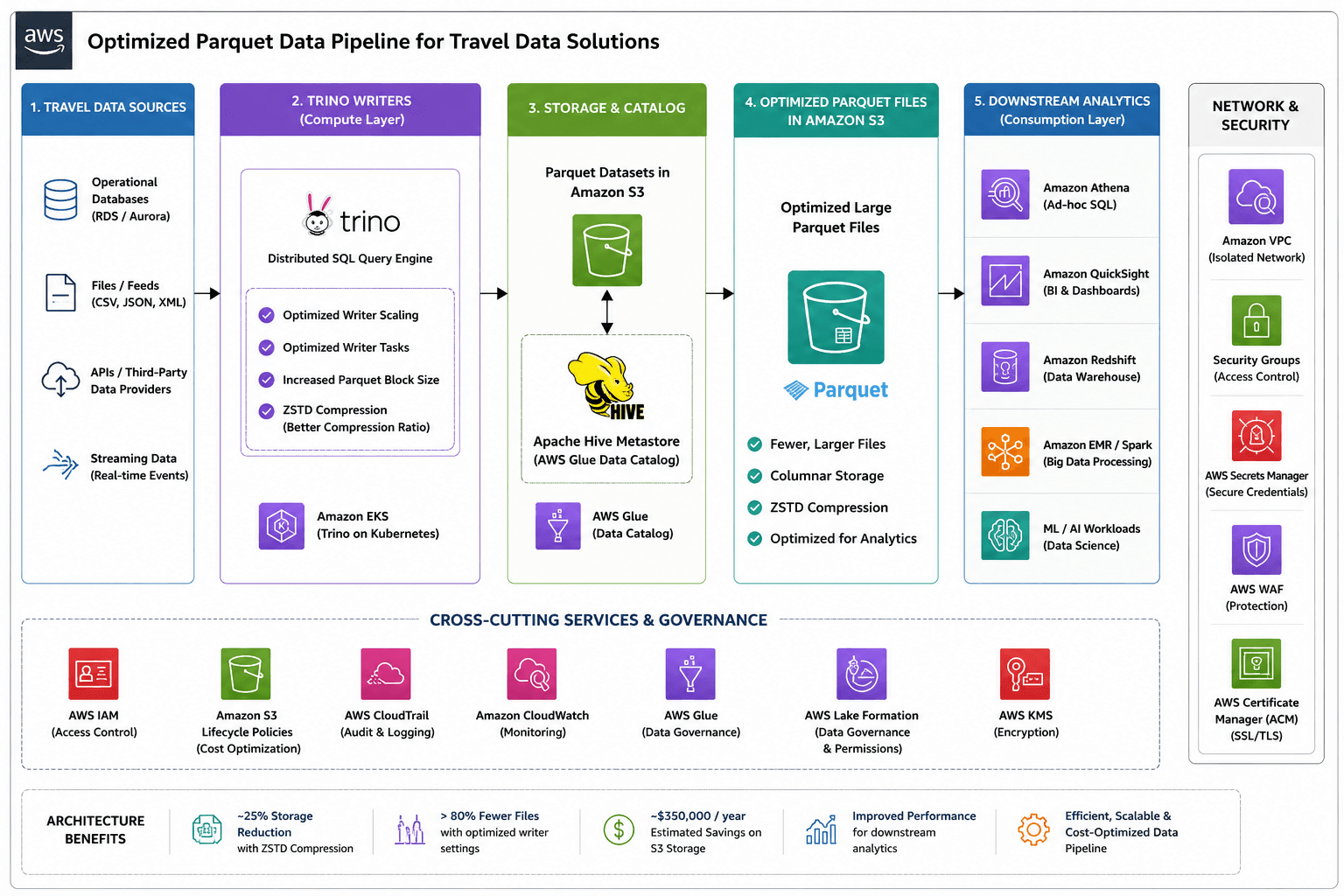
The diagram below shows the optimized pipeline: travel data from operational databases, files, third-party providers, and streams is written by Trino into optimized Parquet files in Amazon S3, cataloged through the Hive metastore, and consumed by downstream analytics and ML workloads.
The Outcome
The optimization delivered substantial operational and financial benefits.
Metric | Result |
| Storage reduction | About 25% using ZSTD compression |
| File count reduction | Over 80% fewer Parquet files |
| Storage cost savings | Approximately USD 350,000 per year |
| Analytics performance | Improved data layout with maintained query performance |
| Operational efficiency | Reduced file fragmentation and simplified downstream processing |
Because only validated changes were promoted, the savings came with minimal operational risk.
Technology Used
The stack behind the optimized data lake:
- Query Engine: Trino
- Metadata Catalog: Apache Hive
- Storage Format: Apache Parquet
- Compression: Zstandard (ZSTD) and Snappy
- Object Storage: Amazon S3
- Container Platform: Kubernetes
- Deployment: Helm