 Add as preferred on Google
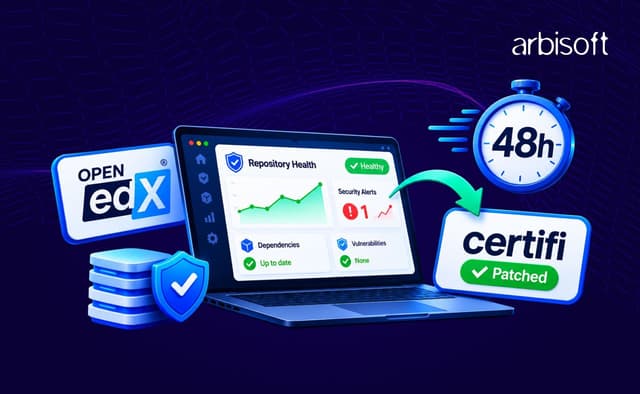
How a Repository Health Dashboard Helped Open edX Patch certifi in 48 HoursRead More

Choosing a team model for an AI, machine learning or data project affects your timelines, your budget and how well the work scales. This guide is for CTOs and engineering or data leaders who have an approved AI, ML or data initiative but can't hire fast enough to deliver it. As a rule of thumb, staff augmentation fills specific skill gaps in a team you already lead, a dedicated team fits long-running work whose scope will change, and outsourcing fits a fixed, well-defined scope you want a vendor to own. The rest of the post covers when each model fits, the cost trade-offs and what to check in a vendor.
In my experience, AI projects that stumble usually had sound ideas and an execution model that didn't fit the team's capabilities or business context. AI work typically involves massive datasets, unpredictable model behavior, regulatory concerns and business needs that keep changing. Add pressure from leadership and limited internal bandwidth, and the team ends up juggling too much.
Hiring delays make it worse. Deadlines stretch, backlogs grow and budget forecasts fall apart, and legacy systems add integration overhead on top. Stakeholders still expect ROI through all of this. In the race to deploy AI, slow hiring cycles or a delivery model that doesn't match the work can mean losing ground to competitors.
Hiring for machine learning and AI roles is harder than it used to be. ManpowerGroup's 2026 Talent Shortage Survey, released in February 2026 after polling 39,063 employers in 41 countries, found that 72% of employers reported difficulty hiring. In our experience, the skill sets are niche and strong ML engineers rarely stay on the market for long.
Teams can spend months sourcing candidates, only to lose them to a faster-moving competitor while the product roadmap slips.
That's why more companies are turning to external talent models that give faster access to expertise.
You'll usually find three common models: staff augmentation, dedicated teams, and full project outsourcing. Each has pros and cons, and your ideal choice depends on project scope, urgency, and internal maturity.
Staff augmentation means bringing in external specialists who integrate with your internal team. You still manage the work, but now you have access to niche skills.
For example, if your ML team needs someone with experience in reinforcement learning for three months, staff augmentation gets you that expertise without a permanent hire.
This model is ideal when you have clear internal processes but just need to plug gaps. It also works well when building hybrid AI teams with a mix of in-house and external contributors.
Dedicated teams involve hiring an external group of engineers, data scientists, or ML experts who work solely on your project. The vendor handles day-to-day team management, while you set priorities and review progress.
This approach is useful when the scope is evolving or when you need deep alignment over a longer duration. These teams often feel like an internal unit but operate independently.
You gain focus, speed, and cohesion. But it requires upfront planning and close collaboration to avoid mismatches.
Outsourcing is the most hands-off model. Project outsourcing means handing over full responsibility to a third-party vendor. From model development to deployment, the vendor owns delivery.
This is best suited for defined scopes like developing a fraud detection engine or building a data analytics dashboard.
It can free up your internal resources, but only if you’re working with a capable vendor who understands your needs.
The three models differ mainly in who runs the work, how much control you keep and how cost builds over time. A dedicated team is aligned with your roadmap, but the vendor manages it day to day.
| Staff augmentation | Dedicated team | Outsourcing |
|---|---|---|---|
Who manages the work | You | Vendor runs the team, you set priorities | Vendor owns delivery |
Your control | High | Medium | Low, defined by contract |
Your management overhead | High | Medium | Low |
Cost profile | Pay per specialist over time | Steady monthly team cost | Fixed or milestone price for a defined scope |
Typical duration | Weeks to a few months | Multiple quarters | Length of the defined project |
Best fit for AI/ML | Filling a niche skill such as reinforcement learning or NLP | Evolving multi-quarter product or platform work | Defined builds such as a fraud detection engine or analytics dashboard |
But choosing the model is only half the battle; what to watch out for when hiring an AI development company for custom AI software projects matters just as much. A poor vendor fit can derail even the best team structure.
Each model fits a different kind of AI or ML initiative. The right one depends on your leadership capacity, how settled the scope is and how long the work will run.
Staff augmentation fits when you already have strong leadership and internal processes. It's great when you need to fill temporary gaps or scale up quickly.
You might be launching a chatbot, migrating models to the cloud, or deploying an NLP engine. All of these benefit from temporary, deep expertise. And depending on the complexity of your project, it may also be worth exploring when to hire a general software company or a specialized machine learning development company to avoid mismatched capabilities.
The main AI-specific risk is knowledge loss. Experiments, feature pipelines and tuning decisions often live with one contractor, so build documentation, code review and a handover of experiments and pipelines into the engagement from day one.
Dedicated teams are better suited for multi-quarter initiatives where project ownership and continuity matter most.
The advantages include high alignment and focus. But the downside is reduced flexibility if your needs shift suddenly. It's a great choice when you want consistent velocity without the burden of hiring.
The contract should state who owns the data, trained models, weights and code, and legal counsel should review the IP and handover clauses before signing. Keep repositories, model artifacts and training data in company-owned cloud accounts from the first commit, so ownership holds in practice as well as on paper. A knowledge transfer plan also matters, so the work stays usable if the engagement ends. Pairing an internal engineer with the team early, then moving one component at a time to internal ownership with a runbook for each, is safer than a single handover at the end.
Hourly rates make a dedicated team look expensive, so compare total cost over the same 12 or 18 months instead. Dedicated teams are usually priced on team size, duration and expertise, so ask each vendor for a monthly figure per role and the notice period for changing headcount. On the in-house side, count salary, benefits, recruiting fees and the weeks each role sits empty during recruiting. On the dedicated side, count the onboarding period, usually a few weeks, and the handover work at the end.
Here are the main advantages and disadvantages of a dedicated AI/ML team, side by side.
Factor | Advantage | Disadvantage |
|---|---|---|
Commitment and cost | A steady monthly cost, without the recruiting, HR and retention overhead of in-house hires on a long-term project | Requires a long-term commitment, which is poor value for a task that ends within a few weeks, such as a short proof of concept |
Continuity | The same engineers stay on the work across quarters, so context on the data, experiments and earlier model decisions builds up | That context stays with the vendor's engineers unless the contract requires documentation and a knowledge transfer plan |
Flexibility | Team size and skills can be adjusted as the roadmap changes | Ending or sharply cutting the team takes longer than releasing one augmented specialist |
Management load | The vendor runs the team day to day while you set priorities and make the decisions | Results depend on an internal lead who has time to set priorities and review output |
Location and working hours | A team that commits to set overlap hours can join your sprint ceremonies and handle production issues within your day | Distance cuts shared hours, so agree overlap hours and how urgent production issues are handled outside them before signing |
Products sold into the EU add a compliance question. As of November 2026, the EU AI Act's rules for high-risk use cases listed in Annex III, in areas such as employment, education, biometrics, credit scoring and critical infrastructure, apply from 2 December 2027, after an amendment extended the original deadline. Confirm with legal counsel whether your use case is covered. If it is, put the technical documentation, activity logging and test records those rules require in the dedicated team's scope from day one, because rebuilding them late is slow and costly.
Outsourcing works well for clearly defined work. You can reduce costs and avoid hiring delays.
But for projects with lots of changing requirements, it's risky. You lose control and depend heavily on the vendor's interpretation.
Specify IP ownership of the models and training pipelines in the contract. A required MLOps handover, covering deployment scripts, monitoring and the retraining process, means your team can run the model after delivery.
In our experience, the real cost of each model depends on how long the work runs and how well defined it is.
Staff augmentation has a low entry cost. You also pay for your own management time and onboarding, though, and the cost keeps building if the need turns out to be permanent. A dedicated team has a steady run-rate that pays off when work continues across several quarters, because the team's accumulated context avoids repeated ramp-up. Outsourcing is predictable for a fixed scope, but change requests and re-scoping raise the cost when requirements shift.
Our view is that a simple break-even rule applies: the longer and less defined the work, the more a dedicated team or in-house hire pays off. The shorter and more defined it is, the more augmentation or outsourcing makes sense.
To make the right call, look beyond price tags and weigh the cost of delay, integration effort and long-term sustainability.
In our experience, a startup with a small core team often gets the most from staff augmentation, because it adds skills without fixed payroll. A mid-sized company with a multi-quarter roadmap is often a good fit for a dedicated team. An enterprise with a well-defined project and internal priorities elsewhere may prefer outsourcing.
You need to assess where you are, what you're building, and how fast you need to move.
The roles a team needs change with its stage, and the right model follows those roles.
Stage | What the AI work demands | Roles to add first | Model that usually fits |
|---|---|---|---|
Early-stage startup building an MVP | Prototypes within weeks on a lean budget, with daily experiments and fast course correction | An ML engineer who can build and deploy, and a data scientist to validate output, working with a technical founder or product owner | Staff augmentation for the specialist the core team lacks |
Growing product moving models into production | Reliable data pipelines and repeatable deployments as usage grows | Data engineers for pipelines, then MLOps engineers as deployment needs grow | Dedicated team for a multi-quarter roadmap |
Enterprise AI initiative | Compliance, traceability and integration with legacy systems, with regulators involved in finance and healthcare | AI product managers, data engineers, MLOps engineers, domain experts and compliance specialists for risk-heavy domains | Outsourcing for a well-defined build, or specialists added to a growing in-house team |
Hiring just ahead of demand keeps each change small. A startup that adds MLOps before it has models in production pays for capacity it can't use yet. An enterprise in a regulated domain that adds compliance roles late is likely to face rework.
If your business changes direction often, you need flexibility. That makes staff augmentation and hybrid teams your best option.
If your direction is set, and you just need help delivering, then dedicated teams will give you better throughput.
Speed is the main reason AI/ML teams choose staff augmentation. Full-time hires with niche skills such as computer vision or NLP can take months to find. A staff augmentation ramp-up usually follows four steps.
Don't overlook culture. Your external team should blend in with your working style, communication habits, and speed.
If they don't, you'll spend more time managing than shipping. That's a cost too.
Cost and speed matter, and these filters decide whether a vendor relationship holds up.
Ask for clarity. Get pricing in writing. Insist on regular budget reviews. If you feel like you’re being kept in the dark, you probably are.
Ask for proof. Real results. Similar clients. And clarity on what they actually delivered. This helps you avoid promises that don’t hold up.
Before shortlisting vendors, it's worth reviewing this detailed guide on how to assess the AI expertise of an AI development company. It walks through what real AI skills look like and how to separate polished demos from production-ready capabilities.
If your project touches customer data, make compliance a non-negotiable. Ask vendors how they manage privacy, encryption, and audit trails.
Under UK GDPR, guidance from the UK Information Commissioner's Office (ICO) on controllers using processors says a controller must only use a processor that can provide "sufficient guarantees". The same guidance says controllers should check a processor's compliance on an ongoing basis, and that processors must allow for and contribute to audits and inspections. The ICO's accountability framework also expects due diligence to include data security checks such as site visits, system testing and audit requests. Rules differ by jurisdiction, so it is sensible to have your legal or data protection lead review the vendor contract before signing.
Don’t fly solo. Pull in your internal stakeholders early. Also, check peer reviews. A 10-minute chat with someone who’s worked with a vendor can reveal a lot.
Alignment comes first, and a few specific questions test it. Ask how the vendor retains engineers and how long it takes to replace one who leaves. A delivery record on similar AI/ML work tells you more than a pitch deck, so request examples close to your use case. The way a vendor escalated a past missed milestone also shows how it behaves under pressure.
A paid pilot of a few weeks on one well-bounded use case is the cheapest way to test a vendor and a model together. Agree KPIs up front, for example a model accuracy target, a deployment date and a cost per sprint, so progress is measured against something concrete. The contract should also include exit and handover clauses. They let you switch models, for example from augmentation to a dedicated team, without losing code, data or trained models.
Don't wait till the postmortem to realize you went off course.
Build for adaptability. A flexible stack and team structure let you adjust without starting over.
If you need to fill a specific skill gap, Arbisoft's team augmentation engagement model adds specialists to a team you already lead. For broader builds, see our AI services. Talk to us about your scope, and we'll help you work out which model fits today and can flex with tomorrow.
1. What are the main engagement models for AI, machine learning, and data projects?
The three most common models are staff augmentation, dedicated teams, and full project outsourcing. Each offers different levels of control, speed, and flexibility, depending on your project scope and internal capabilities.
2. How is staff augmentation different from a dedicated team model?
Staff augmentation adds individual external specialists to your in-house team, with you managing their work directly. A dedicated team is an external group working exclusively on your project but managed more independently, reducing your day-to-day oversight.
3. When should I choose staff augmentation for my AI/ML project?
Staff augmentation works best when you already have strong internal leadership, well-defined processes, and need to fill short-term skill gaps quickly, such as adding an NLP specialist for a specific release.
4. What are the advantages of a dedicated AI/ML team?
Dedicated teams provide long-term focus, deep alignment, and consistent velocity without the overhead of hiring full-time staff. They’re ideal for multi-quarter projects with evolving requirements.
5. When does full project outsourcing make sense for AI development?
Outsourcing is a good fit for clearly defined, self-contained projects like building a fraud detection engine or a data analytics dashboard. It allows your internal team to focus on other priorities while the vendor delivers end-to-end.
...Loading Related Blogs
Trusted by top platforms for our transformative solutions and exceptional results: