

 Add as preferred on Google
Odoo Modules Explained: Which Odoo Apps Your Business Actually NeedsRead More
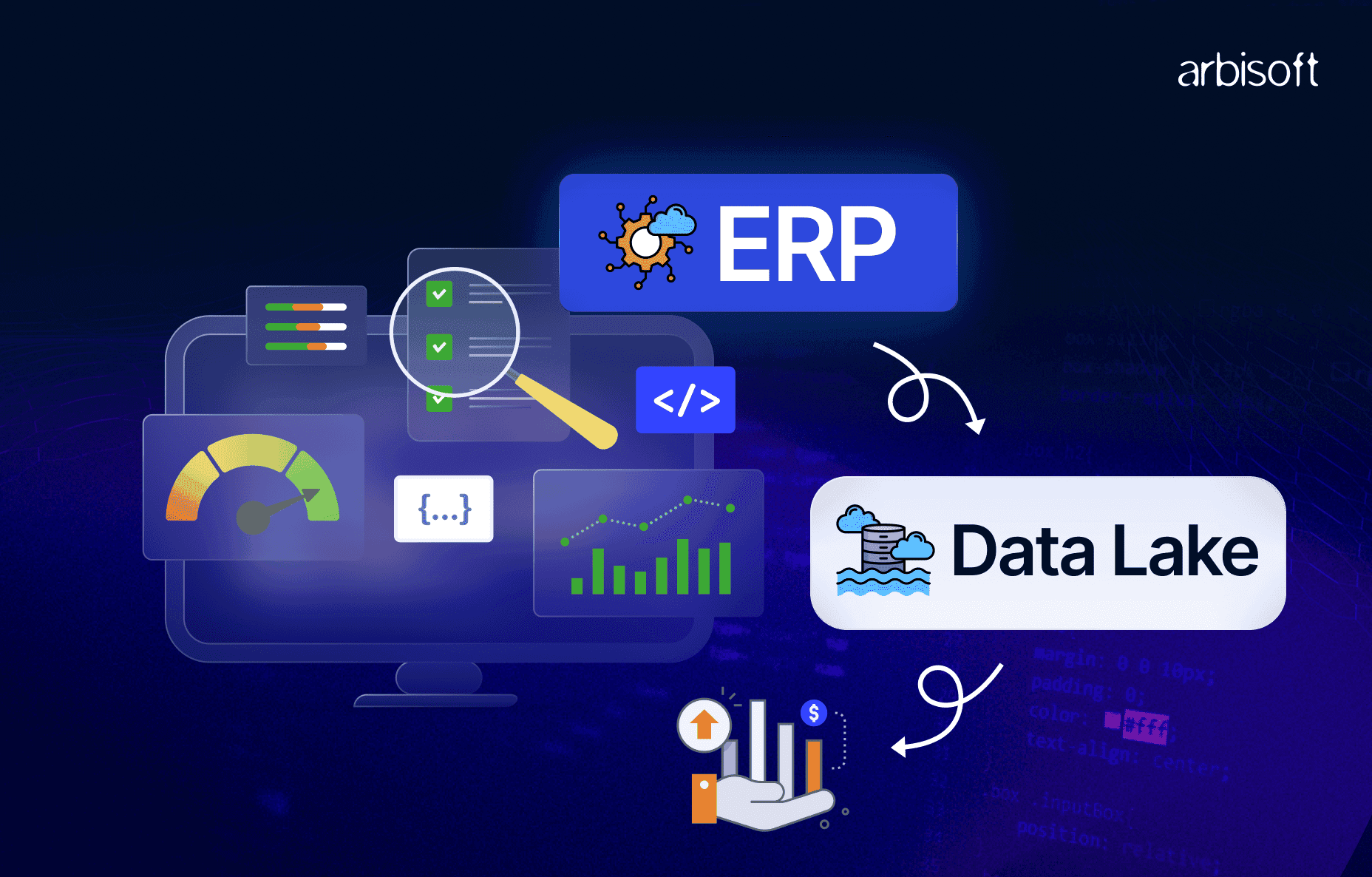
Smart ERPs — ERP platforms with embedded AI, advanced analytics, and direct access to enterprise data lakes — are reshaping how finance leaders work with data.
Most mid-to-large enterprises now have some form of data lake. Transaction logs, subscription events, IoT feeds, support tickets, product-usage telemetry, marketing touchpoints. All of it is stored; far less of it is managed as something that should move margin, cash flow, or valuation.
Doug Laney, who popularised the idea of “infonomics”, makes the connection explicit:
“Once you’ve got both the numerator and the denominator, you can start managing data like a financial asset.”
Laney’s point is straightforward: you can only treat data as an asset once you can measure its economic impact. That means tying the data in your lake to revenue behaviour, cost drivers, risk patterns, and financial outcomes that your ERP already tracks.
In parallel, McKinsey research (widely cited in the data-strategy community) highlights the upside for organizations that actually act on that view:
“Data-driven organizations are 23 times more likely to acquire customers, six times as likely to retain customers, and 19 times more likely to be profitable.”
The gap between those two statements — data as a financial asset and materially higher profitability — is where smart ERPs now matter.
Vendors are building AI models, real-time planning, and lakehouse connectivity directly into their ERP cores. One recent analysis of AI in ERP notes that:
“AI is transforming ERP systems on a much larger scale, handling complex tasks like advanced supply chain management, personalized customer support, predictive analytics, and more.”
For CFOs, that transformation only becomes meaningful when it shows up in the profit and loss (P&L) statements.
This guide focuses on five practical levers you can pull in 2026 to turn data lakes into profit centres using smart ERPs.
CFOs no longer lack data. They lack financially interpretable data.
Alex Meakin, CFO at Dufrain, describes the basic challenge:
“In an age of data proliferation and seemingly every possible thing that can be measured is captured, stored and analysed, understanding your data, the wider data universe in which it lives in and what this means for your business has never been more important.”
Most lakes fail on that “what this means” part. They are excellent at storing events and poor at expressing those events in the language of finance.
From a CFO perspective, a lake only becomes useful once:
Without that, the lake is a storage cost. With it, the lake is a fact base for pricing, profitability analysis, and scenario design.
Laney’s “numerator and denominator” point is a useful mental model here: insist that the data architecture allows you to calculate and recalculate the economics you care about.
The work to implement this mapping sits with the data and IT teams. The specification — which decisions, ratios, and cohorts must be supported — is a finance responsibility.
Traditional ERPs were built for structured transactions. Data lakes were built to capture almost anything. Smart ERPs now sit between those worlds and turn raw data into governed financial signals.
Satya Nadella, CEO of Microsoft, has described the broader shift like this:
“AI is the runtime that is going to shape all of what we do going forward in terms of the applications as well as the platform advances.”
In the ERP context, that “runtime” shows up in a very specific way:
Analysts tracking enterprise systems are already observing the pattern. As one review of AI-enabled ERP systems notes, AI is now handling not just basic automation but “advanced supply chain management, personalized customer support, predictive analytics, and more” inside ERP workflows.
For CFOs, the key step is to treat the ERP as the primary decision layer:
When this loop is in place, the lake is no longer an archive owned by IT. It becomes a continuously updated input into financial decision-making, mediated and governed through the ERP.
Once your ERP can read and act on lake data, the question changes from “what can we analyse?” to “where does profit actually improve?”
Three profit engines are emerging as particularly relevant for CFOs.
Subscription and usage-based businesses already collect detailed product-usage telemetry. In many organisations, that dataset sits with product or engineering and is only weakly connected to finance.
Laney’s infonomics argument — that you “start managing data like a financial asset” once you can measure its economic numerator and denominator — is directly applicable here.
When ERP and lake are connected:
The result is an architected NRR engine rather than a quarterly surprise. Expansion becomes something designed in finance and implemented through systems, not just a sales aspiration.
McKinsey’s research linking data maturity and profitability is often quoted in general terms. The practical lever for CFOs is forecast quality.
When a smart ERP can read live signals from the lake:
For finance, this supports narrower buffers, more confident capital deployment, and faster reallocation of spend as leading indicators move. Data does not guarantee better judgment, but it removes much of the avoidable uncertainty.
The most advanced ERPs are beginning to host AI agents that execute multi-step tasks across finance and operations, not just answer queries.
Bruce Harris, VP of Finance & Accounting at Taco Bell, described the impact of agentic workflows in finance in a recent discussion of AI adoption:
“Our agentic workflows automate the routine work, freeing our people to focus on insight, strategy, and growth.”
In an ERP–lake environment, similar agents can:
The essential shift for CFOs is to treat these agents as capital investments rather than experiments: define baselines, measure hours saved and errors avoided, attribute cash-flow impact, and include them in ROI and payback models alongside human headcount.
Without governance, the same data lake that powers these profit engines can quickly become a liability.
As one governance guide on modern data architectures puts it:
“Without proper governance, data lakes can easily turn into ‘data swamps’ where information becomes unorganized, inconsistent, and difficult to analyze.”
This is not merely an IT concern. It is a risk, returns, and reputation issue for finance.
A relevant reference comes from Anil Chakravarthy, CEO of Informatica, who explains that:
“The best companies are treating data as a strategic asset that everyone has to manage well."
For data-to-profit specifically, that translates into three expectations finance should set:
i) Shared ownership: Finance co-sponsors the lake roadmap with technology. If the current schemas cannot support questions about margin, CAC payback, NRR, or cash conversion, they are incomplete from a finance standpoint.
ii) Aligned semantics: The ERP’s definitions of value, cost, customer, product, and region become the reference for how data is structured and labelled in the lake. This alignment keeps AI models and metrics comparable across teams.
iii) Explainability and control: As AI models and agents influence planning, pricing, and hiring, boards and auditors will expect clear explanations. Research on explainable AI consistently stresses that as models become more complex, organisations must understand why a system produced a given recommendation, not just what it produced.
For CFOs, this is familiar territory: validating model assumptions that affect capital plans, setting thresholds for mandatory human review, and ensuring that AI-assisted decisions remain defensible.
Good governance keeps the data-to-profit engine auditable and trustworthy. Weak governance turns a promising asset back into a cost line.
Many finance leaders already talk about data as an asset. The combination of smart ERPs and data lakes is where that language becomes operational.
Smart ERPs give you:
Data lakes give you:
When those two elements are designed as one system, managed with finance in the room, Laney’s call to “start managing data like a financial asset” stops being a slogan and becomes a design principle.
For CFOs, the practical agenda for 2026 looks like this:
The role shifts from reporting on profitability to engineering it in the way systems, data, and capital are wired together.
If that architecture is in place, the data lake is no longer a sunk infrastructure cost. It becomes part of how the organisation systematically converts data, AI, and compute into durable cash flows.
Arbisoft works with finance and technology teams to ensure that data lakes, ERP systems, and AI capabilities operate as one profit-focused architecture. Our Data Engineering and Data Governance teams structure and clean the lake data so it can be interpreted correctly by ERP systems.
Our BI & Analytics and Agentic AI teams then build forecasting models, usage intelligence layers, and automated financial workflows that plug directly into ERP systems like Odoo.
For CFOs looking to move from stored data to revenue impact, Arbisoft provides the technical foundation and the integration expertise needed to turn data lakes into engines for Net Revenue Retention, or NRR growth, margin expansion, and tighter capital allocation.

Trusted by top platforms for our transformative solutions and exceptional results: