
 Add as preferred on Google
The Future of Education Technology in 2027: How AI Is Changing Learning for All AgesRead More
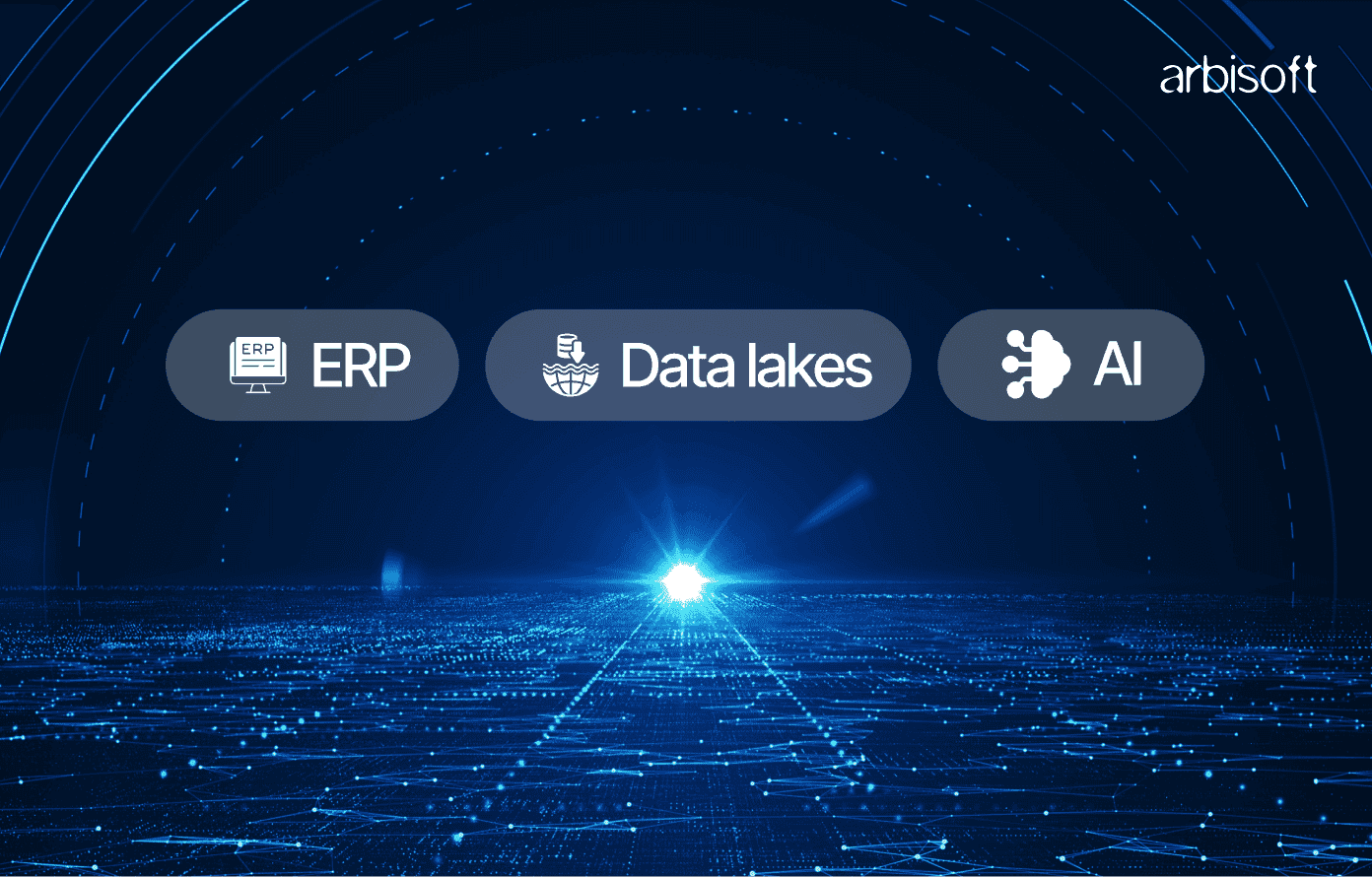
Enterprise technology changes fast, but the most valuable guidance still comes from people who have spent decades building large systems. When you listen to these experts, you see one pattern repeat across their experiences: ERP, AI, and data lakes now form a strategic triangle that shapes modern decision-making.
This isn't a theory. It’s the architecture senior practitioners are using in real transformations. This blog explains that triangle using verified expert insights, not assumptions or speculations.
Let’s dive in!
ERP systems continue to anchor enterprise operations because they hold the most accurate, governed, and complete record of business activity. Experts who have spent decades in implementation and modernization consistently describe ERP as the foundation every modern data strategy depends on.
After working with mid-sized B2B organizations for over 30 years, Christiano Gherardini captures ERP’s central purpose:
“What makes ERP indispensable is its ability to provide a single source of truth.”
This idea is reinforced by Gartner, whose long-standing definition of ERP highlights its role as the system that collects, stores, and governs data across critical business processes:
“ERP is a suite of integrated applications that an organization uses to collect, store, manage, and interpret data from various business activities.”
These perspectives show why ERP remains the backbone: it consolidates transactions, enforces consistent rules, and preserves data integrity at scale. Without this truth layer, every downstream decision engine becomes unreliable.
This connection between ERP accuracy and business outcomes becomes even clearer in the words of Ralph Hess, a 35-year ERP veteran who has led ERP strategy and channel growth at companies such as Navigator Business Solutions, N’Ware Technologies, and Third Wave Business Systems:
“Without data, without accuracy, without robust data to feed the AI models, you’re not going to achieve the outcomes.”
His warning is direct: if ERP data is wrong, every downstream system, the data lake, analytics tools, and eventually AI, will inherit that inconsistency.
Hess also stresses that delaying ERP modernization is itself a strategic risk:
“The real risk is doing nothing.”
Across these experts, the message is consistent:
ERP is still the most reliable source of truth inside any organization, and strengthening it is the first step toward any modern data or AI strategy.
Organizations that operate at scale rarely treat ERP as the end point. Instead, they see it as the most reliable input into a wider analytical ecosystem.
This is why senior data architects often describe the data lake as the “missing middle layer.” It provides a unified environment where ERP data is combined with signals that ERP cannot hold on its own, such as customer behavior, operational telemetry, marketing activity, logistics patterns, and other external sources.
Head of Data at Eurowag, Václav Dorazil, captures the impact of this unified environment in their award-winning lakehouse initiative:
“And because we have the single source of truth data lake, we’re now able to take a step towards data democratization and say to people: you can find all the data here and you don’t need anybody’s help to click on what you need.”
It should be noted that the data lake does not replace ERP. It, in fact, extends it, giving AI, analytics, and BI the environment they need.
AI can only produce value when its inputs are complete, unified, and trustworthy.
KPMG’s IT Advisory team summarized this relationship in their ERP + Data Lake + Analytics research:
“The integration of D365 F&O, Azure Data Lake, and Azure Synapse Analytics creates a synergy that transcends the traditional benefits of an ERP system.”
This “synergy” is the triangle itself: ERP for transactions, data lake for unification, AI for intelligence. This also proves that the ERP + Data Lake + AI triangle isn’t theoretical. Instead, it's already being adopted by leading enterprises in the Microsoft ecosystem, validated by KPMG.
The Forbes-published conversation with Srinivas Atreya, Chief Data Scientist at Cigniti Technologies, reinforces this dependency with absolute clarity. He explains that AI outcomes always mirror the condition of the data feeding the models:
“If the data used to train an AI model is inaccurate, incomplete, inconsistent, or biased, the model’s predictions and decisions will be too.”
Atreya goes further, warning that poor foundations can’t be overcome later:
“One assumption a lot of ML practitioners make is that by using ‘Big Data’ we can cover up the problems due to bad data quality. This is never true.”
And he makes the link explicit between data readiness and AI effectiveness:
“High-quality data results in AI systems being able to make more accurate predictions, provide relevant recommendations, and effectively automate processes.”
Across KPMG’s architecture guidance and Forbes’ expert commentary, the message is consistent and clear. AI is never the starting point. It is the result of a system that has already been structured, cleaned, and unified.
Organizations only unlock meaningful AI outcomes when their ERP layer provides dependable transactional truth, and the data lake offers a governed, comprehensive view of the business. Without this foundation, AI simply amplifies inconsistency and pushes errors downstream at scale.
For this reason, modern enterprises avoid treating AI as an isolated initiative. Instead, they follow a disciplined, sequential model: ERP → Data Lake → AI.
When you bring together the insights of ERP veterans, data-lake architects, and AI leaders, a single architecture keeps appearing. Each expert highlights a different part of the system, yet the pattern is unmistakable: ERP, data lakes, and AI are not separate initiatives. They are three tightly connected layers of one strategic model.
ERP remains the first and strongest layer because it provides accurate, governed, and auditable transactional truth. As Christiano Gherardini explains, this is what makes ERP indispensable as the single source of truth. Ralph Hess reinforces it by warning that no AI model can succeed without clean, reliable ERP data feeding it.
The data lake becomes the second layer by extending ERP. It unifies structured ERP data with operational signals that ERP cannot store, from customer behavior to logistics streams and marketing activity. This is why experts like Václav Dorazil describe the lake as the bridge that unlocks the full analytical potential of ERP.
AI forms the third layer, but only after the first two are ready. KPMG’s research on Microsoft’s enterprise stack demonstrates this clearly. The real value appears only when ERP, the data lake, and analytics work in sequence, creating the synergy they describe as “transcending the traditional benefits of an ERP system.”
Forbes reinforces the same idea through the lens of data science: AI outcomes rise or fall based on data quality, completeness, and governance.
Across these perspectives, the conclusion is consistent. AI is not where the journey begins. It’s where a prepared system ends. Enterprises that mature their ERP layer, unify their data through a lake, and govern it well are the ones that unlock reliable, scalable AI.
Senior practitioners agree that the triangle only produces value when each layer is ready. To help leaders evaluate their own systems, here are three quick checklists aligned with the expert insights shared above.
Your ERP is ready when it meets these minimum conditions:
If these are missing, both the data lake and AI will inherit fragmentation.
A modern data lake is more than storage. Experts view it as the analytical extension of ERP. It should contain:
The lake becomes the “single source of context” that ERP alone cannot provide.
Organizations with mature foundations exhibit the following signals:
When these elements are in place, AI does not struggle to perform; it accelerates decision-making and operational improvement.
The ERP + Data Lake + AI triangle only delivers value when each layer is engineered with discipline. Most organizations understand the potential of this architecture, but few have the in-house talent to align ERP modernization, enterprise data engineering, and AI in one unified strategy. This is exactly where Arbisoft adds strength.
We start by strengthening the foundation. Through our Odoo ERP services, we help organizations replace scattered systems with a unified source of truth, which is a prerequisite for any reliable analytics or AI initiative.
Next, we build the data layer. Using our enterprise data solutions and Databricks consulting expertise, Arbisoft designs modern data lakes and lakehouses, fixes data quality issues, and establishes governance so ERP data can flow into a central, trusted environment.
With the foundation and lake ready, we enable the final step: intelligence. Through our AI development solutions, our team develops models, automation, and analytics that operate on clean, unified enterprise data. That’s exactly the environment experts recommend.
Arbisoft delivers what the triangle requires: a reliable ERP core, a governed data lake, and AI that works because the groundwork is solid.
Interested? Let’s talk.
...Loading Related Blogs
Trusted by top platforms for our transformative solutions and exceptional results: