

 Add as preferred on Google
Odoo Modules Explained: Which Odoo Apps Your Business Actually NeedsRead More

After working in several large and complex software organizations, I’ve noticed one uncomfortable pattern. Many transformation efforts fail. Surprisingly, it’s usually not because teams cannot execute. The real issue is that leadership often misidentifies the problem.
Agile, Lean UX, and Design Thinking are frequently introduced to improve efficiency, speed, or delivery. But these approaches were never only about speed. They exist because modern product development is filled with uncertainty. Markets change quickly. Customer expectations shift. Technology evolves faster than most long-term plans.
When organizations struggle with Agile, the problem is rarely about team capability, Scrum practices, or tools. In many cases, the real barrier is mindset. Without the right mindset, Agile turns into a set of meetings, UX becomes just another deliverable, and quality becomes a checkpoint at the end of development.
I’ve seen teams deliver every sprint on time with impressive velocity metrics. On dashboards, everything looked excellent. Yet customer complaints kept increasing, and the product struggled in the market. The teams were executing well, but execution alone was not solving the real problem.
This article explores how Agile, Lean UX, and Design Thinking work best when they operate together. They should not exist as isolated practices. When combined, they form a leadership approach that supports learning, quality, and sustainable value creation.
Agile is often described as a framework or methodology. While that description is common, it misses the bigger idea behind Agile.
At its core, Agile reflects a belief about how work should happen in environments where uncertainty is normal. It assumes that we cannot know everything up front. Change will happen. Learning is more valuable than prediction, and the people closest to the work are often in the best position to make decisions.
These ideas closely connect with the concept of a growth mindset, introduced by psychologist Carol Dweck. A growth mindset accepts uncertainty and treats mistakes as opportunities to learn.
A fixed mindset, on the other hand, looks for certainty. It resists change and often sees failure as a sign of incompetence.
I once supported a program where every Agile ceremony was executed perfectly. Stand-ups were punctual, sprint reviews were polished, and retrospectives produced detailed action items. However, most important decisions were still made outside the team. When UX research surfaced late insights, they were labeled as “scope creep.”
On paper, the team looked Agile. In reality, very little had changed.
Organizations that “do Agile” without actually “being Agile” often keep traditional command-and-control structures. They expect precise estimates while asking teams to stay flexible. They measure success through output rather than outcomes.
The result is predictable. Agile practices get layered on top of non-Agile thinking.
From a quality perspective, this mismatch creates problems. Teams may move faster, but defects appear earlier and more frequently. UX work gets squeezed, testing becomes reactive, and learning is replaced by reporting.
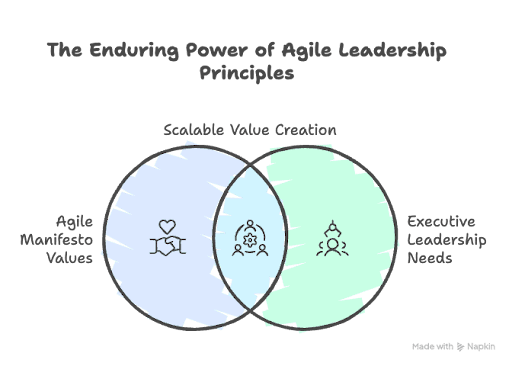
The Agile Manifesto is now more than twenty years old, yet its core ideas remain highly relevant. The reason is simple: it does not prescribe specific solutions. Instead, it focuses on values.
It encourages organizations to prioritize:
These are not technical rules. They are leadership principles.
Executives sometimes ask whether Agile still applies outside software development. In reality, Agile thinking has spread far beyond engineering teams. Today, marketing departments, operations teams, educational institutions, and even government organizations use Agile principles.
Agile continues to work because it supports decision-making under uncertainty. It connects work to customer value and recognizes that creating value is ultimately a learning process.
For example, I’ve seen marketing teams adopt Agile approaches when launching campaigns. Instead of committing large budgets upfront, they ran small experiments first. Within a few weeks, they learned which messaging resonated with customers before scaling the campaign.
That is Agile thinking applied outside software.
One of the most misunderstood Agile principles is “deliver early and often.” Many interpret it as a push for speed. In reality, early delivery is about risk reduction. Smaller increments reduce the cost of failure, shorten feedback loops, and surface incorrect assumptions sooner.
I once worked on a product where the first release was delayed for months to “get it perfect.” When it finally shipped, users struggled with basic workflows that had never been tested outside the team. A smaller, earlier release would have exposed these issues in weeks instead of months and at a fraction of the cost.
From a quality and governance perspective, this matters. Large and delayed releases gather hidden technical, usability, performance, and compliance risks. Early delivery allows organizations to validate direction before scaling investment. It adjusts priorities based on evidence and makes informed trade-offs. This is not about moving faster; it is about learning faster.
Waterfall assumes that control comes from prediction. Agile assumes control comes from adaptation.
Neither approach is inherently wrong. Waterfall works well when problems are well understood. Agile excels when uncertainty is high.
Many organizations struggle because they apply Agile execution while retaining Waterfall thinking at the leadership level. This tension creates friction, especially for UX and QA roles, which depend on early learning and continuous feedback.
Agile teams can deliver working software efficiently. However, working software is not the same as a successful product. Without strong UX integration:
I’ve seen a system where all functional tests passed, and performance metrics met targets. On paper, the release looked flawless. Within days, users struggled with simple tasks, and support tickets spiked. Technically correct did not mean usable. This is not a tooling problem—it is a discovery problem.
Design Thinking focuses on a simple but critical question: are we solving the right problem?
Before jumping into solutions, it encourages teams to step back and understand users. This usually involves developing empathy for the people who will use the product, clearly defining the problem, and exploring possible approaches before committing to one direction.
For executives, this approach helps reduce risk. It lowers the chances of investing large amounts of time and money in a solution that does not address the real user need. For product and QA teams, it also brings clarity. When the problem is well understood, acceptance criteria become clearer, and there are fewer surprises late in development.
Design Thinking does not replace Agile. Instead, it helps guide it by ensuring the team is focused on the right challenge from the start.
Lean UX sits between discovering the problem and delivering the solution. Its biggest contribution is how it changes the way teams think about ideas.
Instead of treating requirements as fixed instructions, Lean UX encourages teams to treat them as hypotheses that need to be tested. Documentation becomes less important than experiments, and opinions are replaced with real evidence from users.
In simple terms, Lean UX asks: are we building the right thing?
I have seen teams spend weeks debating design decisions based purely on personal opinions. In one case, a quick prototype tested with a few real users proved the main assumption wrong within days. That small experiment saved the team weeks of unnecessary development work.
By validating assumptions early, Lean UX helps reduce waste and improve alignment across product, design, and engineering teams. It also helps teams treat failure as learning rather than as a setback.
From a quality perspective, this approach is valuable. Usability risks appear earlier, outcomes become measurable, and testing aligns more closely with how users actually behave.
Once the team understands the problem and has validated the direction, Agile becomes the execution engine.
At this stage, the main question changes to: are we building it correctly?
Agile supports incremental delivery, continuous integration, frequent testing, and the ability to respond quickly when requirements change. It helps teams move forward step by step instead of relying on large, risky releases.
However, Agile on its own is not enough. Teams can become very efficient at building software, but still end up building the wrong thing. When Agile is combined with Design Thinking and Lean UX, the three approaches create a continuous learning loop.
In many Scrum teams, UX is treated as a shared resource or supporting function. This often results in delayed insights and compromised outcomes.
A mature model treats UX as:
A full-time role within the team
A partner in decision-making
An advocate for user value
When I joined a team as the dedicated UX lead, backlog prioritization improved, acceptance criteria became clearer, and rework dropped noticeably within a few sprints. UX designers should participate throughout the product lifecycle and not just during design phases. When integrated effectively, quality improves by design, not by inspection.
An actionable strategy is not a long-term plan locked in documents. It is:
Lightweight
Rapid
Adaptable
Measurement is central. We measure not to control people, but to inform decisions. The key question is simple: is it working?
Organizations that act to learn outperform those that plan to predict.
These practices work best when they follow a clear flow:
When teams skip these steps, the risk increases. When the order changes, unnecessary work often follows. For leaders, keeping this sequence intact helps ensure that investment decisions are based on evidence and that execution remains flexible.
An effective strategy is not a long document that stays unchanged for years. In practice, strategy needs to remain flexible.
The most useful strategies tend to be:
Measurement plays an important role here. The purpose of measurement is not to control people, but to help teams make better decisions. The most important question is simple: is this actually working?
Organizations that learn through action often outperform those that rely only on long-term predictions.
Agile, Lean UX, and Design Thinking are not trends. They are responses to the realities of modern product development.
When applied in isolation, their impact is limited. When integrated thoughtfully, they form a powerful system for learning, quality, and innovation.
As a Principal SQA Engineer, I have seen that quality is not enforced; it emerges. It emerges from clarity of purpose, early learning, and shared ownership.
Organizations that embrace this integrated mindset move beyond shipping software. They create products that matter, adapt with confidence, and build trust with their users.
The real promise of Agile is not speed but sustained value.

Trusted by top platforms for our transformative solutions and exceptional results: