
 Add as preferred on Google
How to Modernize a Legacy Learning Platform Without a Full RewriteRead More
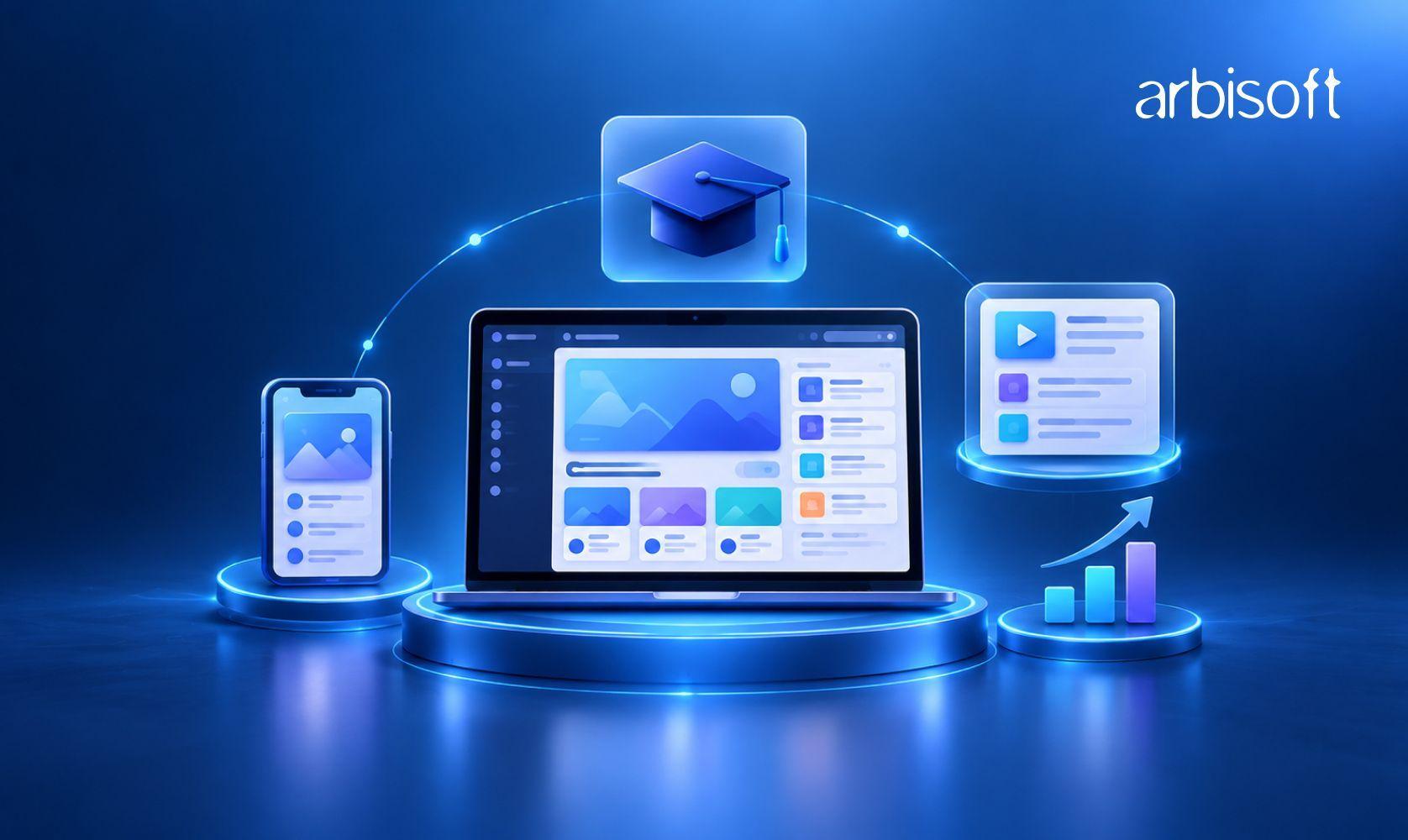
EdTech software development in 2026 is the process of building, integrating, modernizing, or scaling digital platforms that deliver, manage, and measure learning. Successful products require more than a strong feature set; teams must make informed decisions about platform type, MVP scope, architecture, AI, accessibility, privacy, integrations, budget, and engineering talent.
This guide walks through the complete EdTech software development process, from validating an idea and defining version one to choosing the right tech stack, building AI-powered capabilities, meeting institutional requirements, estimating development costs, staffing the project, and selecting a development partner. It is designed to help founders, product leaders, CTOs, and education organizations plan and build scalable learning software with fewer costly mistakes.
EdTech software development is the work of building, extending, integrating or modernizing software that delivers, manages or measures learning. A new LMS written from scratch is one case among many. Most 2026 projects start from something that already exists: an Open edX or Moodle instance that needs a new business model, a legacy platform that fails a security review, or a mature product that needs AI features.
Education software also carries obligations that ordinary SaaS can often skip. Institutions buy through procurement, so products are expected to meet WCAG 2.1 AA accessibility and supply a VPAT, handle student data under rules such as COPPA and FERPA, and connect through standards like LTI 1.3 and OneRoster. Traffic follows the academic calendar, with term start and exam windows packing heavy demand into a few days.
Each obligation is scoped engineering work. This is why two vendors can quote $150,000 and $400,000 for what looks like the same feature list, as the EdTech software development cost guide explains. Teams that plan for these requirements from the first sprint avoid the most expensive rework later.
The first decision is the job the platform exists to do. Two products both called "learning platforms" can share almost no core workflow, so the label on a pitch deck says little about what needs to be built.
Function is one of four dimensions. Audience, delivery format (self-paced, live, cohort, mobile-first), business model and deployment (hosted, open source, single-tenant or multi-tenant) each change the scope independently. A marketplace, for example, needs provider onboarding, payouts and dispute handling that a branded academy never touches.
The category also decides the build route. Many requirements are well served by configuring an existing product or extending Moodle or Open edX, and custom development pays off when a distinctive workflow or learning mechanic is the reason customers choose the product. EdTech platform types explained compares each family and walks through the buy, adapt, integrate or build choice in detail.
Most EdTech products that fail were built exactly as requested, for a problem that was never tested. A request for a mobile app may turn out to be a lesson-completion problem that a responsive redesign or a Progressive Web App solves at a fraction of the cost. Discovery exists to catch that before budget is committed.
A workable roadmap moves through ten stages, and each one produces the input for the next:
The administrator experience deserves as much discovery as the learner experience. A confusing permissions model or a missing report export can lose a renewal that the learner-facing product had already won.
A mid-complexity MVP usually takes three to six months from discovery to a controlled launch. Discovery takes two to four weeks, MVP development eight to sixteen, and pilot testing four to eight. Heavy video, real-time collaboration, AI personalization or several institutional integrations push that longer. The EdTech product development roadmap covers each stage with deliverables and timelines.
Startups face the same stages with less runway and less room for a second attempt. The priority is a first release small enough to ship quickly and specific enough to prove one outcome to one audience, whether that is learners paying directly or a school agreeing to a pilot. Early choices about hosting, data models and third-party services should keep the path to institutional sales open without paying for it upfront. EdTech app development for startups covers MVP scoping, validation and funding-stage decisions for founders.
Feature scope follows five answers: who is learning, how learning is delivered, what content the platform carries, how it earns money, and what outcome it must produce. Settle those first and the feature list mostly writes itself. Skip them and the backlog fills with a competitor's history.
Most learning products share one foundation:
Everything else depends on the model. Certificates with expiry matter to compliance and certification buyers. Scheduling is the core of a tutoring product. Payouts and discovery define a marketplace. Native mobile apps earn their cost when offline access or push reminders are central, and responsive web covers most other cases.
Because each of these choices changes engineering scope and sequencing, teams estimating how long does it take to build an EdTech platform should define the version-one feature set before committing to a delivery timeline.
The most common scoping mistake is polishing the learner interface while under-building the admin layer. Without bulk imports and client-scoped reporting, every new customer becomes a manual onboarding project. Learning platform features to build includes an eight-question prioritization framework and a feature matrix for corporate, tutoring, certification, customer education and marketplace products.
Architecture for a learning platform follows the workload, and the workload follows the learning model. A registration count says little on its own. The same headline number can hide four different bottlenecks:
| Scenario | Where the system is stressed |
| 100,000 learners in self-paced courses over a month | Cacheable reads and video delivery; one well-indexed database copes |
| 30,000 employees finishing compliance training in the last 48 hours | Completion writes, certificate generation and manager reports spike together |
| 10,000 students starting a timed exam at 9:00 a.m. | Continuous autosave writes with audit requirements |
| 5,000 concurrent live tutoring sessions | Media routing and TURN relay capacity; the database barely works |
The sensible order is product model, then workload patterns, then architecture, with technology selection last. Most teams make the technology decision first.
For most new platforms, a modular monolith is the right starting point. It keeps deployment simple and lets enrollment, payment and progress updates succeed or fail together. Clear internal boundaries between courses, assessment, billing and tenancy make it possible to extract a service later when a specific workload, such as video transcoding or AI inference, needs to scale on its own.
A common default stack pairs React (with Next.js for public catalog pages) with Node.js or Python on the backend, PostgreSQL as the system of record, Redis for caching and object storage behind a CDN for media. Java or .NET suit large institutional platforms maintained for a decade. The team's ability to operate the stack at 2 a.m. matters more than the language.
Three decisions are expensive to change once customer data exists: the tenancy model, the core data model and whether assessment integrity was designed in. Integrations also shape the data model early. SAML or OIDC single sign-on, SCIM provisioning, HRIS or SIS sync, LTI 1.3 launches and SCORM or xAPI tracking each change how users, organizations and progress are stored.
The best tech stack for a learning platform guide includes a layer-by-layer reference stack, requirements by platform type and a twelve-question decision framework.
Organizations that already run learning technology have five routes, and the right one depends on where their differentiation lives. Large programs usually combine several: extend the LMS, integrate the HRIS, build the assessment product and modernize reporting.
| Situation | Likely route |
| The product or workflow is the differentiator | Build custom |
| The requirement is standard and well served | Buy and configure |
| A good platform is missing one capability | Extend Moodle, Open edX or a commercial LMS |
| Individual systems work but the workflow breaks between them | Integrate |
| A valuable product is held back by its architecture | Modernize incrementally |
Integration is often the most underestimated route. A corporate compliance workflow can start with a new employee record in the HRIS, trigger role-based training, notify a manager, flag an expiring certification and update the compliance record. Almost none of that is learner-facing, and most of it is event handling, data mapping and error recovery.
Modernization rarely requires starting over. Isolating a bottleneck, extracting a service, replacing an integration layer or rebuilding the data model behind reporting usually returns more value at lower risk. A full rewrite should follow evidence that the current architecture cannot support the operating model.
Enterprise deployment also raises the bar on tenancy, delegated administration, SSO and observability. Weak tenant structure turns every enterprise customer into a manual setup project, and growth then adds implementation cost faster than revenue. Enterprise EdTech development explained walks through scoping questions, enterprise architecture requirements and the causes of overruns.
AI features succeed in EdTech when they sit on data the platform already structures well. Most of the engineering effort goes into grounding outputs in trusted sources, keeping tenant boundaries intact during retrieval, putting people at the right review points and measuring whether outputs are correct.
Two AI capabilities come up most often, and they solve different problems.
AI authoring shortens the assembly of course content. Review time stays roughly where it was, because models fail unevenly and some drafts fall outside what they do well. A maintainable design stores every learning objective, outline node, content block and assessment item as a versioned record linked to the source passages it came from. Assessments, learner-segment variants, translations and content updates then read from the same structure.
The generation pipeline mirrors how an instructional designer plans a course. It drafts objectives and an outline, stops for subject-matter expert approval of the outline, then generates grounded content and assessment items against a blueprint. Automated checks route weak or unsupported blocks to review. AI-drafted items stay provisional until learner response data confirms their difficulty, and certification use needs mandatory expert sign-off and an audit log.
Data residency narrows model choice for buyers in the GCC and Canada, where few frontier models run inside local cloud regions. How to build AI course authoring for a learning platform covers the architecture, quality gates, localization and a three-release implementation plan.
Adaptive learning changes what a learner sees next based on how they performed. Many established products do this with rules and item statistics and no generative AI at all. A production system needs a learner model that estimates mastery, an event pipeline that captures every attempt, a tagged item bank, a decision layer that selects the next activity quickly and a way to explain each recommendation to teachers.
Measurement decides whether personalization helps. Teams should define the learning outcome first, then test whether adaptive paths improve it against a fixed-path control group. How to build an adaptive learning platform with real-time personalization details the architecture and the order in which to build it.
A practical sequence for most platforms starts with AI that supports staff (authoring, grading assistance, content search), then moves to learner-facing features once data quality and review processes are proven.
The learning mechanics inside a product decide whether it improves results, and two of them shape the build more than most: assessment and engagement design.
Assessment engineering scales with the stakes. A practice quiz needs speed and instant feedback. A placement diagnostic needs a calibrated item bank. A formal exam needs controlled question exposure, timing, reliable scoring, appeals and a retained record of every attempt. Identity checks and proctoring belong in high-stakes certification, where a score gates a credential, and add cost without value in a weekly quiz.
Digital assessment is also moving toward continuous measurement. Frequent low-stakes checks, feedback within seconds and analytics that flag struggling learners early give teachers more to act on than a single end-of-term exam. The platform has to record each attempt as an event with a stable item ID for that to work. The future of assessments in EdTech looks at how these methods change the way student progress is measured.
Points, badges, streaks and leaderboards work when they target a specific behavior, such as finishing a module, returning weekly or completing a practice set. The team should name that behavior and the metric that will show whether it changed before building anything. Without that link, gamification adds data models and screens that measure nothing.
STEM subjects show the strongest fit, because problem sets, simulations and challenge levels map naturally onto progression mechanics. How gamification in EdTech elevates STEM education covers examples and design patterns.
Compliance requirements run through every step above, and they cost far more to retrofit than to design in. They also decide whether an institution can buy the product at all, since most reach vendors through procurement questionnaires and VPAT requests.
| Requirement | What applies in 2026 |
| Accessibility (US public sector) | ADA Title II names WCAG 2.1 AA; compliance dates are April 26, 2027 for entities serving 50,000+ people and April 26, 2028 for smaller ones |
| Accessibility (EU) | European Accessibility Act in force since June 28, 2025, including for non-EU sellers |
| Children's privacy (US) | Amended COPPA Rule, full compliance required by April 22, 2026 |
| Student records (US) | FERPA for records held by covered institutions |
| EU and other regions | GDPR, Saudi PDPL, Quebec Law 25 and similar rules |
| Interoperability | LTI 1.3, OneRoster, QTI, SCORM, xAPI and cmi5 |
WCAG 2.2 has been a W3C Recommendation since October 2023, and building to it keeps a product ahead of buyers who update their requirements. Legal obligations vary by audience, age and jurisdiction, so the consent model and data flows should be confirmed with counsel before they are built.
The cost guide breaks down how each of these requirements affects budget. The enterprise EdTech guide covers data governance, identity and tenant isolation in more depth.
A focused EdTech MVP costs roughly $92,000 to $281,000 with an offshore team in 2026. A production platform for institutional buyers runs $274,000 to $896,000, and a high-stakes assessment system $548,000 to $1.68 million. Every estimate reduces to people multiplied by months multiplied by an hourly rate.
The build route moves the number more than any single feature. Configuring commercial SaaS costs least upfront but adds per-seat licensing as the product grows. Building on Open edX or Moodle removes the foundation work while leaving engineering for customization, hosting and upgrades. A from-scratch build costs the most and gives full control.
After launch, the project cost becomes a run rate. Hosting and video delivery grow with usage, AI features add an inference cost per interaction, and compliance work recurs as standards change. The engagement model sets who absorbs overruns:
Many EdTech products that reach institutional customers combine a short fixed-price discovery with a dedicated team for the build that follows. EdTech software development cost in 2026 explains each cost driver and includes seven questions that make vendor quotes comparable.
Team planning starts with capabilities that need an owner, and headcount follows. Seven appear on almost every EdTech product: product ownership, UX design, frontend, backend, QA, technical leadership and infrastructure. The product decides which specialists join them. Integrations need backend and identity depth, children's data needs privacy expertise, and adaptive features need data and ML engineering.
An MVP team is built for coverage. A founder-led assessment product might run with a product owner, a technical lead who also codes, one or two full-stack engineers, a part-time designer and a QA engineer, buying security and accessibility help as needed. As institutional customers arrive, ownership splits: integrations, reliability during term starts and procurement security reviews each need a named owner.
| Model | Best fit |
| In-house | Long-horizon roadmaps with technical leadership already in place |
| Project outsourcing | Bounded, fully specified scope |
| Dedicated external team | Ongoing work without building an engineering organization |
| Hybrid | Internal product and architecture ownership with external capacity or specialists |
Every model still needs internal product ownership. Hiring should also follow dependency order: someone must own the data model before four developers start writing code against it.
Comparing an internal salary to an external hourly rate usually misleads, because one excludes recruiting, management and idle time while the other often includes them. How to build and hire an EdTech development team turns a roadmap into a staffing plan and covers what drives team cost.
The right partner has built something close to the product in question and can show the evidence. "EdTech experience" alone predicts little, because a consumer study app and a district platform with SIS rostering are different engineering problems.
A useful evaluation tests the vendor's reasoning in these areas:
Proposals become comparable once every vendor answers the same questions. Two quotes for the same feature list often describe different products, one priced as a demo and one priced to pass an accessibility audit and survive term-start traffic.
How to choose an EdTech development company lists the questions to ask before signing and the evidence to request. For a starting shortlist grouped by what each firm builds best, see the top EdTech technology partners in 2026.
Three shifts are shaping what buyers will expect from education software over the next few years. AI is moving from standalone chat features into authoring, feedback and personalization built into the platform. Learning is spreading across every age group, with workforce reskilling and lifelong learning growing alongside K-12 and higher education. Regulation is catching up, through accessibility deadlines, children's privacy rules and the EU AI Act, which classes several education uses of AI as high-risk.
Products designed today should expect all three. Structured content data, event capture from the first release and a clear compliance posture make it far cheaper to add capabilities later. Education in 2026: how tech and AI will redefine learning for all ages explores these trends in more detail.
Most readers arrive with one decision in front of them. This table maps the common starting points to the guides that answer them first.
| Current stage | Typical situation | Start with |
| Idea | An education concept with no product yet | Platform types, product roadmap, startup app development |
| MVP | The product is defined and version one needs a scope | Features, team, cost |
| Growth | Users are arriving and the platform must scale | Tech stack, adaptive learning, team |
| Institutional sales | Selling to universities, districts or enterprises | Enterprise EdTech, cost |
| Modernization | An existing product is holding the business back | Enterprise EdTech, tech stack, AI course authoring |
| Vendor selection | Scope is clear and a partner is needed | Choosing a company, top partners, cost |
A focused MVP usually takes three to six months from discovery to a controlled launch. A production platform for institutional buyers with SSO, LTI, multi-tenancy and accessibility conformance typically takes eight to twelve months. High-stakes assessment systems can run twelve to eighteen months.
With an offshore team, a focused MVP costs roughly $92,000 to $281,000 and a production institutional platform $274,000 to $896,000. The same builds with an in-house US team cost about two to three times more. Accessibility, integrations and multi-tenancy move the number more than the feature list does.
An open-source base is usually the cheaper route when the differentiator is content, pedagogy or service. Custom development pays off when a distinctive learning mechanic, workflow or data model is the reason customers choose the product. Many programs combine both, extending an open-source LMS and building the differentiating features around it.
It depends on the audience and market. US public institutions expect WCAG 2.1 AA and a VPAT, products for children under 13 fall under COPPA, and student records fall under FERPA. EU learners bring GDPR and the European Accessibility Act. Counsel should confirm which rules apply before the data and consent model is built.
A responsive web app or Progressive Web App serves most products. Native apps earn their cost when offline access, push reminders or frequent short sessions on the move are central to how people learn.
In most cases it can. Extracting a bottleneck into a service, replacing an integration layer or rebuilding the data model behind reporting can remove the main constraints at lower risk. A rewrite is justified only when evidence shows the architecture cannot support the required operating model.
The client should own the source code, intellectual property, pipelines and cloud accounts outright, and the contract should say so explicitly.
Every EdTech project starts from a different place. Some teams need a new product, some need an existing LMS to support a new business model, and some need AI features, institutional integrations or extra engineering capacity. A short technical conversation usually shows which of these applies before budget is committed.
Arbisoft has worked on Open edX with edX since 2013, with more than 150 people contributing to a platform used by over 20 million learners and 140 partners (edX case study). The same education team builds custom learning platforms, AI course authoring through its Edly division, integrations and dedicated engineering teams for EdTech companies and institutions.
Discuss your EdTech product with the team, and bring your roadmap, current systems and constraints.
...Loading Related Blogs
Trusted by top platforms for our transformative solutions and exceptional results: