
 Add as preferred on Google
How to Modernize a Legacy Learning Platform Without a Full RewriteRead More
Bad code sinks fewer EdTech products than most people assume. The more common failure looks like this: a team builds exactly what the client asked for, then discovers the request never matched what the business or its users needed.
That gap matters more in education technology than in almost any other software category. A single EdTech platform might serve a student on a shared classroom tablet, a teacher planning lessons between classes, a school administrator responsible for compliance and billing, and a parent checking progress on a phone. Those four people are often inside the same system during the same week.
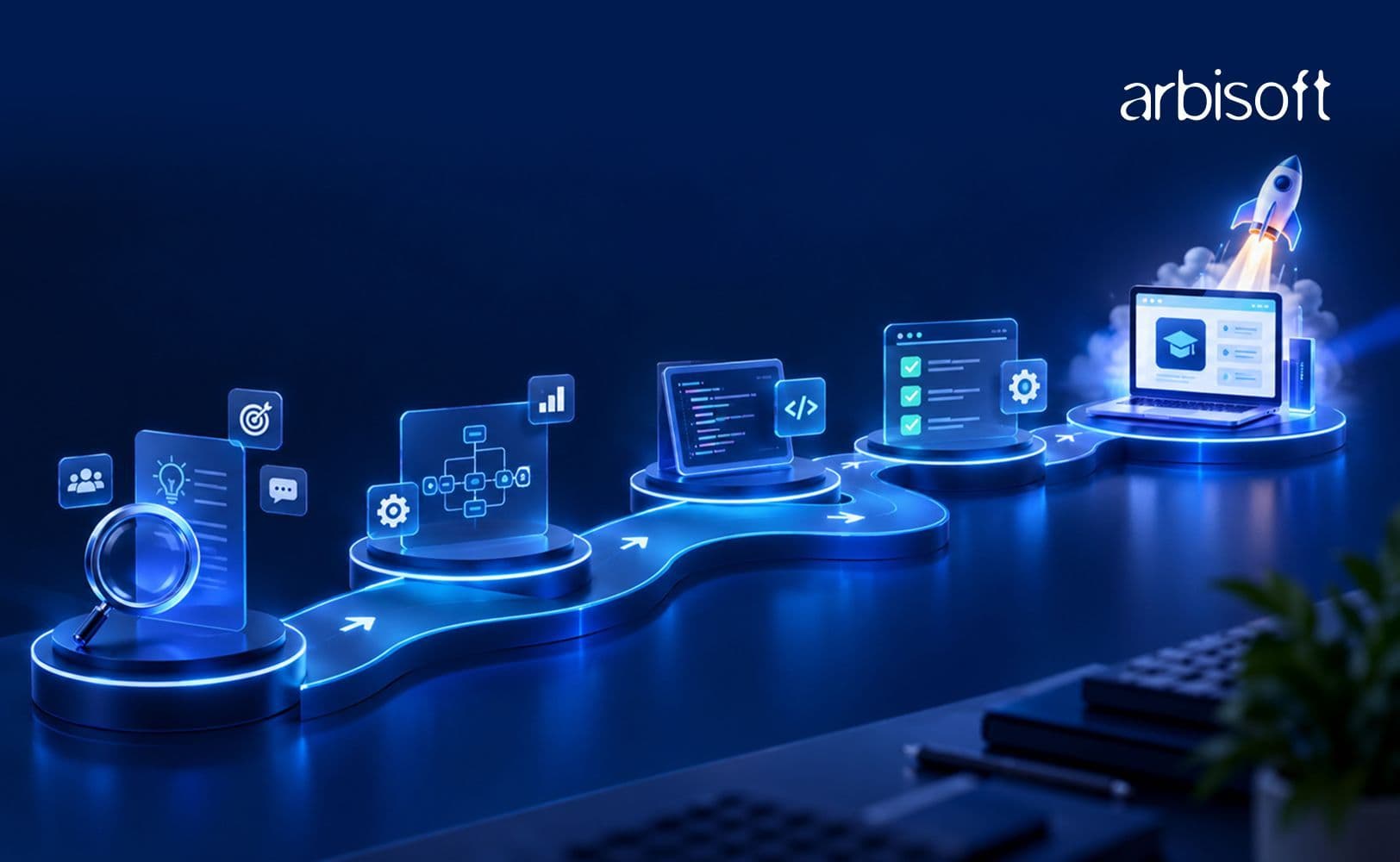
This article lays out a realistic EdTech product development roadmap: how a business problem becomes a validated product strategy, how that strategy becomes an architecture and a working product, and how the product keeps improving after launch. It answers the practical question of how to build an EdTech product that survives contact with real classrooms, institutions, and learners, and not only in a demo. It's written for EdTech founders, product leaders, CTOs, school administrators, and training organizations who are either planning a build or evaluating an EdTech product development company to build it with them.
Generic software development optimizes for one thing: whether the feature works as specified. EdTech software development has to satisfy several requirements at once, and they don't always pull in the same direction.
A few factors make education technology product development structurally different from a typical SaaS build:
Given that complexity, a client's first instinct about what to build works best as an early hypothesis. A strong EdTech development partner tests that request instead of closing the ticket on it.
When you're planning an EdTech product, it's natural to come into the conversation with a solution already in mind.
Maybe it's a mobile app, an AI tutor, a new LMS, or a more advanced student dashboard. Sometimes that first idea is exactly right. But before budget and development time go into it, it's worth checking that the solution actually addresses the underlying problem.
Say a company approaches an EdTech product development partner and asks for a mobile application. A closer look at the users and their behavior in the current product might reveal something else: students aren't completing lessons because the existing platform is hard to use on a phone.
That changes the conversation.
A native mobile app could still be the best option, but it may not be the only one. A responsive web redesign, a Progressive Web App, offline access, simpler lesson navigation, better onboarding, or more useful notifications could solve the same problem at a very different level of investment.
This is why the discovery stage matters.
Before deciding what gets built, a development partner should help you understand the reason behind the request, the users affected by it, and the outcome you want. Arriving with a perfectly defined technical solution isn't the client's job. Figuring that out is part of what an experienced EdTech development company is hired to do.
A strong partner won't simply turn an initial feature list into a proposal. They should be willing to ask questions, test assumptions, and recommend a different approach when it better supports your users, budget, or business goals.
That kind of pushback has a practical purpose: making sure the product you fund solves the right problem before development starts.
Before a development company starts estimating features, budgets, or timelines, the problem the product needs to solve should be clear. A good EdTech partner will work through these questions with you during discovery instead of expecting every answer up front.
Once the real problem is defined, the next step is mapping every Ideal Customer Profile (ICP) the product serves, including the ones who never touch the invoice. Common ICPs include students, teachers, tutors, parents, school administrators, corporate trainers, institutional decision-makers, and content creators. Each of these groups needs a different experience, and a recolored version of the same screens won't cover it.
Priorities here are easy navigation, visible progress, engagement mechanics, clear assessments, appropriate gamification, and personalized recommendations. If a student has to think about the interface, the interface has already failed.
Priorities here are course and curriculum management, student performance dashboards, assignment creation and grading, communication tools, and the ability to create content without engineering support.
Priorities here are user management, granular permissions, institution-wide reporting, billing, compliance controls, and configuration that works across multiple schools or departments.
Teams naturally put their energy into the student and teacher experience, since that's where engagement is won. The admin portal, though, often determines whether an institution renews at all. A confusing permissions model or a missing report export can quietly kill a deal that the learner-facing product had already won, which is why admin-side strategy deserves the same discovery rigor as the rest of the product.
With the problem and ICPs defined, requirements have to be put in order. A flat feature list won't do that work, and this is where EdTech product strategy earns its keep by turning a long wish list into an ordered plan. A simple framework:
The most common mistake at this stage is trying to launch every ICP's full wish list at once. EdTech MVP development means building the smallest version that real users can test and that produces a usable signal. A smaller, worse copy of the full product doesn't qualify.
Several techniques make prioritization defensible: user journey mapping to see how users move through the product today and where they get stuck, product discovery conversations with real or prospective users, feature prioritization scored on effort and impact instead of the volume of internal requests, prototype testing before a line of code is written, and technical feasibility analysis so ambitious ideas like live video at scale or AI grading get costed honestly before anyone promises them.
Architecture decisions made in the first few weeks quietly determine cost, performance, and flexibility for years. "We'll fix it later" is the most expensive sentence in an EdTech software development project.
A solid EdTech software architecture needs a deliberate answer for front-end architecture (web, mobile, or both; native or cross-platform), back-end architecture (monolithic or modular, sized to the team and the complexity), database design for student, course, and performance data, APIs designed with future integrations in mind, beyond the screens being built now, cloud infrastructure with auto-scaling for enrollment spikes, content management and versioning, authentication and SSO, flexible user roles and permissions, analytics instrumented from day one, notification infrastructure, video infrastructure, real-time communication for live classes or chat, and a clear plan for third-party integrations.
Common EdTech integrations to plan for include LMS platforms (Canvas, Moodle, Google Classroom), Student Information Systems, payment gateways, video conferencing tools, assessment and proctoring systems, CRM platforms, and learning analytics tools.
Architecture should be designed for two timelines at once: the requirements in front of the team now, and a realistic growth scenario 18 to 24 months out. Over-engineering wastes budget. Under-engineering for growth that's already visible on the roadmap creates a rebuild that costs far more than doing it right the first time.
With strategy and architecture settled, development splits into parallel workstreams: UX/UI design validated against the journey maps, front-end and back-end development, admin portal development (often under-scoped), API development, integrations, QA, security testing, and performance testing under realistic load.
Agile fits well here because it ships functional slices incrementally, starting with a working registration flow, then a lesson player, then a gradebook, instead of one big-bang release. Each increment is also a chance to validate assumptions before the next one gets built, which leads directly into the next stage.
One consistent difference between EdTech products that succeed and those that quietly underperform is when real users enter the process. Teams that wait until launch are testing their assumptions for the first time at the highest possible stakes.
Real ICPs should be testing the product throughout development, through user interviews, prototype testing, usability testing on early builds, beta and pilot programs, classroom testing under real conditions, milestone-based feedback surveys, and analytics on early builds.
This is where three things separate visibly: what stakeholders think users need, based on assumptions and past experience; what users say they need in interviews and surveys, which is shaped by how the questions are asked; and what users actually do, which only shows up when you watch real behavior.
Take a corporate training platform whose stakeholders assumed employees wanted more video, since interviews suggested video felt more engaging. Pilot data showed the opposite. Video completion ran lower than short interactive modules, because employees were training in short gaps between meetings and video needed sustained attention. The roadmap shifted to shorter, interruptible formats, a decision interviews alone would never have surfaced. Catching that during a pilot costs a sprint. Catching it after full launch costs a churn wave and a much larger rebuild.
Before going live, a responsible EdTech development process includes final QA across roles and devices, security checks (including penetration testing where student data is involved), performance testing under peak load, data migration for institutions leaving a legacy system, onboarding flows, verified analytics, support readiness and documentation, teacher and admin training, a pilot rollout, and a deliberate choice between a phased and a full launch.
A controlled rollout usually wins. A phased launch, one school or cohort at a time, catches integration and usability issues while the blast radius is small. Education buyers are also tightly networked, so a rocky full-scale launch can do reputational damage well out of proportion to the bug that caused it. A phased rollout largely avoids that.
Launch starts the product's real lifecycle. Teams should track user activation, engagement and time-on-task, completion rates, daily and monthly active users, retention by cohort, feature adoption, teacher activity, support request volume, conversion rate, and churn.
This data feeds back into the roadmap the same way early ICP testing did, showing where the product delivers value, where users get stuck, and which should-have features are worth building next. Continuous improvement is what separates a product with a long, healthy lifecycle from one that plateaus right after launch.
| Stage | Main Objective | Key Activities | Main Stakeholders | Typical Deliverables |
| 1. Discovery | Identify the real business/user problem | Stakeholder interviews, requirement discovery | Founders, product leads, dev partner | Problem statement, discovery report |
| 2. User/ICP research | Understand who the product must serve | User interviews, persona and journey mapping | Students, teachers, admins, product team | ICP profiles, journey maps |
| 3. Product strategy | Define what to build and in what order | Feature prioritization, MVP scoping | Product leads, engineering, stakeholders | Roadmap, MVP scope document |
| 4. UX/UI design | Design usable, role-specific experiences | Wireframes, prototypes, usability review | Designers, ICPs, product team | Wireframes, clickable prototypes |
| 5. Architecture | Design a scalable technical foundation | System design, integration planning | CTO/tech leads, engineers | Architecture diagram, tech stack decision |
| 6. Development | Build the product | Front-end, back-end, admin, API development | Engineering team | Working software increments |
| 7. Testing | Ensure quality, security, performance | QA, security testing, load testing | QA team, security engineers | Test reports, bug fixes |
| 8. ICP validation | Confirm the product works for real users | Beta/pilot programs, feedback analysis | Real students, teachers, admins | Validated feedback, revised backlog |
| 9. Launch | Release the product responsibly | Final QA, training, phased rollout | Full project team, institutional stakeholders | Live product, training materials |
| 10. Continuous improvement | Improve using real usage data | Metrics tracking, roadmap updates | Product team, support, users | Updated roadmap, product releases |
The sequence matters because each stage produces the input the next one depends on. Teams that skip ICP research and jump straight to architecture end up designing for assumed users. Teams that skip pilot testing and go straight to a full launch find their usability problems at maximum scale instead of minimum scale. The order exists to catch expensive mistakes while they're still cheap to fix.
Before any responsible EdTech development company gives a timeline, several things need to be clarified: target users and how many ICPs the product will serve, product scope and MVP definition, required integrations, content requirements, platform scope (web, mobile, or both), admin-side complexity, user roles and permissions, security and compliance requirements such as FERPA, COPPA, GDPR, and accessibility, data migration needs, analytics requirements, and scalability expectations over the next 12 to 24 months.
A firm timeline given before those are answered almost always gets revised upward mid-project, and that revision is usually where trust between client and vendor starts to break down.
There's no single universal EdTech development timeline. Complexity varies enormously between a single-school pilot tool and a multi-tenant platform serving hundreds of institutions. Realistic ranges for a mid-complexity MVP:
| Phase | Typical Duration |
| Discovery | 2-4 weeks |
| UX/UI design | 3-6 weeks |
| Architecture planning | 2-4 weeks (often overlapping with design) |
| MVP development | 8-16 weeks |
| QA | 2-4 weeks (ongoing throughout) |
| Pilot testing | 4-8 weeks |
| Launch preparation | 2-3 weeks |
A focused EdTech MVP development effort often runs three to six months from kickoff to a controlled launch. Products with heavy video infrastructure, real-time collaboration, AI personalization, or multiple institutional integrations should expect longer. Any vendor promising one fixed timeline before discovery is complete is estimating blind.
Strong answers are specific and grounded in past projects rather than generic reassurance. Look for a concrete example of a time the vendor pushed back on a client's request and why, an unambiguous written statement that the client owns the code and IP outright, and a real description of what continuous improvement looks like in practice, including which metrics get tracked and how often the roadmap gets revisited.
Comparing EdTech development cost purely by hourly rate is a reliable way to overpay in the long run. Rate is one input. The bigger driver is how much work the product actually needs and how well the first version gets built.
Major cost drivers include product complexity, number of ICPs, web versus mobile versus both, custom versus templated UX/UI, admin portal complexity, number of integrations, video functionality, real-time communication, AI functionality, analytics depth, content management sophistication, security and compliance scope, accessibility standards, QA depth, infrastructure choices, and ongoing maintenance.
Three pricing models come up most often. Fixed price gives predictable cost for a clearly scoped MVP, though it fits poorly when requirements will keep evolving out of discovery and testing. Time and materials suits iterative, discovery-driven work, and it needs transparent reporting to keep budgets trustworthy. A dedicated development team embedded with the client fits a long, evolving roadmap best, offering the most flexibility in exchange for more active client involvement.
Total Cost of Ownership goes beyond the initial invoice. Cloud infrastructure and hosting, third-party API fees, ongoing maintenance, support, upgrades, security patching, and new feature development driven by post-launch data all belong in the real cost picture.
The cheapest vendor at proposal stage can turn into the most expensive one over the product's lifetime. Poor architecture, skipped security work, or an MVP built without real ICP validation often surfaces 12 to 18 months later as a costly rebuild, at which point the savings are long gone.
Most mid-complexity EdTech MVPs take three to six months from discovery to a controlled launch. Simpler, single-ICP products can move faster. Platforms with heavy integrations, video, or AI features take longer.
It depends on complexity, number of user roles, integrations, and platform scope far more than on any vendor's hourly rate. A realistic quote should follow a discovery phase, not precede it.
An MVP solves the core validated problem for the primary ICP with the smallest feature set that produces a real usage signal. A full platform adds the should-have and future-roadmap features once that signal confirms the direction is right.
It depends on the actual problem. If the issue is discoverability or install friction, a Progressive Web App or a responsive redesign may solve it without native app development costs.
Through structured methods run throughout development: user interviews, clickable prototype testing, usability sessions on early builds, and beta or pilot programs with real classrooms, schools, or trainee groups.
A partner that runs real discovery before proposing a solution, has built multi-role products before, tests with real ICPs during development, and stays engaged with continuous improvement after launch.
In a properly structured engagement, the client owns the source code and intellectual property outright. This should be explicit in the contract instead of assumed.
The path from a client's first request to a mature, continuously improving EdTech product follows a consistent shape: client problem, requirement discovery, ICP research, product strategy, UX/UI design, architecture, development, real-user testing, launch, and continuous improvement. Skipping steps in that sequence rarely saves time. It moves the cost of the skipped work later into the project, where fixing it is more expensive.
Building a successful EdTech platform takes more than strong engineering. It takes product thinking that questions assumptions, real user research across every ICP the platform touches, working knowledge of how education and training environments actually operate, UX expertise tuned to very different users, architecture built for the growth already visible on the roadmap, and continuous validation after launch.
If you're evaluating an EdTech development partner, look for one that asks harder questions than "when do you need this by," one willing to challenge a request when the data points elsewhere, and one that thinks about your product's second year as seriously as its first release.
...Loading Related Blogs
Trusted by top platforms for our transformative solutions and exceptional results: