

 Add as preferred on Google
Odoo Customization Guide for Smarter ERP DecisionsRead More
Build a travel booking website in this order: decide whether you are an OTA, a direct booking site, or a booking engine, apply to a hotel bedbank or a GDS for inventory, open a high-risk merchant account, register as a seller of travel wherever your customers live, then validate demand on a white-label platform before you write custom code. Supplier approval and merchant onboarding each take weeks to months, and either can be refused, so both belong in week one. A hotel booking MVP runs $50,000 to $100,000 USD and a full platform $250,000 and up. The website is the last problem to solve.
You don't need permission to build the website. You need permission for almost everything else.
If you have searched how to build a travel booking website, or how to build an OTA like Booking.com, or a flight booking website from beginning to end, you have probably opened five or six articles by now. They all did the same thing. They listed features you already knew you needed (search bar, filters, user accounts, payment gateway, admin panel), then quoted a cost range from two thousand dollars to a million.
Listing "search bar" as a feature of a travel booking site is like listing "doors" as a feature of a car. Accurate, and no help to anyone.
This is what those pages skipped:
None of those are development problems. Every one can stop you. They all run on other people's timelines, which is why they belong at the start of your project. Month five, with the money already spent, is too late.
We know this because we have been building travel technology since 2007. We have been KAYAK's engineering partner since 2008, with around 70 people across 17 teams working on more than 45 parts of a product that handles billions of searches a year. We built Sastaticket.pk from scratch and it became Pakistan's largest OTA by flight booking volume. We have done hundreds of integrations across Travelport, Amadeus and Sabre, plus direct connections to airlines, hotels and car rental companies. More recently we have been rebuilding how travel engineering itself gets done. Travly is a consumer hotel search and booking app run by a five-person team, and we set them up with an agentic engineering system.
This guide is ordered the way you should actually do the work: by how long you will wait on things you do not control. Supply, then money, then the legal reality. The tech stack arrives near the end, and that is the entire argument.
"Travel booking website" describes at least three businesses that share a phrase and almost nothing else. We have built all of them, so this is not hypothetical.
An OTA, or online travel agency. You sell other people's inventory, following the Booking.com, Expedia and Priceline model. This is the hardest of the three, because you own nothing you are selling. Sastaticket.pk works this way: flights from Sabre and Amadeus alongside Pakistan Railways and local bus operators, PNR generation, sold direct to consumers.
A direct booking travel website. You already have inventory (you are a hotel, tour operator, DMC, or an agency with real contracts) and you would like to stop paying an OTA 15 to 30% to sell your own rooms. This is far smaller, cheaper and more profitable than building an OTA. A meaningful share of the people who come to us asking about OTAs actually want this.
A travel booking engine. The component that searches, checks availability, holds a rate, and takes a reservation. If you already have a site and need the engine, you are scoping an integration.
A fourth shape is worth naming, because it is where some of the best businesses hide: B2B. Travelliance is a 30-year-old corporate lodging provider that books hotels for airlines when flights get disrupted. We built their platform, including accounting, reporting, and a custom API that plugs into airline systems and can place up to 500 stranded passengers from a single disruption. Seven million bookings a year across six continents, with no consumer marketing at all, because their customers are airlines.
Nobody searches "how do I build Travelliance." That's rather the point.
Then a second fork, and it matters as much as the first: hotels or flights. These are two separate builds. A hotel booking site means bedbanks, channel managers and rate-and-availability feeds. A flight booking website means GDS or NDC connections, fare rules, PNRs, ticketing deadlines, and a penalty regime that bills you for mistakes.
If this is you, you can stop reading here: you run one property, or you sell in one country, and you are content with the agency model where the supplier takes payment and you earn commission. Buy a white-label booking engine, connect it to your channel manager, and you will be live in two to six weeks for a few thousand a year. You need none of what follows, and we would rather tell you that than sell you a platform.
The ranges you have seen are meaningless because they average a WordPress plugin together with a multi-supplier aggregation platform. These are the factors that move the figure:
For rough anchors, all sourced from development agencies who have a commercial interest in the number, so treat them as opening estimates: a hotel booking MVP tends to land at $50,000 to $100,000, a full platform at $250,000 and up. Four to seven months for something focused, seven to twelve for a real OTA.
For calibration from our side, the Sastaticket build ran with a twelve-person team: architect, frontend, backend, UX, DevOps, QA. That is the shape of a serious OTA build, not two developers and a template.
None of those figures include the cash locked in a rolling reserve, or the months spent waiting on approvals that may never come.
This should have been the first section of every article you read. It was in none of them.
You can build a beautiful supermarket. Whether anyone will supply it is a separate conversation, and the wholesaler does not care how nice your shelves are.
Bedbanks are wholesalers. They buy inventory in bulk at net rates and resell it through an API, and realistically this is where a new platform starts.
Hotelbeds is the reference point: roughly 300,000 hotels, with onboarding that means verifying your company is legally registered and licensed where applicable, submitting a business profile explaining your distribution model, and starting on prepaid terms. They are built for partners who produce volume, and they are good at working out whether you will.
RateHawk is widely described as the easier door, with a pure B2B net-rate model, and integration partners reporting no minimum booking volume and fast sandbox turnaround. Worth saying plainly: those terms come from third-party integrators. RateHawk does not publish them. Ask them directly and get it in writing, because your business plan may depend on it.
This is Expedia's own supply, exposed to partners through an API. It is not open to the public.
You need a formal Expedia Partner Solutions agreement, evidence of PCI compliance unless you use their hosted checkout, and you must agree to carry TripAdvisor content. Applications are reviewed case by case, and launch requirements differ for B2C and B2B.
Read that again, because it is the sentence the feature-list articles cannot bring themselves to write: you apply, and they can turn you down.
That is the real answer to "how do I start building an OTA." You begin by finding out who will supply you, on what commercial terms, and how long their approval takes. If the answer is nobody, there is no website to build.
The highest margin and the slowest build, and it does not scale without people knocking on doors. Most platforms end up hybrid: a bedbank for breadth, direct deals in the niche or region they actually care about.
If you are here for flights, recalibrate. This is materially harder, and we say that having spent eighteen years inside it.
Airline content comes from a GDS (Amadeus, Sabre or Travelport) and increasingly from a mix of GDS and direct NDC connections. Amadeus integration typically runs $5,000 to $20,000. Sabre setup lands around $2,000 to $8,000, plus certification, plus a PCC before you can create a booking.
Worth knowing before you build a budget: none of the three publish a rate card. You ask three companies what something costs and you get invited to three meetings. Pricing turns on your access tier, your volume, and which API modules you switch on. Anyone quoting you a confident GDS number without having had that conversation is guessing.
For a small team, the realistic entry point is Amadeus's self-service tier, with a free sandbox and pay-as-you-go production. It is rate-limited to 50 search calls a minute on the free tier, but it is real, and it is how you find out whether your idea survives contact with actual fare data.
As of 2026, 73 airlines out of the 300-plus IATA represents are certified to deliver at least some content via NDC, and 81% of surveyed airlines report live NDC channels. Some carriers are past 50% NDC penetration of indirect bookings.
IATA's "100% Offers and Orders by 2030" target refers to capabilities being available. The industry has not switched over. Airlines run NDC, GDS and direct APIs in parallel, so you may end up building three paths to the same seat.
We can be specific about how long that tail is, because we still maintain integrations on EDIFACT, a message format standardised in the 1980s and comfortably older than most of the people currently searching how to build a travel booking website. Both formats, in production, today.
If your plan assumes clean modern JSON, adjust it.
Airlines audit agency bookings and bill you for errors, through something called an Agency Debit Memo. Miss a surcharge, misapply a fare rule, misuse a commission, and you get an invoice. Industry averages put a typical ADM around $269, with ticketing errors consuming roughly an eighth of the commission earned.
Hotels are the high-margin side. OTA commissions run 15 to 30%, with effective rates climbing toward 30 to 40% once visibility programs and promotions are counted.
Flights work differently, and the reason is structural. Airlines eliminated base commission to agencies two decades ago. What remains is a share of GDS fees, whatever incentive you can negotiate with a carrier, and whatever service fee you can add without losing the sale. Low-cost carriers mostly bypass GDSs entirely, so on those bookings there is no GDS fee to share either.
The codebase looks similar in both cases. The business does not. If you are indifferent between verticals, start with hotels. That is an opinion, and we will stand behind it.
Two decisions here, both routinely mistaken for implementation details.
In the agency model, the supplier takes the customer's money and you earn a commission. You never touch the funds. In the merchant model, you take the payment, become the merchant of record, settle with the supplier separately (usually by virtual card), and set your own price.
Comparison point | Agency model | Merchant model |
| Who takes the customer's payment | The supplier | You |
| Who sets the price | The supplier | You |
| Chargeback and refund liability | Effectively none | All of it |
| PCI burden | Light | Full scope |
| Working capital required | None | Rolling reserve of 5 to 15%, held 90 to 180 days |
| Fraud exposure | The supplier's problem | Yours |
Most people assume they want the merchant model, because "more control, better margins" sounds unambiguously good. Then comes the bill.
Travel carries a formal high-risk classification from acquiring banks, filed alongside the industries you would expect.
The logic makes sense from the bank's side. They take on liability the instant the card is charged, but delivery might be six months away. A customer books in January, flies in July, and can dispute at any point in between. If the supplier collapses, or a refund disappoints, the processor holds the bag.
So the bank behaves like a silent partner who expects you to fail, and has priced accordingly:
Then there are hard ceilings from the card networks, which changed recently enough that most write-ups still have them wrong.
Visa's VAMP replaced the old VDMP and VFMP programs on 1 April 2025, merging fraud and disputes into a single ratio, so you can no longer offset weakness in one with strength in the other. The merchant threshold was 2.2%, and from 1 April 2026 it dropped to 1.5% across North America, the EU and Asia Pacific. Monitoring begins once you pass 1,500 combined fraud reports and disputes in a month, and enforcement runs $8 per disputed or fraudulent transaction, with no grace period at the Excessive tier.
Mastercard's Excessive Chargeback Program works differently. You need to breach both a count and a ratio, sustained across two months: 100 to 299 chargebacks with a 1.5 to 2.99% ratio for ECM, 300-plus and 3%-plus for the high-excessive tier. Fines start near $1,000 and can pass $200,000. One quirk is worth knowing: Mastercard divides this month's chargebacks by last month's sales, so a slow sales month can push your ratio up even when disputes stay flat. Getting out takes three consecutive clean months.
There is a way through. Hold disputes well under the thresholds, process cleanly for six to twelve months, then formally request a reserve review with documented evidence. You have to survive year one to get there.
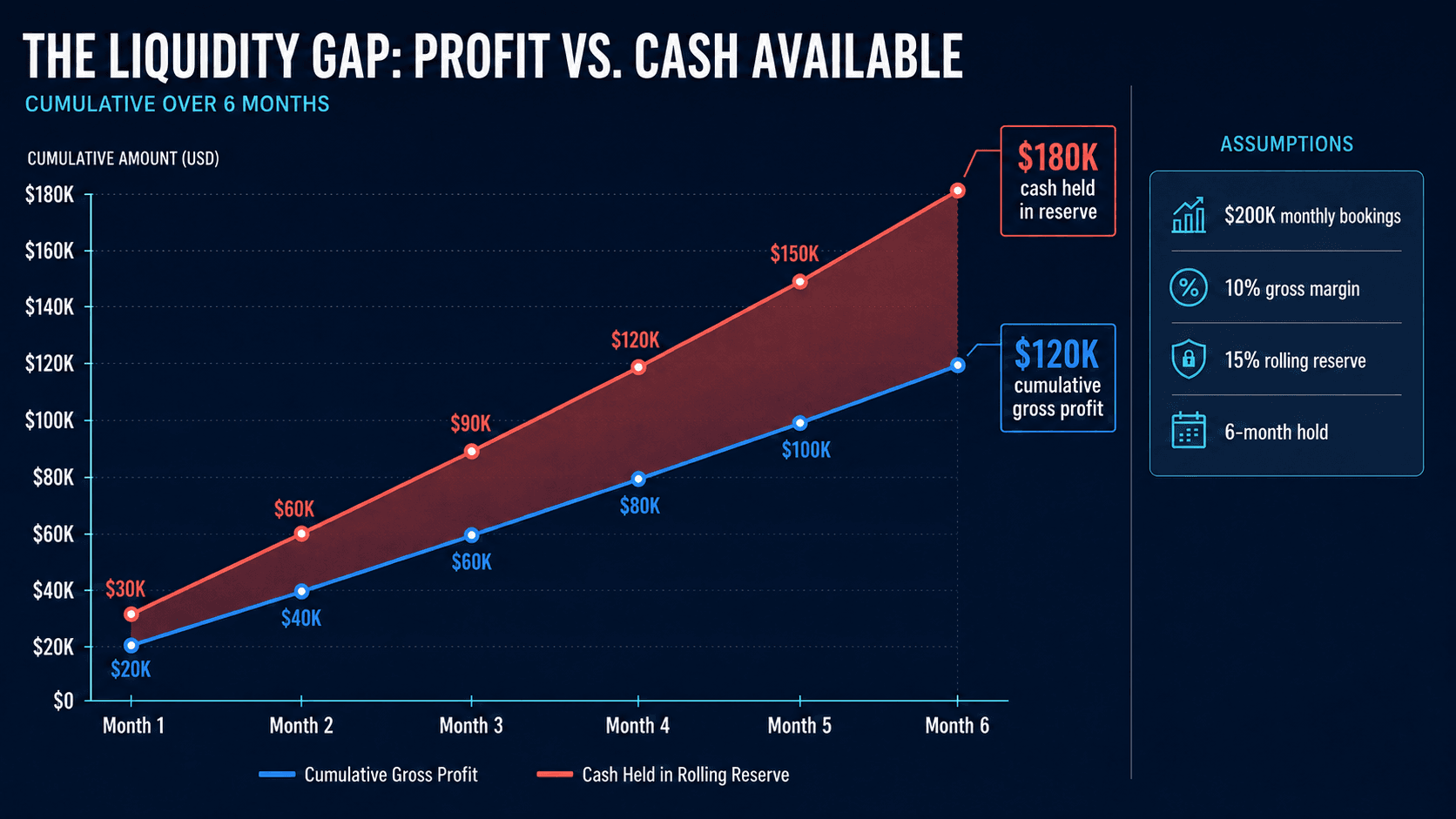
Say you are running $200,000 a month in bookings at a 10% margin, so $20,000 of gross profit. A 15% rolling reserve holds back $30,000 of that month's revenue for six months. Every month.
By month six, roughly $180,000 of your money is sitting in someone else's account, against $120,000 of cumulative gross profit.
You are profitable on paper and out of cash.
This is one of the most common ways these businesses die, and we could not find it discussed on a single page ranking for the query that brought you here.
This is not legal advice. Hire a lawyer. But know what you are walking into.
In the US there is no federal travel-seller licence. Four states run Seller of Travel registration: California, Florida, Hawaii and Washington.
Florida is the most clearly documented: $300 nonrefundable annual registration, proof of assurance in the form of a surety bond up to $25,000, and $50 a year for independent sales agents. ARC contractors with three or more years under the same ownership are exempt. It applies if you have a Florida business location or offer travel services in Florida.
California requires registration with the Attorney General, participation in the Travel Consumer Restitution Fund, and your CST number displayed in advertising to California clients. We are deliberately not printing California's fees, because the published figures disagree with each other and the assessments are being amended by current legislation. Check oag.ca.gov/travel for what is true the week you apply.
The detail that catches online businesses in every one of these states: you register based on where your customers live, not just where your office is. An OTA run from Texas selling to Californians is in scope.
For air ticketing, IATA accreditation (IATAN or ARC in the US) means financial audits, a premises inspection, documented verification, and a year of travel-related bank transactions. A bank guarantee or bond is required if your accounts show liabilities exceeding assets, so it depends on your financial position. Requirements vary substantially by country.
In the UK, if you sell flight-inclusive packages you must hold your own ATOL, act as an authorised agent for an ATOL holder under a written agency agreement, or qualify for an exemption under ATOL Regulation 10. Licensed operators post insurance bonds with the CAA. Watch your timing: the UK government has committed to legislating ATOL and Package Travel reforms by June 2026, so anyone entering the UK market now should check the current position rather than a 2024 guide.
By this point you have cleared the gates that cannot be coded around. From here, the difficulty is at least yours to control.
A problem that does not exist with one supplier and becomes your largest headache the moment you add a second.
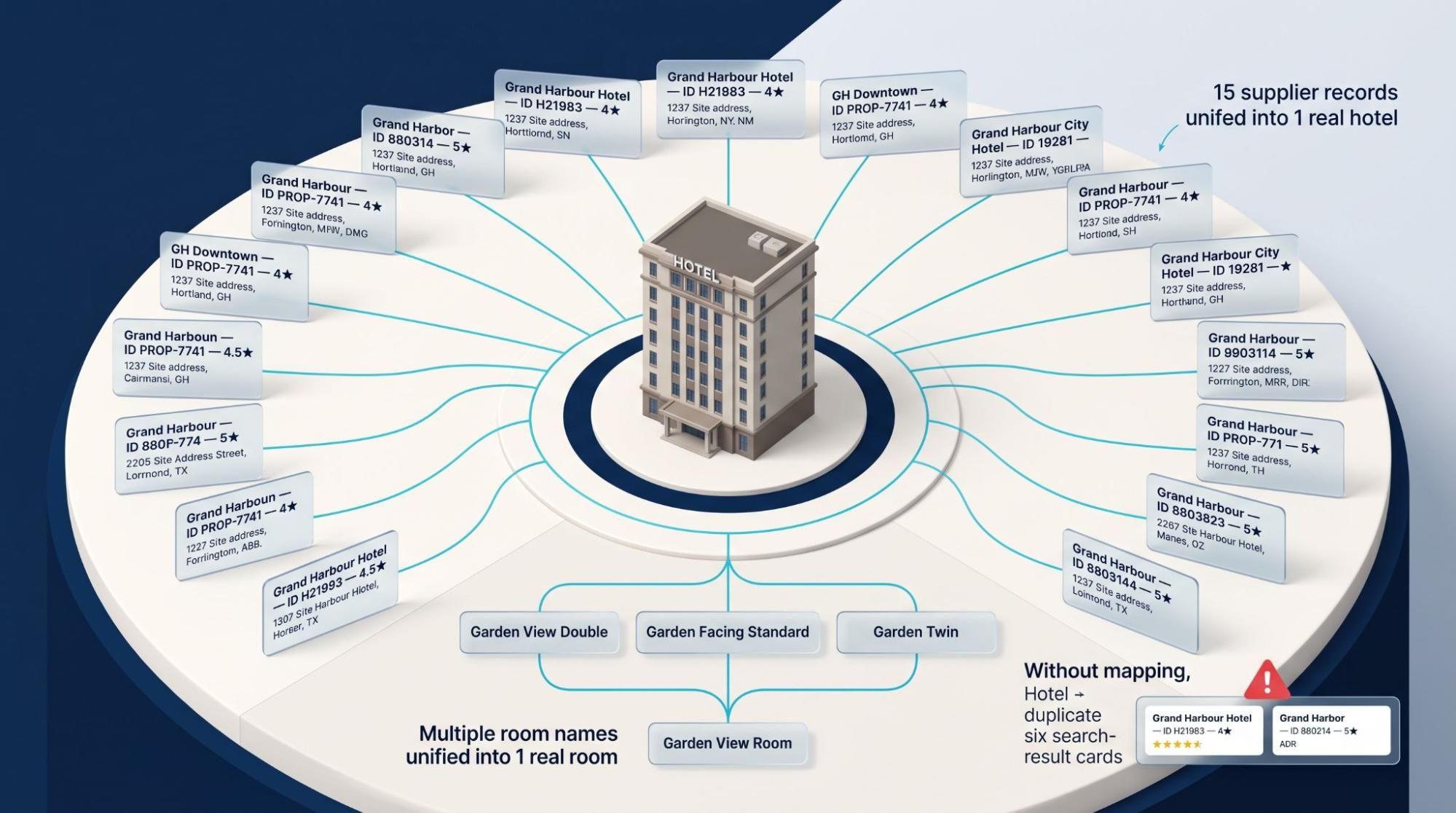
Every supplier uses its own property IDs, naming and content. Connect two and you have duplicates immediately: the same hotel appearing twice with slightly different names, addresses and star ratings. Connect fifteen, which is where mid-sized OTAs tend to land, and you are managing fifteen inconsistently formatted views of the same 200,000 to 400,000 actual buildings. It is a conference where every attendee wears fifteen different name tags and you have to work out that they are one person.
Room level is worse. One supplier's "Garden View Double" is another's "Garden Facing Standard" is another's "Garden Twin", and all three are the same room. Get it wrong and you sell a rate for a room that does not exist.
Duplicates in search results confuse travellers and kill conversion. Mapping vendors, who have an interest in the figure, put the cost of a single mapping error at around €1,500 to find and fix.
This is not specific to hotels. When we helped Wanderu expand into Europe, the work was integrating hundreds of ground carriers running through thousands of locations, and a real share of that effort went into custom location mapping, because bus and rail operators name stops with even less consistency than hotels name rooms. One operator's "Berlin ZOB" is another's "Berlin Central Bus Station" is a third's stop code that resolves to a car park two streets away.
Our opinion, held strongly: buy mapping, don't build it. Vervotech, Giata and others do nothing else. Mapping is a data problem that never finishes. Teams who treat it as a feature they ship once usually discover this after building half of one badly.
Travellers experience how fast results appear, and they leave when it is slow.
The clearest published example: Expedia took flight search from over three seconds to 150 milliseconds. Amadeus runs about an 85% cache hit ratio on a two-layer architecture and has absorbed traffic peaks at fifty times normal volume. Industry estimates put the conversion cost of latency at roughly 7 to 12% per additional second. Treat the precise figure with caution, though the direction is not in dispute.
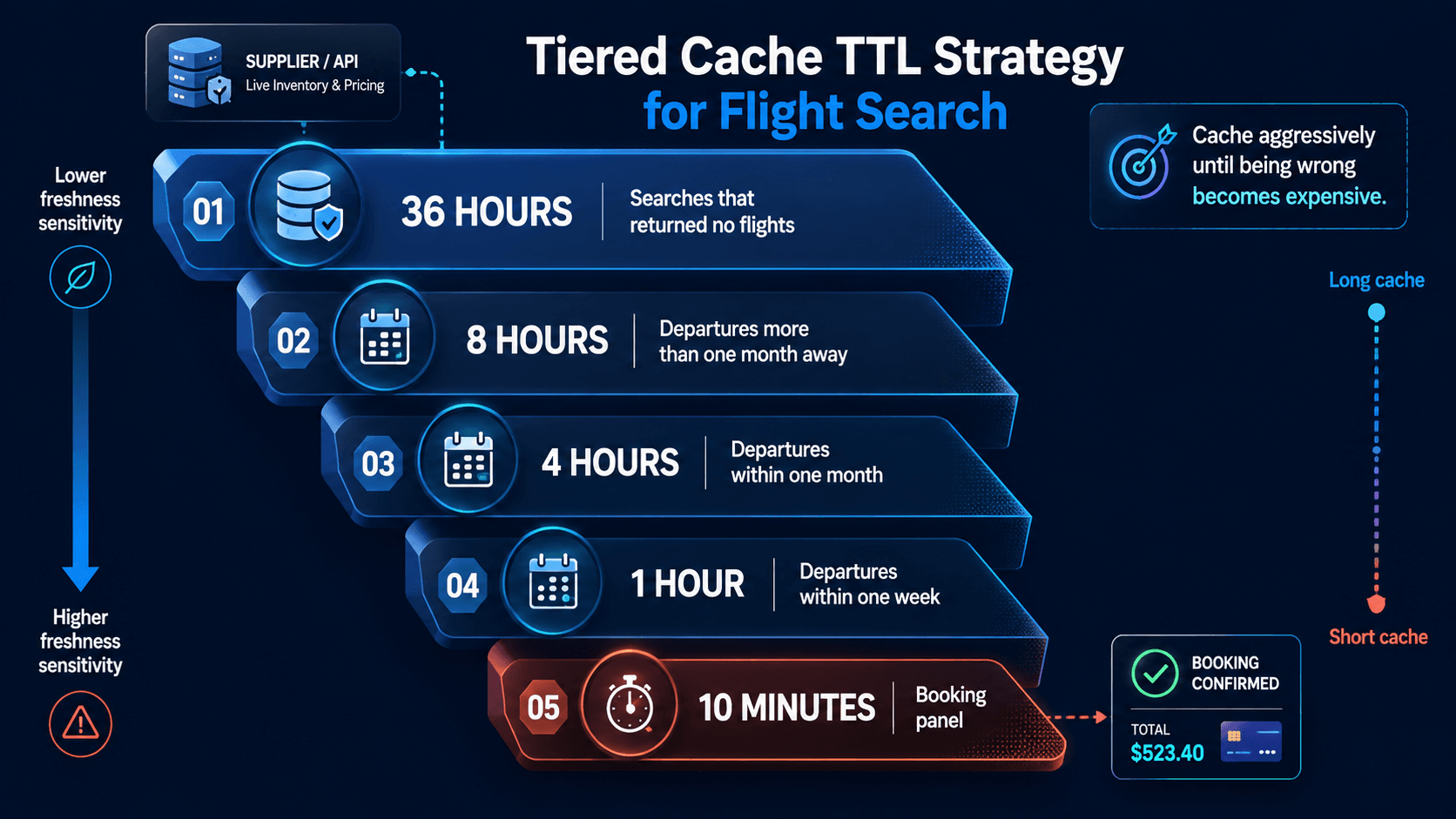
You do not reach those numbers by querying suppliers live on every search. You cache, in tiers. Skyscanner's published TTL ladder is worth stealing outright:
Tiered caching cuts API call volume by 60 to 80%, which matters for your bill and for the next thing.
This is the layer where we have spent the most hours over eighteen years. KAYAK processes billions of searches a year, and at that volume search performance stops being an optimisation and becomes the product surface itself. Even at a fraction of it, this deserves attention early. On the Sastaticket build, data polling to speed up ticket search was explicit scope from the start.
If you are planning to tune search speed after launch, you have misunderstood what you are building.
Suppliers measure how many searches you send per booking you produce. It is called the look-to-book ratio, and a poor one earns you throttling, higher per-transaction fees, or commercial restrictions.
This catches people because it inverts the usual startup instinct. More traffic is normally good news. Here, traffic that does not convert becomes a liability with your own supplier, and a strong argument for being deliberate about which bots and metasearch crawlers get to hammer your search endpoints.
Different architecture, and considerably simpler.
Your PMS or CRS is the single source of truth for availability, rates and inventory. A channel manager pushes that outward to OTAs and to your own booking engine, and delivers reservations back inbound. Your revenue team changes a rate once and everything downstream follows.
The work in this case is integration against Cloudbeds, Mews, RMS or whatever you run, instead of supplier aggregation. That is why it costs a fraction as much, and why many of the people who ask us about OTAs should be asking about this.
Custom booking engines get quoted at 12 to 24 months and $100,000 to $300,000-plus. White-label platforms claim two to six weeks to live. Both numbers come from firms selling one of the two options.
Our read: white-label to find out whether anyone wants what you are selling. Build custom once you know your differentiator and the platform cannot express it.
Sastaticket illustrates the second case. Pakistan's market needed GDS flights and Pakistan Railways and local bus operators in one place, with business logic no off-the-shelf platform was going to accommodate. That justified a custom build. "We'd like it to look nicer" does not.
Building custom before you have demand is how $250,000 gets spent on a product nobody visits.
Most build guides end at launch. Launch is where the real failure starts.
The current numbers are worse than the ones usually quoted. In 2025, Booking Holdings spent $8.19 billion on marketing, 30.4% of total revenue. Expedia Group put roughly $7.4 billion into direct sales and marketing, about half its annual revenue. Across the sector, OTA marketing spend passed $20 billion in 2025. The majority of it goes to Google. No new entrant is outbidding that.
Brand loyalty will not rescue you either, for a structural reason worth sitting with. As one founder put it on Hacker News: "people don't travel frequently enough to develop brand loyalty to a travel site." Most people book a couple of trips a year. There are not enough repetitions to form a habit, and you are being forgotten between purchases by design.
Booking Holdings and Expedia together hold over 65% of the OTA market, so competing on breadth is closed. What remains open:
A niche. Wanderu did not take on Expedia. It went after buses and trains, ground travel that the majors served badly, across 40 countries in North America and Europe. Different question, different competitors.
A geography. Sastaticket did not try to beat Booking.com globally. It built the first all-encompassing OTA for Pakistan, integrating local rail and bus alongside GDS flights, and became the country's largest OTA by flight booking volume. The majors were never going to do that work.
An inventory relationship nobody else has. The strongest position on this list, and the reason direct contracts are worth more than they look.
B2B. Travelliance again: sell booking capability to businesses instead of fighting for consumers. Seven million bookings a year, and not one Google Ad.
Three of those four are supply-side or audience-side strategies. We would go further, and label this an opinion: we do not believe interface quality has ever been the deciding factor in a travel platform's success. It is necessary, and nowhere near sufficient.
Google's free booking links put properties and smaller OTAs into Google Hotels with a live price and a booking button, without ad spend. Current guidance is to put 25 to 35% of digital budget into Google Hotel Ads and free booking link optimisation, up from 15 to 20% in 2024.
When OpenAI shipped its Apps SDK in October 2025 with Booking.com and Expedia as launch travel partners, it created a distribution surface that did not exist before and will not stay closed forever.
If we were starting today, this is the gap we would focus on most. Booking.com's research found 89% of consumers want to use AI in future travel planning. Expedia's found that roughly 70% still prefer to complete the booking with a travel brand they trust. Travellers will plan with AI and will not pay through it. Someone is going to build the thing that sits in that gap, and it will not be whoever ships the nicest search filters.
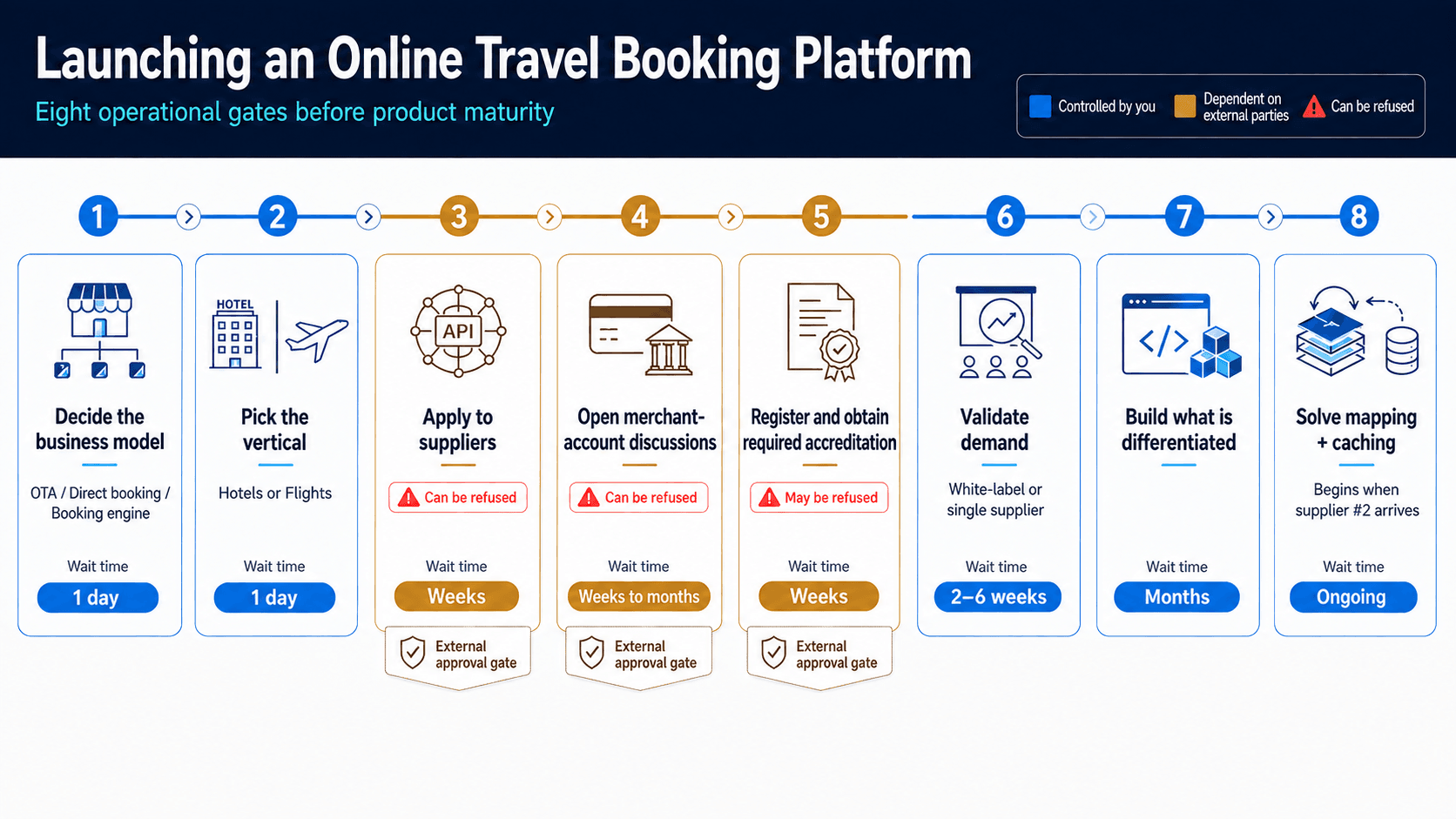
Everything above as a sequence, with the waiting attached:
Look at what that list says. The first five steps involve almost no development. Three of them can be refused by someone else. And every one is on the clock from the day you begin.
There is a practical reason for that ordering. Wanderu's former VP of Engineering put the value of it plainly: "Arbisoft has helped us bring on more partners more quickly because we're able to augment our internal team and get work done faster." Partner onboarding speed was the thing worth optimising, ahead of feature count. In this business, the pipeline of supply is the roadmap.
The website is rarely what kills these projects.
What kills them is a founder spending the budget on the part they controlled, then running out of runway before finding out whether anyone would supply them, bank them, or visit them. Nobody had told them the website was the last problem to solve.
The gates are real. They are also lower than they have ever been. Bedbanks now onboard small platforms that would have been ignored a decade ago. Amadeus will let you build against a free sandbox today. Google will put you in front of travellers without charging for the click. You have to know the gates are there, and walk through them in the right order.
If you have reached the point of needing people who have already been through these integrations, including the GDS certifications, the EDIFACT connections nobody mentions at conferences, and the mapping problem that arrives with supplier number two, that is the conversation we usually have. Eighteen years, hundreds of integrations, travel products in production across four continents.
We are happy to tell you which parts of your plan we think are wrong before you spend anything. Book a call with us today!
Trusted by top platforms for our transformative solutions and exceptional results: