
 Add as preferred on Google
The Future of Education Technology in 2027: How AI Is Changing Learning for All AgesRead More
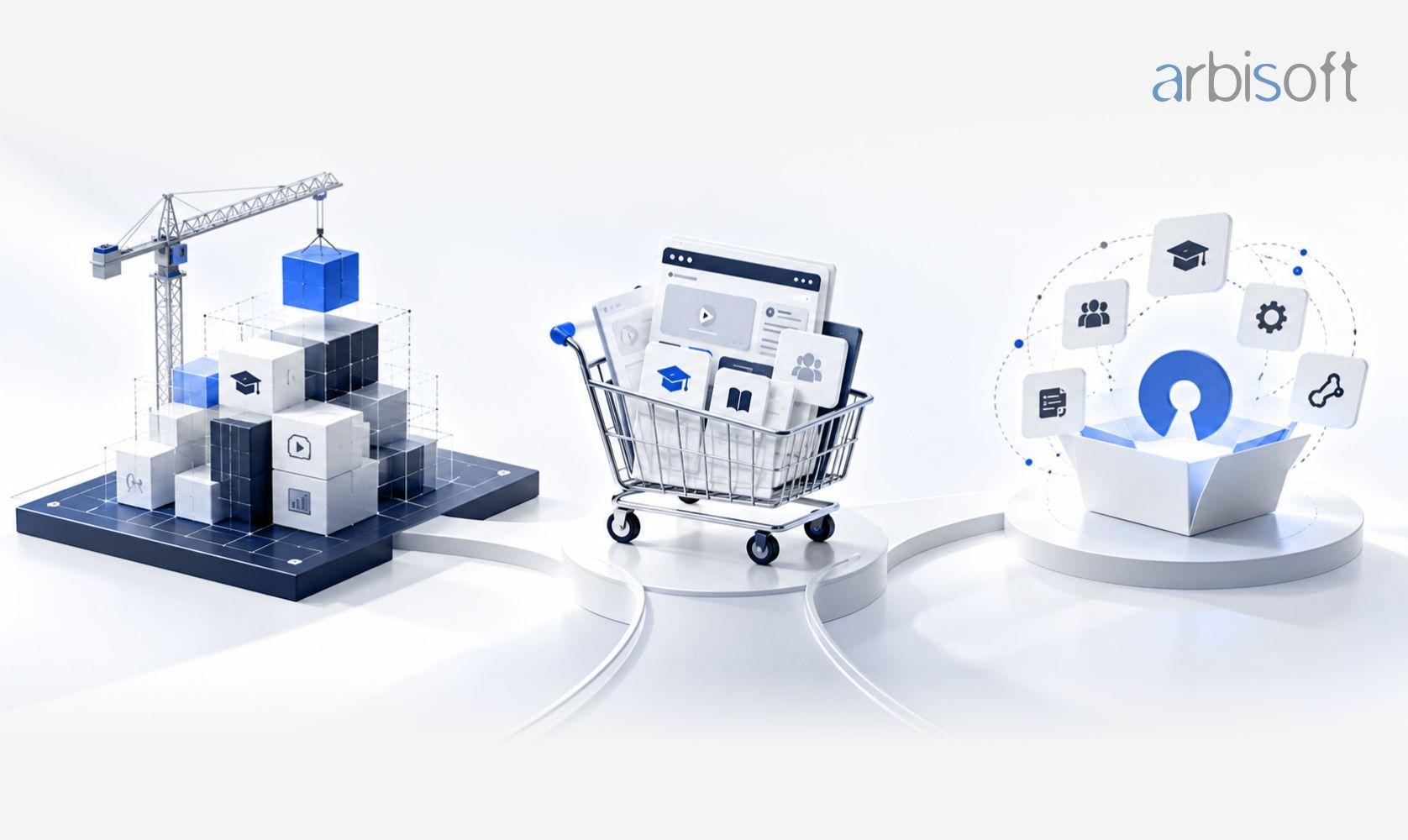
Choosing between building, buying, or using open source for an EdTech platform can shape product cost, speed to market, ownership, and future development. The right approach depends on the product, the organization behind it, and the capabilities that matter most.
EdTech companies, universities, publishers, training providers, enterprises, certification bodies, and public-sector organizations may need different sourcing models across the same ecosystem. A custom learner experience may justify development, while services such as payments, identity, video, or analytics may be better sourced from existing providers.
This guide compares build vs buy vs open source for EdTech platforms, including hybrid models, across cost, customization, scalability, data control, integrations, AI readiness, and long-term maintenance. It also provides a practical framework for deciding which approach fits each part of an EdTech product or platform.
The four options differ mainly in who owns the code, who controls the roadmap, and who carries the ongoing cost.
Building means a custom application designed and owned by the organization or a development partner working for it. Control is high, and so is responsibility for architecture, security, scaling, and maintenance.
Buying means licensing commercial software and configuring it. That can be a whole platform, such as a hosted LMS or course platform, or a single service: identity, video, live communication, proctoring, payments, analytics, authoring tools, AI model APIs, or cloud infrastructure. The vendor runs the software and sets its roadmap.
Open source means starting from software whose code is public, such as Open edX or Moodle, and hosting, configuring, and extending it. There are no license fees, and the organization (or its partner) owns the deployment, the customizations, and the upgrade work.
Hybrid, or composable, means combining the three, for example a custom learner experience on an open-source learning engine, with payments, video, and identity bought from specialist vendors. Many complex EdTech products eventually use some version of this.
The overview of EdTech platform types helps pin down which category a product belongs to before deciding how to source it.
The table compares the four approaches on the criteria that decide most EdTech platform choices. Ratings describe the typical case; contracts, vendors, and team skills create exceptions in every row.
| Criterion | Build | Buy (SaaS) | Open source | Hybrid |
|---|---|---|---|---|
| Speed to first launch | Low | High | Medium | Medium |
| Initial investment | High | Low | Medium | Medium |
| 3 to 5 year TCO | Depends on team size | Grows with users and add-ons | Depends on customization depth | Depends on the mix |
| Product differentiation | High | Low | Medium to high | High where it matters |
| Customization depth | High | Low to medium (settings, APIs, extensions) | High | High |
| Data ownership and access | High | Varies by contract and API | High | High for owned parts |
| Infrastructure control | High | Low | High | Mixed |
| Vendor dependency | Low | High | Low for code; medium if relying on a support partner | Spread across vendors |
| Integration flexibility | High | Depends on vendor APIs | High | High |
| AI extensibility | High | Medium, depends on APIs and extension options | High | High |
| Internal engineering needed | High | Low | Medium to high | Medium to high |
| Maintenance and upgrade burden | High | Low | Medium to high | Medium |
| Time to change the business model | Fast once built | Slow, limited by vendor | Medium | Fast in owned parts |
| Exit or migration difficulty | Lower, though data migration still takes work | Varies with export and API terms | Low to medium | Medium |
Three patterns stand out. Buying usually wins on speed and initial cost and gives up control. Building usually wins on control and differentiation and costs the most engineering over time. Open source sits between them: it saves the foundation work while keeping ownership, but upgrades get harder the further customizations move from the platform's design.
Work through these questions in order. Each answer points to an approach or moves to the next question.
The most useful version of the build vs buy question is asked capability by capability. Most EdTech products contain a small differentiating core surrounded by functionality every education product needs.
| Capability | Build | Buy | Open source |
|---|---|---|---|
| Differentiated learner experience | Strong candidate | Rarely enough | Strong foundation to extend |
| Course, enrollment, and progress management | Only if your model is unusual | Often | Strong options |
| Authentication and SSO | Rarely | Usually | Often |
| Payments and subscriptions | Rarely | Usually | Sometimes |
| Assessment engine | When assessment is the product | Often | Possible |
| AI tutor or personalization | Often, since this is frequently the differentiator | Model and API providers | Open models possible |
| Video hosting and streaming | Rarely | Usually | Possible |
| Live classes and real-time communication | Rarely | Usually | Possible |
| Analytics and reporting | When insight is part of the offer | Often | Possible |
| Content authoring | When content production is the business | Often | Strong options |
| Mobile app | Often custom for the experience | Sometimes | Hybrid |
| CRM, ERP, HRIS | Rarely | Usually | Sometimes |
Read the table as defaults to challenge. An assessment company should build its assessment engine; a corporate academy probably shouldn't. For each row, the test is whether that capability is why customers pick you. For an adaptive learning business, that is the learner model. For a certification body, it is the assessment method and credential lifecycle. For a marketplace, it is matching and supply economics. Everything outside that core is a candidate for buying or for open source.
The same organization can land on different answers at different stages. These are reasonable starting points for the situations that bring most teams to this decision.
| Situation | Usual starting point | Why |
|---|---|---|
| Startup building an MVP | Buy commodity services, build the differentiating workflow | Validates demand without building authentication, payments, or video from scratch |
| EdTech company replacing legacy software | Modernize in stages around custom and open-source components | Keeps the product running while replacing the parts that limit it |
| University needing deep integrations and ownership | Open source plus customization | Keeps data and hosting under institutional control without a ground-up build |
| Enterprise launching a standard employee academy | Buy | Commercial platforms serve the need, and the academy is not the product |
| Company with a unique AI-powered learning model | Build the AI and learning layer, buy infrastructure services | The model is the IP; hosting, payments, and video are not |
| Education marketplace | Custom marketplace experience, bought payments, video, and messaging | Matching and marketplace economics differentiate; transaction plumbing does not |
| SaaS platform no longer fits | Move the constrained parts to custom or open source | Removes limits on roadmap and data without a full rebuild |
| Custom platform full of commodity features | Replace commodity parts with bought or open-source components | Frees engineering time for the parts that differentiate |
The last two run in opposite directions and share a fix. Teams outgrowing SaaS feel customization limits, restricted APIs, or license costs rising faster than revenue. Teams that built everything feel engineers tied up maintaining login, enrollment, and reporting. Both sort capabilities into core and commodity and re-source each one.
Open source can also carry the core at very large scale. Arbisoft's work with edX since 2013 has covered Studio course tooling, proctored exams, analytics, enterprise SSO, and third-party LMS integrations on the Open edX platform, which serves more than 20 million learners. Arbisoft's EdTech division also maintains Tutor, which the Open edX documentation describes as the community-supported installation method and strongly recommends for development and installation.
Universities, enterprises, and public-sector programs often find that requirements outside the feature list decide the outcome. A university might prefer SaaS on cost and speed, then find that SSO with its identity provider, SIS integration, accessibility conformance, data residency, research-system connections, governance rules, and long-term data portability point somewhere else.
The factors that most often change the answer:
These factors don't favor one approach automatically. Some SaaS vendors handle them well; some open-source deployments handle them poorly. They need to be scored alongside differentiation and cost, before a shortlist exists. The enterprise EdTech development guide covers the architecture these requirements lead to.
Every option fails in predictable conditions.
Building is the wrong choice when requirements are mostly standard, when differentiation comes from content, instruction, or service instead of software, when time to market decides the outcome, or when there is no budget for engineering after launch. A custom platform keeps costing money every year it runs.
Buying is the wrong choice when the core workflow falls outside what commercial platforms support, when the business model needs pricing, tenancy, or roles the vendor can't handle, when data access or residency matters and the contract can't guarantee it, or when the platform is the product being sold.
Open source is the wrong choice when the organization can't access engineers who know the platform, when planned customizations fight the platform's core model, or when nobody owns security patches and upgrades. Licensing needs legal review too. Moodle uses the GPL v3, whose obligations mainly apply when modified versions are distributed, and the Open edX platform uses the AGPL v3, which can also apply when modified software is offered to users over a network. What that means for a specific deployment is a question for counsel.
Hybrid is the wrong choice when the organization can't manage several vendors and integrations, or when the moving parts outgrow the team that maintains them.
License price against development cost is the wrong comparison, because each approach has costs that appear after year one.
Building carries development, QA, DevOps, hosting, security, product management, maintenance, and ongoing features. Buying carries licenses, implementation, per-user growth, premium tiers, integrations, professional services, workarounds, price increases, and eventually migration. Open source removes the license fee and keeps implementation, hosting, customization, security patching, upgrades, specialist engineering, and integrations.
5-year TCO = initial implementation + recurring software and infrastructure + customization and integrations + internal team cost + maintenance and upgrades + migration or exit cost
| Cost line | Year 1 | Year 3 | Year 5 |
|---|---|---|---|
| Initial implementation or build | |||
| Licenses or hosting | |||
| Customization and integrations | |||
| Internal team (product, engineering, support) | |||
| Maintenance and upgrades | |||
| Migration or exit (estimate) | |||
| Cumulative total |
One common illustrative pattern: SaaS costs least in year one and grows with learners and add-ons, custom costs most in year one and levels off if the team stays lean, and open source falls in between. The real curves depend on learner growth, pricing model, how much of the roadmap is custom, integration count, and team location, so a different mix can reverse the order. For current build cost ranges, the guide to EdTech software development costs gives 2026 figures by product type.
Mostly buy: a commercial learning platform at the center, connected to a CRM, payments, and analytics. Fast to launch, with the roadmap set by the vendor.
Open-source foundation: Open edX or Moodle as the learning engine, with a custom frontend, SIS or HRIS integrations, a separate analytics store, and AI services through APIs. Philanthropy University is an example: Arbisoft integrated Open edX with NodeBB for discussion and built web and mobile apps for low-bandwidth and intermittent connections, for a platform with over 100,000 registered users.
Custom product: a custom application on cloud infrastructure, with bought payments, video, and email, model APIs for AI, and a CRM connection.
Composable: a custom experience layer on an open-source learning engine, with commercial proctoring, a video provider, custom AI workflows, and enterprise identity and records integrations. Arbisoft's Edly division takes a related route with Compose, which lets creators author with AI inside LMSs including Canvas and Blackboard, so the AI layer is built while the institution's existing LMS stays in place.
The cheapest time to plan an exit is before signing or building anything:
AI is the first variable. Personalization, tutoring, content generation, semantic search, and feedback need access to learner data, content, and events, plus freedom to choose models. Custom and open-source platforms give that access directly. Commercial platforms vary: some offer APIs, webhooks, and extension frameworks that support external AI services, while others limit AI to built-in features. If AI is likely to become part of the product's value, test data access and extensibility before choosing.
Scale is the second. A choice that works for 10,000 learners can strain at a million, as tenants, integrations, reporting, permissions, regions, and compliance grow. Buying works while the vendor's architecture keeps up; building and open source work while the team can scale the architecture.
Buy when your requirements are standard and the platform is not what customers pay you for. Build, or extend an open-source platform, when your workflow, business model, or data requirements fall outside what commercial software supports. Many organizations buy or adopt a standard platform and build only the differentiating layer around it.
Open source is usually cheaper to a first release, because accounts, courses, enrollment, and grading already exist. Over five years it depends on customization depth. Heavy customization that departs from the platform's model adds upgrade work every release and can approach the cost of a custom build.
Custom software is built for one organization's workflows and owned by it, so it can change in any direction but needs a team to run it. SaaS is shared software run by a vendor, faster to start, and limited to the vendor's features, extension options, pricing, and roadmap.
Yes, if the exit is planned from day one. Choose a vendor with complete data export and open APIs, keep custom work outside the vendor platform where possible, and own the learner-facing experience if it matters to the brand. Migration then becomes a planned project with a known scope.
List every capability your product needs, mark the two or three that customers choose you for, and run the decision tree on those first. Score the enterprise factors that apply, source everything else by the capability matrix, then fill in the five-year TCO for the two strongest options. If the answer still isn't clear, the core is probably more complex than it looks, and an architecture review before committing costs less than a migration after.
...Loading Related Blogs
Trusted by top platforms for our transformative solutions and exceptional results: