

 Add as preferred on Google
Odoo Customization Guide for Smarter ERP DecisionsRead More
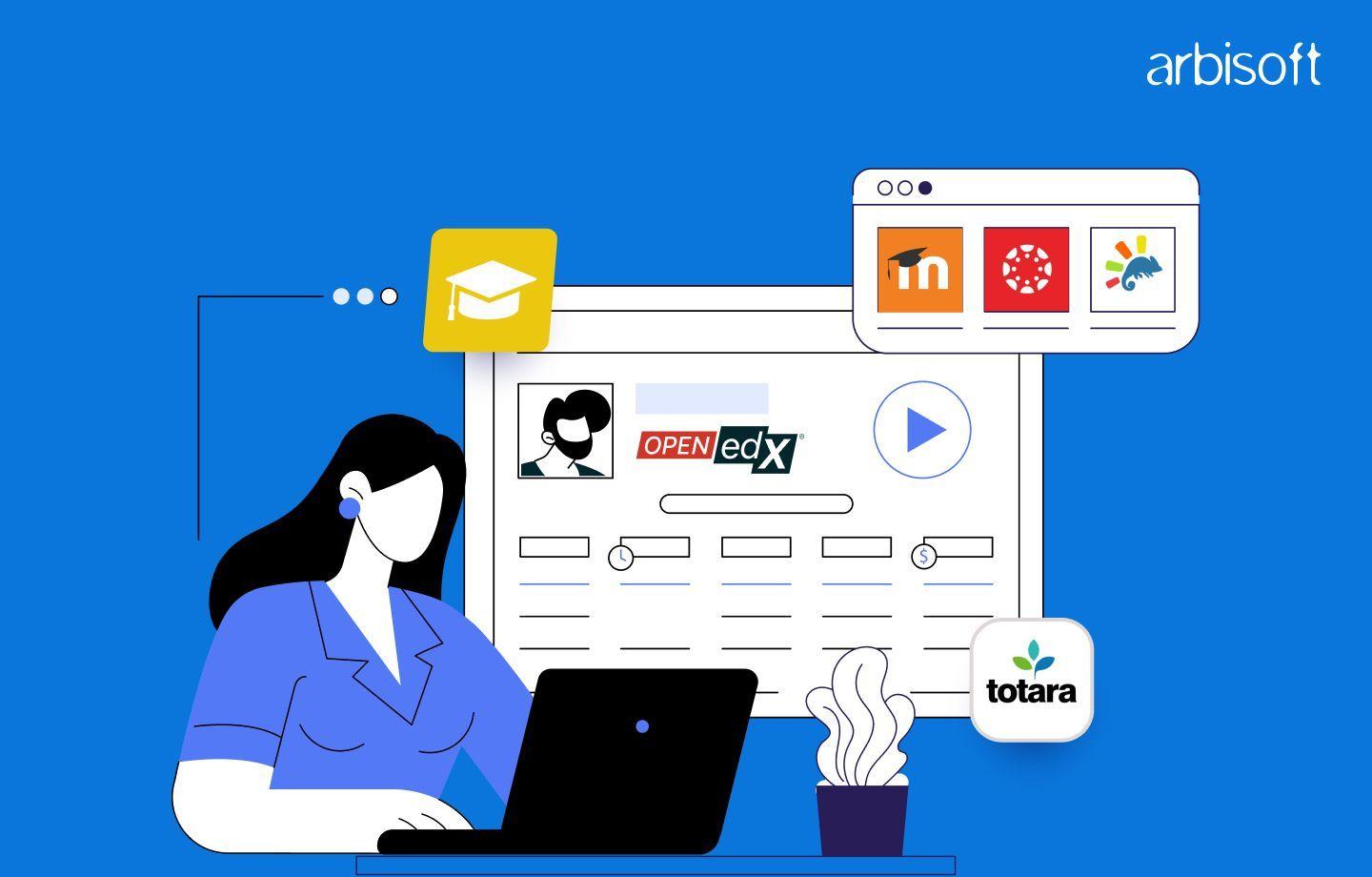
The eLearning industry is booming, with a projected global market size of $389 billion in 2026. Learning Management Systems (LMS) are at the heart of this growth!
Most LMS decisions start with optimism.
A team shortlists platforms, compares features, checks pricing, and assumes they’ve made a solid choice. The system goes live, courses are uploaded, users are enrolled, and everything looks like it’s working.
But a few months later, reality shows up.
Engagement drops. Reporting becomes messy. Integrations break. Teams struggle to scale. And suddenly, the LMS that looked “perfect on paper” starts feeling like operational debt.
This pattern is more common in 2026 than ever before.
Because the problem is no longer access to LMS platforms, it’s choosing the right foundation for how learning actually scales today.
Open source LMS platforms still play a major role, but the way they’re evaluated, implemented, and scaled has changed completely.
This blog breaks down that shift in detail and helps you understand:
The first step is to identify who you'll be creating courses for and their specific learning needs. Here's a breakdown of common user groups.
Once you've identified your audience, use this list to assess your specific LMS requirements.
At its core, an open source LMS is still what it has always been: a learning management system where the source code is publicly available and can be modified, extended, and self-hosted.
But in 2026, that definition is no longer enough.
Today, open source LMS platforms are less about “free software” and more about infrastructure ownership.
They give organizations control over:
This shift matters because learning systems are no longer isolated tools. They are deeply connected to HR systems, analytics pipelines, onboarding flows, and even AI-driven decision systems.
However, this control comes with a trade-off:
And this is where most LMS decisions start to break down.
Before evaluating platforms, there is a more important question to answer:
What kind of learning system are you actually trying to build?
Because in 2026, an LMS is no longer just a content delivery system.
It is:
Once you see it this way, the decision becomes less about features and more about architecture.
To make that decision clearer, let’s break it down.
Instead of comparing platforms directly, it helps to evaluate them through a structured lens.
Every LMS starts with a different primary goal:
A mismatch here is the first point of failure in most implementations. Even strong platforms fail when applied to the wrong context.
Scalability is no longer just about users—it’s about complexity.
Ask:
This is where platforms like Open edX stand out, especially for large-scale environments.
Open source LMS platforms sit on a spectrum:
The deeper you go, the more control you gain, but also the more engineering effort you need to sustain it.
This is where LMS platforms are being redefined.
Modern learning systems are expected to support:
Most open source LMS platforms do not include these natively, but they allow you to build them.
The real question is: Can your team actually build and maintain that layer?
This is the most underestimated factor.
Beyond setup, you must consider:
Many LMS projects fail here, not because of poor selection, but because of underestimated complexity.
Once you understand the decision framework, evaluating platforms becomes much clearer.
Below are the most relevant open source LMS platforms in 2026, not just based on popularity, but based on real-world adoption and scalability.
Moodle remains one of the most widely adopted LMS platforms globally.
It is often the first choice for organizations that want flexibility without building everything from scratch.
Why it’s still relevant:
Where it struggles:
Moodle works best when customization is a priority, and teams are prepared to invest in long-term maintenance.
Open edX is designed for organizations that operate at serious scale.
Originally developed for large-scale online learning environments, it remains one of the most powerful open source LMS architectures available today.
Why organizations choose it:
Trade-offs:
Open edX is less of a plug-and-play tool and more of a learning infrastructure platform.
P.S. We’ve partnered with edX since 2013 to educate millions of learners across the globe through thousands of MOOCs. Read more about it here.
Canvas LMS is known for its modern interface and strong adoption in education.
It is often preferred by institutions that prioritize ease of use and adoption speed.
Strengths:
Limitations:
Canvas works well when user experience is the top priority.
Chamilo is designed for simplicity. It is often used by smaller organizations that need a functional LMS without heavy infrastructure requirements.
Strengths:
Limitations:
Chamilo works best in constrained environments where simplicity matters more than extensibility.
Sakai is widely used in higher education institutions that prioritize collaboration.
Strengths:
Limitations:
Sakai remains relevant in traditional academic ecosystems.
This downloadable checklist empowers you to compare top open-source LMS platforms and identify the perfect fit for your needs.

To simplify the selection process, we've created a downloadable LMS Feature Checklist & Cheat Sheet.

One of the most important shifts in 2026 is the rise of AI-native learning systems.
These platforms are built around:
When compared to open source LMS platforms, the difference becomes clear:
| Dimension | Open Source LMS | AI-Native LMS |
| Customization | High | Limited |
| Speed of deployment | Slower | Faster |
| AI capabilities | Built manually | Built-in |
| Data control | Full ownership | Platform-managed |
| Long-term flexibility | High | Medium |
You are choosing between: Control and customization vs speed and intelligence
While open source LMS platforms offer significant advantages, they also introduce hidden complexity.
Deployment is often the easiest part. Long-term success depends on integration and optimization.
Updates, plugins, and dependencies require ongoing engineering effort.
Connecting LMS platforms with HR systems, analytics tools, and identity systems often becomes a project of its own.
Performance issues rarely appear early; they emerge under real usage load.
Open source LMS platforms are powerful, but not universally suitable.
They may not be the right choice if:
In such cases, a managed or AI-native LMS may deliver better results.
To simplify the decision further:
The key is better and improved alignment.

The LMS landscape in 2026 is no longer defined by features or pricing alone.
It is defined by:
Open source LMS platforms remain a powerful foundation, but only when chosen with a clear understanding of what they demand in return.
The organizations that succeed are the ones that design a learning system that can evolve with them.
But with so many choices, how do you pick the right one? Consider who you're teaching (your target audience) and what you want them to learn. This information will help you analyze your needs and pick the perfect LMS to launch your eLearning adventure. Using education technology & elearning solutions can make your LMS more effective, helping you create a more interactive, scalable, and engaging learning experience. Remember, a great LMS is like a springboard; it helps you create engaging lessons and spread knowledge within your company or school.
Trusted by top platforms for our transformative solutions and exceptional results: