

 Add as preferred on Google

Whitepaper
The Boardroom AI Agenda
A strategic briefing for C-suite executives and board directors navigating the compliance, accountability, and value imperatives of enterprise AI in 2026.
Executive Brief
By 2030, no IT work will be done by humans without AI. 75% will be human-augmented, 25% AI-alone, according to a November 2025 Gartner survey of over 700 CIOs
By 2030, no IT work will be done by humans without AI — 75% will be human-augmented, 25% AI-alone, according to a November 2025 Gartner survey of over 700 CIOs.1 For CIOs, this rewrites the evaluation criteria: uptime, delivery velocity, and infrastructure efficiency are no longer sufficient. Performance now depends on how effectively IT organizations are redesigned around AI-assisted operations, autonomous decision systems, and continuously evolving business models.
Many enterprises already understand the importance of AI adoption. Fewer understand the operational restructuring required to support it. The next five years will separate organizations experimenting with AI from organizations rebuilding their operating models around it.
For CIOs, the challenge is no longer whether to adopt AI. The challenge is how to restructure IT organizations, talent models, governance systems, and infrastructure strategies before AI-native competitors redefine market expectations.
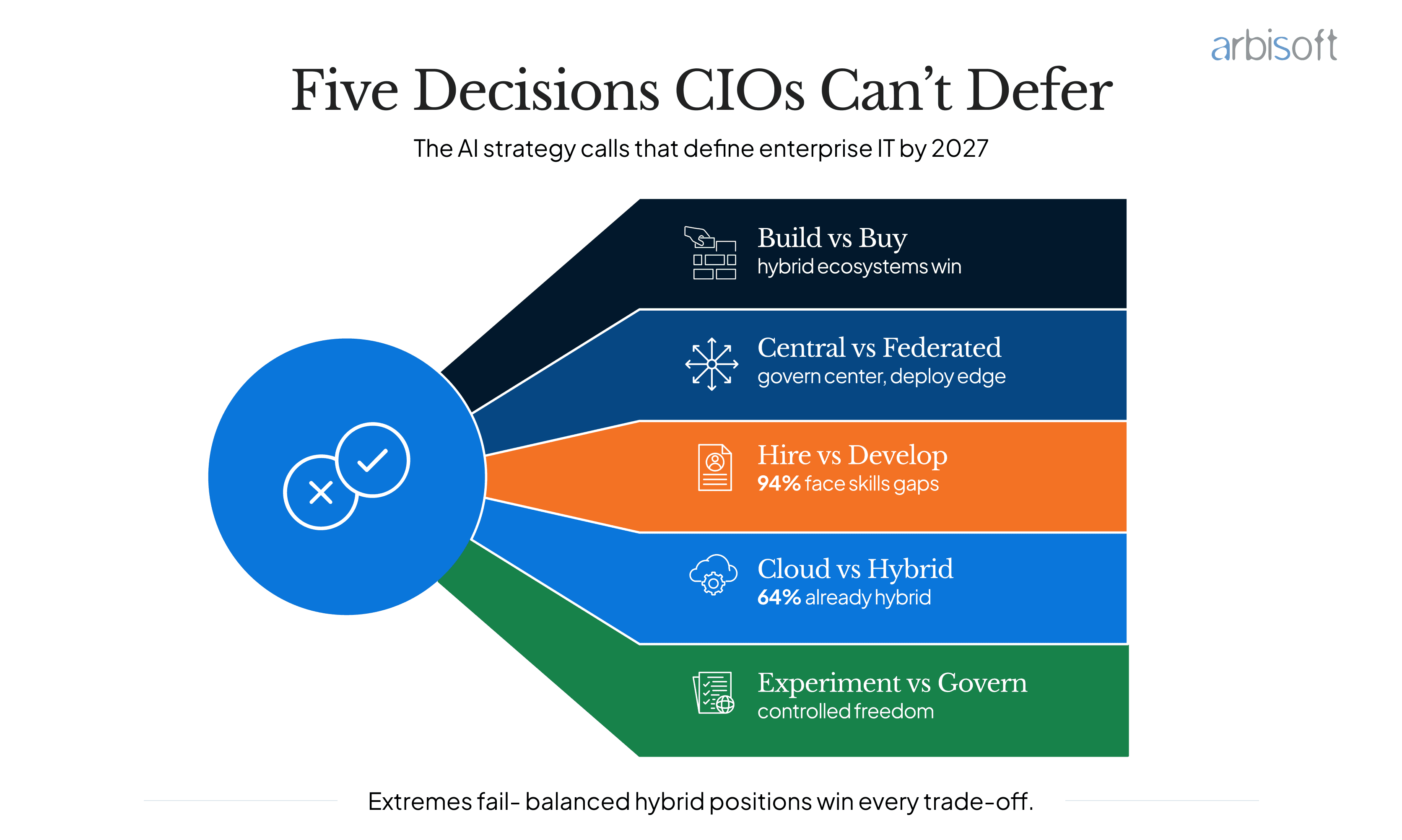
Most enterprise IT organizations were built for predictable software delivery cycles, centralized governance, and human-led decision-making. AI-driven enterprises operate differently. Autonomous systems increasingly participate in software development, customer support, infrastructure optimization, cybersecurity analysis, procurement, and operational planning. According to McKinsey's 2025 State of AI survey, 23% of organizations are already scaling an agentic AI system in at least one function and another 39% are experimenting — with IT and knowledge management leading deployment.2
This shift creates three immediate pressures for CIOs:
• Decision velocity becomes a competitive differentiator. AI high performers are nearly 3x more likely than peers to have scaled AI agents across the enterprise — and the gap is widening, not narrowing.2
• Infrastructure complexity increases. AI workloads require scalable data environments, model orchestration capabilities, governance tooling, and cost-management discipline that many enterprises do not currently possess.
• Workforce structures become unstable. Traditional role boundaries across development, operations, QA, analytics, and support functions are already blurring as AI agents automate repeatable cognitive work.
20 years. 550+ partnerships. Trusted to deliver. Let's talk about yours.
Talk to our teamWhitepaper
A strategic briefing for C-suite executives and board directors navigating the compliance, accountability, and value imperatives of enterprise AI in 2026.
Trusted by top platforms for our transformative solutions and exceptional results: