

Whitepaper
The Boardroom AI Agenda
A strategic briefing for C-suite executives and board directors navigating the compliance, accountability, and value imperatives of enterprise AI in 2026.
 Add as preferred on Google
EXECUTIVE SUMMARY: WHAT EVERY BOARD NEEDS TO UNDERSTAND ABOUT AI IN 2026
Something fundamental shifted in 2025. AI stopped being a technology decision and became a governance obligation. The boardroom is now the last line of defense, and the first line of accountability, for how AI shapes financial outcomes, operational decisions, and stakeholder trust.
This report is written for C-suite leaders and board directors who understand that AI is already embedded in their enterprise, whether they placed it there deliberately or not. Its thesis is direct: organizations that treat AI governance, data provenance, and return on investment as separate functions will underperform, face regulatory exposure, and lose ground to peers who integrate all three into a unified AI accountability agenda. Arbisoft refers to this integrated model as the AI Accountability Matrix: a single operating view that ties governance, provenance, and ROI to one another instead of managing them as separate programs.
The stakes are no longer hypothetical. The EU AI Act enters full enforcement for high-risk systems on 2 August 2026, with penalties that vary by tier: up to 35 million euros or 7% of global annual turnover for prohibited practices, and up to 15 million euros or 3% of global annual turnover for high-risk system non-compliance. The Trump administration unveiled a non-binding National Policy Framework for AI on 20 March 2026, a four-page set of legislative recommendations to Congress whose adoption into law remains uncertain.
Meanwhile, institutional investors, including signatories to the UN Principles for Responsible Investment, are increasingly factoring AI governance maturity into their assessments, according to industry reporting. And yet, according to MIT research cited by the World Economic Forum, 95% of enterprise generative AI pilots fail to deliver measurable profit-and-loss impact.
The performance gap is not random. Organizations that govern AI rigorously are the same ones seeing 1.7x revenue growth and 3.6x total shareholder return versus peers who treat AI as a technology experiment, according to BCG's 2025 "Widening AI Value Gap" analysis. Governance and ROI are not in tension. They are the same discipline applied from different angles.
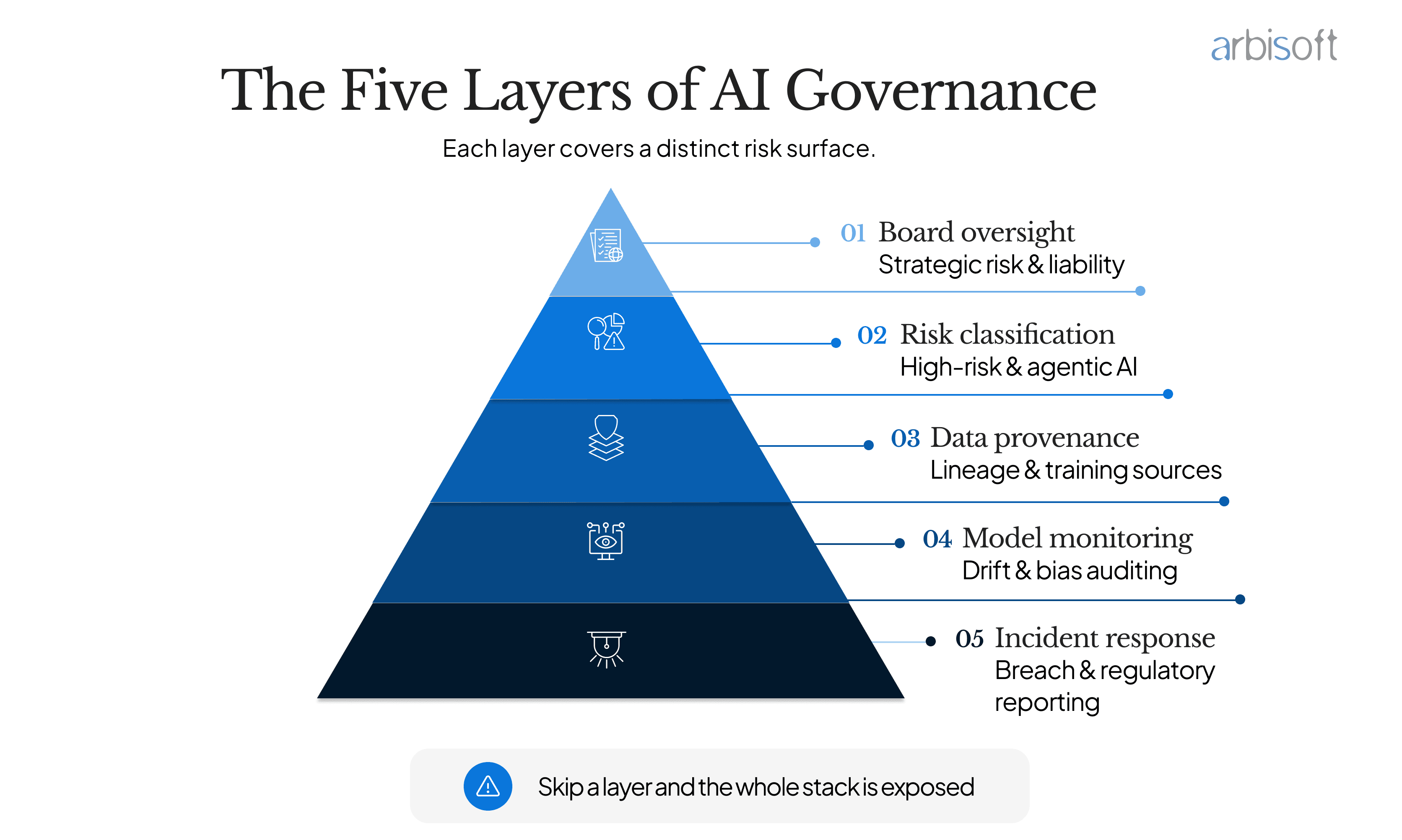
This report walks through the three interconnected boardroom imperatives: building an AI governance architecture that can withstand regulatory and investor scrutiny, establishing data provenance as a business asset rather than a compliance checkbox, and constructing an ROI framework that translates AI investment into decisions the board can defend. Each section closes with specific actions. A consolidated five-step governance roadmap is included for immediate use.
Leverage two decades of experience
20 years. 550+ partnerships. Trusted to deliver. Let's talk about yours.
Talk to our team