
 Add as preferred on Google
How a Repository Health Dashboard Helped Open edX Patch certifi in 48 HoursRead More
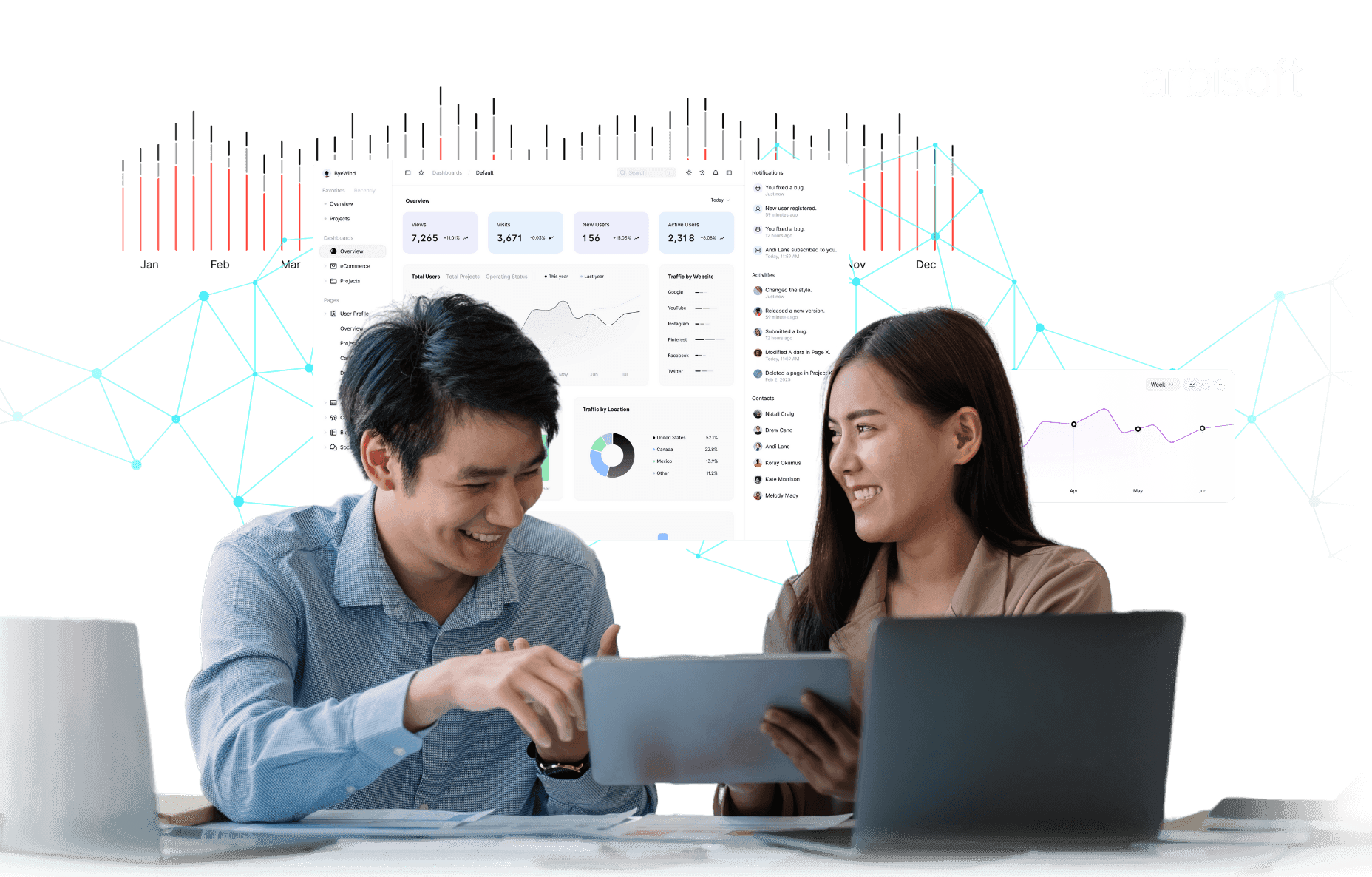
Predictive analytics programs reach production when work follows eight ordered steps, starting with one decision and its KPI and ending with monitoring and retraining.
Agree the KPI and baseline before any modeling starts, then pilot on the data path production will use.
Predictive analytics programs often stall somewhere between a promising notebook and a model people use every day. The order of work is usually to blame. Teams buy a platform before they know which decision the model should change, or they start modeling before anyone has checked whether the data can support it, and the budget ends up paying for a pilot that never reaches production.
This guide sets out eight predictive analytics implementation steps for CTOs planning 2027 work, from the first use case to scaling. Each step has an owner and a test for when it is done. Finance and insurance teams will also find the EU AI Act dates that fall inside 2027 delivery plans.
Three blockers come up most often: legacy integration, data quality and a shortage of the right skills. None of them is a modeling problem, and a better algorithm fixes none of them.
Legacy integration is usually the biggest single piece of work. The inputs for a churn or fraud model tend to sit in several places, such as a CRM, a billing system, a core banking platform or ERP, and raw event logs that nobody has joined before. The old systems can stay where they are. An integration platform (iPaaS) or prebuilt connectors can copy the fields the model needs into a warehouse or lakehouse, which leaves far less custom code to maintain.
Data quality fails more quietly. A model trained on incomplete or late inputs still produces scores, and those scores look just as confident as good ones. Sound data governance and compliance practice, meaning known dataset owners, documented consent terms and records an auditor can trace, is what makes data usable for a model.
Talent is the third gap. A first model needs data engineering, modeling, business knowledge and production operations, and few teams already have all four in house.
Programs also stop after a pilot works. A Gartner survey run from January to April 2026 covered 1,303 respondents at organizations with at least $50 million in annual revenue. It found that only 22% had scaled AI across multiple business units or adopted an AI-first approach.
The survey covers AI in general. In our view, predictive models stall the same way, because the second use case often starts from scratch when nothing from the first was built for reuse.
The date to plan around is 2 December 2027. From then, the EU AI Act's rules for stand-alone high-risk AI systems apply. That date comes from the Digital Omnibus on AI (Regulation (EU) 2026/1744), which entered into force on 27 July 2026 and deferred the earlier deadline. Rules for high-risk AI embedded in regulated products follow on 2 August 2028.
Annex III of the Act lists two areas that are common predictive analytics use cases:
A credit-scoring or insurance-pricing model that goes live in 2027 could face the high-risk requirements. Legal and compliance review belongs in Step 1. Our view is that changing how a model was built and documented after deployment costs far more than planning for the requirements before anyone writes the first line of modeling code.
Budget review is the other 2027 factor. In the same Gartner survey, high performers that constantly tracked the ROI of their AI initiatives reported positive returns in 81% of them. We expect boards to ask for that kind of measured result from your own pilots. Agree the KPI and baseline before any modeling starts.
Order matters, because each step feeds the next. The data audit shapes vendor choice, the pilot shapes the rollout plan, and the table below lays out all eight steps as a quick reference for planning reviews.
| Step | Owner | Common failure | Done when |
|---|---|---|---|
| Define the decision and KPI (Step 1) | CTO with the business owner | Picking the use case with the most data | One use case has a KPI, a baseline and a named owner |
| Audit data and governance (Step 2) | Data engineering lead | Modeling before checking data latency | Inputs arrive on time through a pipeline |
| Choose vendors and platforms (Step 3) | CTO and procurement | Buying before Steps 1 and 2 | The platform is tested on pilot data |
| Pick a team model (Step 4) | CTO or VP Engineering | No handover plan for outside specialists | Every role has a named person |
| Match modeling techniques (Step 5) | Lead data scientist | Choosing accuracy nobody can explain | The model beats the baseline on held-out data |
| Run a pilot (Step 6) | Product or business owner | Piloting on a hand-cleaned extract | The business owner signs off results |
| Embed predictions in decisions (Step 7) | Business owner | Scores with no agreed action | The process names the prediction and its action |
| Monitor, retrain and scale (Step 8) | ML engineering lead | No drift checks after launch | The model has completed one retraining cycle |
Step 1 picks one decision the model will change and the number that will show it changed. "Reduce churn" is a goal. A model needs something narrower, such as "flag accounts likely to cancel in the next 60 days so the customer success team calls them first." For that churn case, the KPI might be the renewal rate among flagged accounts compared with a control group, and for a sales use case it might be the forecast error on next quarter's sales.
A useful test is to ask who acts on the prediction and what they will do differently. If nobody can answer, the use case is not ready.
The CTO owns the shortlist. The business owner of the decision signs off the KPI, and if the use case is credit scoring or insurance pricing, legal and compliance review starts here too, at the same time as the KPI work. You can close Step 1 once one use case has a written KPI, a measured baseline and a named owner.
The data audit checks whether the inputs for the chosen use case can support a model. It usually takes longer than the modeling. Trace every input back to its source system, then test it for completeness, duplicates, missing values, outliers and arrival time.
Arrival time gets missed most often. A churn model trained on billing records that land a week late will keep flagging cancellations that have already happened.
Governance belongs in the same audit. Record who owns each dataset, which consent terms or regulations (GDPR, HIPAA or sector rules) cover it, how long it may be kept, and whether an auditor can trace a training record back to its source.
The data engineering lead owns Step 2. It is done when a pipeline delivers the inputs on the schedule the decision needs and every known quality fix has an owner.
Vendor selection comes third because the audit shows what the platform has to connect to. A platform earns a place on the shortlist if it integrates with your warehouse and source systems, explains individual predictions, holds the security certifications your sector expects and stays affordable at ten times the pilot's data volume. Ask how models and data can be exported before signing. Lock-in is cheapest to avoid at the contract stage.
Our guide on how CTOs should evaluate and select an AI vendor for predictive analytics covers the weighted scorecard and how to run a proof of concept on your own data. The most common failure is buying first. Teams that sign before Steps 1 and 2 end up choosing use cases to fit the platform's features. Step 3 is done once the chosen platform has run on the pilot's real data.
A first production model needs four roles: data engineering, data science or ML engineering, an analyst who knows the business process, and someone who can deploy and run models in production. The team model decides where each of those people comes from.
| Team model | How it works | Main trade-off | Best for |
|---|---|---|---|
| In-house team | Hire and train permanent staff | Slowest to start, strongest long-term ownership | Companies with several years of predictive use cases planned |
| Project consultants | An outside team delivers a defined scope | Fast start, but knowledge leaves unless handover is planned | One well-defined pilot |
| Team augmentation | External specialists join your team and workflows | Adds skills quickly, needs internal leaders to direct the work | Filling gaps such as data engineering or MLOps while hiring |
| Hybrid | Outside specialists build alongside internal staff who take over | More coordination in the first months | First programs that must end in internal ownership |
Hiring is slow. Arbisoft's team augmentation page cites a 40 to 50 day recruitment cycle, and that's a long stretch to leave an analytics project sitting idle while you wait for one missing person to sign. For the business-knowledge role, reskilling your own analysts is often cheaper than hiring.
Outside specialists are most useful on the pilot and the first production pipeline, each paired with an internal engineer and working to a set date for handing ownership back. The failure to avoid is a model nobody inside can retrain once the consultants leave. Step 4 is complete once every role has a named person and the handover plan is written down.
The output the decision needs determines the technique. A yes-or-no outcome, such as churn or a fraudulent transaction, is a classification problem, and logistic regression and tree-based models (single decision trees or gradient-boosted ones) are the usual candidates. Next month's sales figure is a regression problem. A number tracked over time, where seasonal patterns matter, calls for a time-series forecast.
Start with the simplest model that beats the current baseline. A credit committee can read a logistic regression, and for credit decisions that fall under the EU AI Act, that may matter more than a small accuracy gain from an ensemble nobody can explain. AutoML tools speed up the comparison of candidate models. A data scientist should still check for leakage, meaning inputs the model would not actually have at prediction time.
The deployment target narrows the choice further. The award-winning parking prediction app Arbisoft built for Predict.io detects a driver's parking behavior from real-time sensor data, and its SDKs had to be optimized to avoid heavy resource use. A nightly batch forecast in a warehouse has no such limit. The model is ready when it beats the baseline on held-out data and the team can explain what drives its predictions.
A pilot puts one model in front of real users on a limited scope, such as one region or one product line, for long enough to compare the KPI against the Step 1 baseline. Bring IT and security in from day one. The pilot should run on the integration path production will use, and we recommend shipping the same container image in pilot and production because the build that passed is then the build that goes live.
Write the scaling roadmap after the pilot. By then the team knows the real data latency and what the model costs to run. The classic failure is a pilot run on an extract someone cleaned by hand, which proves only that the model works on data that production will never see. The pilot is over when the business owner signs off its results and makes a go or stop decision.
A prediction creates value only when it changes what someone does. Scores should appear where people already work, for example:
Separate dashboards tend to fade after a few weeks. Users need training on what a score means and where it can be wrong, and each prediction should show its top reasons.
Agree in advance when people may override the model, and log every override. Overrides are the next version's best feedback. Step 7 is finished when the decision owner's written process document names both the prediction and the action it triggers, and when someone is tracking how often it is used.
Models lose accuracy as customer behavior and prices shift. Monitoring starts on launch day and covers three layers: the system (latency and error rates), the input data (whether its distribution drifts away from the training data) and the model (accuracy against real outcomes once they arrive). Prometheus, an open-source systems monitoring and alerting toolkit, handles system metrics. Data and model drift need their own checks inside the ML pipeline.
Retraining triggers get set in advance, such as accuracy falling below an agreed level or drift passing a threshold, with a scheduled retrain as a backstop. Scale only after the first model has completed a full retraining cycle. The second use case can then reuse the pipeline and monitoring built for the first, and that reuse is where costs start to fall.
After launch, failures usually come from broken integrations or lost trust. A model fed by hand-built connectors can fail silently when a source system renames a field, and nobody notices until the predictions have been wrong for weeks. Schema checks that stop the pipeline loudly catch this early.
Adoption fades when users cannot see why a score is high. Data literacy training and early wins shown in the users' own numbers bring them back.
Accuracy problems damage trust fastest. One confidently wrong prediction with no explanation can undo months of goodwill. Teams that publish the model's accuracy and announce model changes before they ship keep users relying on the scores.
Track four measures, because model accuracy alone says little about value:
An ROI case built from your own pilot holds up better with a board than an industry average. The arithmetic is simple. Take the measured lift, multiply it by the volume of decisions the model will touch, then subtract run and maintenance costs, and repeat the calculation after the first retraining cycle, when the real maintenance cost is finally known.
Waiting is not necessary. Clean only what the first use case needs, and make the fix in the pipeline so it lasts. Waiting until all company data is clean delays every project. A narrow audit tied to one decision finds the quality problems that affect that model's results.
Annex III's credit-scoring entry excludes AI systems used to detect financial fraud, so a fraud model does not fall under that entry. Data protection rules such as GDPR still apply to the personal data it uses, and other Annex III categories may apply depending on how the model is used. Confirm the classification with legal counsel.
Retrain when monitoring shows accuracy loss or input drift past a threshold agreed in advance, with a scheduled retrain as a backstop. A fraud model facing fast-changing behavior usually needs it far more often than a quarterly demand forecast.
Ownership is split. The CTO or head of data owns the platform, pipelines, monitoring and team. Each business owner owns the decision a model supports, its KPI and the action a prediction triggers. Without a named business owner, models still get built but rarely change how anyone works, and that is the most common way programs lose funding.
Our recommendation for 2027 is to start with one decision and its KPI and to audit the data for that decision before signing any platform contract. Then pilot on the production data path. If your roadmap includes credit scoring or life and health insurance pricing for EU customers, add the high-risk requirements to the plan now, because 2 December 2027 falls inside most delivery schedules being set this year.
Capacity most often runs short at data engineering and production monitoring. Arbisoft's predictive analytics services cover feasibility assessment, implementation roadmaps, connecting scattered data sources, deploying machine learning models to production and integration with existing workflows. A scoping call can map which of the eight predictive analytics implementation steps your team can own and where outside help fits.
...Loading Related Blogs
Trusted by top platforms for our transformative solutions and exceptional results: