 Add as preferred on Google
Breaking the 20-Field Limit: How We Built Histora for Salesforce Field History TrackingRead More
Envision a Monday morning demo. The new Head of AI shows the leadership team an assistant that reads incoming support tickets, pulls up the customer’s order history, and drafts a reply. The room loves it. The CEO asks, “When can we roll this out?” Everyone says “next quarter.”
Six months later, the demo still works. On the demo data.
In production, the assistant cannot reach the billing system. Nobody has decided who signs off when it gets something wrong. Security wants to know where customer data goes, and the finance team has just noticed the API bill. The project is not dead, but it is not really alive either.
If that sounds familiar, you are in good company. Most organizations are living some version of this story right now. And as 2027 gets closer, the gap between companies that get AI workflows into real operations and companies that keep running pilots is about to get a lot wider.
In this guide, you will learn what AI workflows actually are, how they are changing in 2027, why so many pilots stall, and how to prepare with a practical seven-step plan.
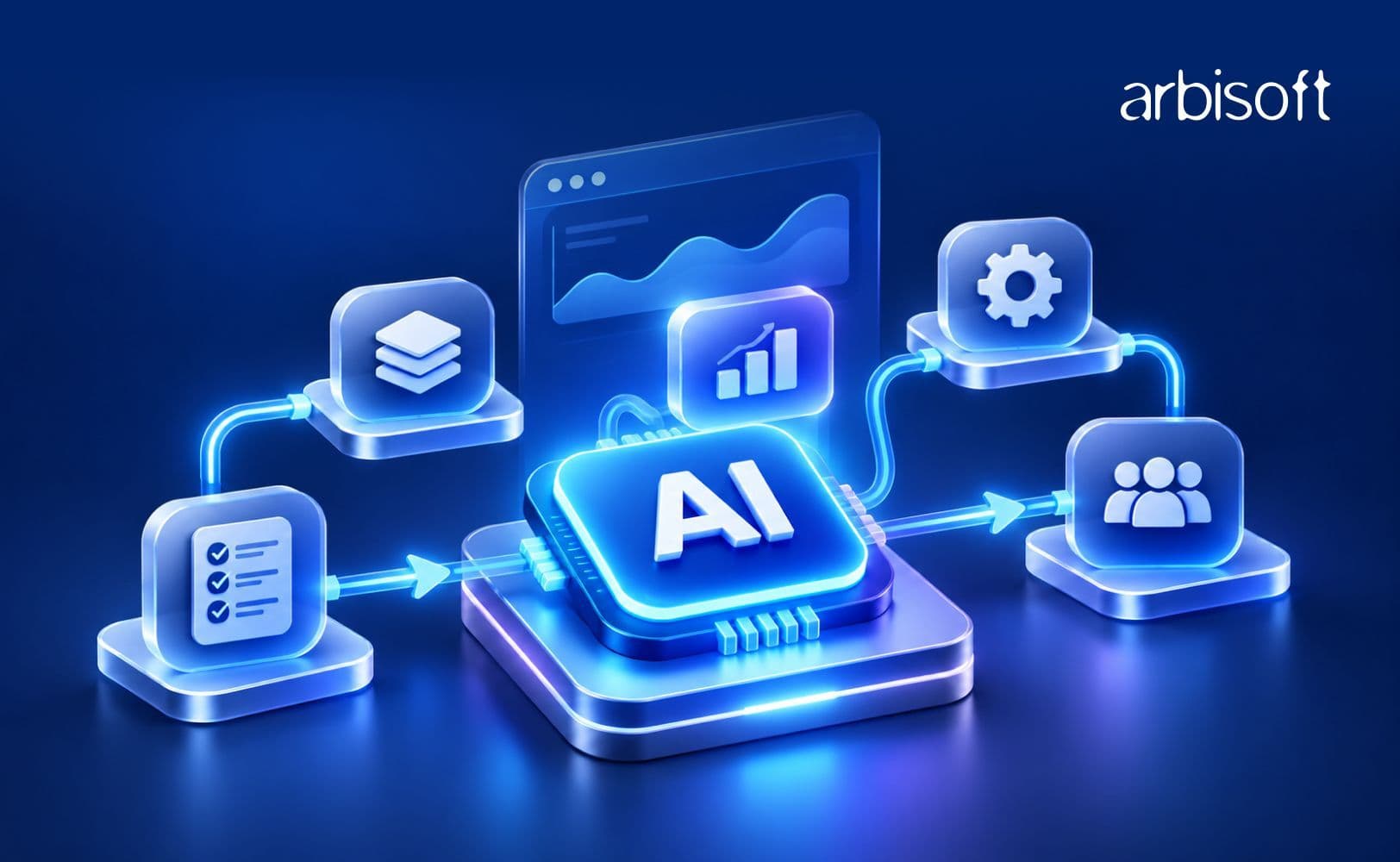
An AI workflow is a business process where AI handles one or more of the steps, instead of answering a single question and stopping there.
The easiest way to see the difference is to compare three kinds of help:
That third option is where things are heading. Gartner describes AI agents as systems that can “operate and perform complex, end-to-end tasks,” compared with assistants that “depend on human input and do not operate independently” (Gartner, Aug 2025).
So when people talk about “AI workflows in 2027,” this is mostly what they mean: AI moving from answering questions to doing parts of the work.
Based on what the research and the market are already showing, here are four changes to expect:
You may never “buy an agent” at all. It will arrive inside your CRM, your helpdesk, or your HR system. Gartner predicted that 40% of enterprise applications would include task-specific AI agents by the end of 2026, up from less than 5% in 2025 (Gartner).
For you, that changes the question in 2027. Instead of asking “should we use agents?”, you will be asking “which of the agents already switched on in our tools do we trust, and which ones do we connect to our own systems?”
Today, most agents do one job. The next step is agents working together. Gartner expects that by 2027, one-third of agentic AI implementations will combine agents with different skills to handle complex tasks (Gartner).
Take an insurance claim. One agent reads the documents, another checks the policy, a third flags possible fraud, and a human approves the payout. That is faster. It is also harder to debug when something goes wrong, because more moving parts means more places for things to break.
This is the trend that deserves the closest watch. Deloitte’s 2026 enterprise survey found that 40% of companies already let AI execute decisions or actions without human approval to at least a moderate degree. Among companies running multiple agents on the same workflow, just 9% say those workflows are fully governed, and 23% of companies say accountability is unclear when an AI system causes a bad outcome (Deloitte State of AI in the Enterprise 2026).
In other words, AI is getting the car keys faster than companies are writing the driving rules.
If you sell into Europe, 2027 has a date circled on it. Under the EU AI Act, as amended by the “AI Omnibus,” strict rules for high-risk AI systems in areas like education, employment, biometrics, and critical infrastructure apply from December 2, 2027. Systems built into regulated products get until August 2, 2028 (European Commission).
Those rules cover risk management, data quality, activity logging, documentation, and human oversight. Read that list again and you will see a checklist for running AI workflows well, whether you are regulated or not.
Let’s start with where most companies actually are.
McKinsey’s 2025 State of AI survey found that 88% of organizations use AI in at least one business function, but nearly two-thirds have not started scaling it across the enterprise. Only 39% report any EBIT impact at the enterprise level. On agents, 23% say they are scaling an agentic system somewhere, but in any single business function, no more than 10% are scaling agents (McKinsey).
MIT’s NANDA initiative was even blunter. In its 2025 “GenAI Divide” research, only about 5% of AI pilot programs achieved rapid revenue acceleration, with most delivering “little to no measurable impact on P&L” (Fortune on the MIT report). One fair caveat: that report is preliminary and interview-based, so treat the exact number as directional. The pattern, though, matches what nearly every survey says.
Looking ahead, Gartner predicts over 40% of agentic AI projects will be canceled by the end of 2027 “due to escalating costs, unclear business value or inadequate risk controls” (Gartner, June 2025).
So why does the demo work when production does not? In our experience, it usually comes down to a handful of very unglamorous reasons:
You may notice that “the model wasn’t smart enough” is missing from that list. It rarely makes the cut.
Here’s a practical seven-step roadmap. None of it is glamorous, but it is the work that separates shipped workflows from shelved ones. Let’s walk through it!
Skip the flashiest idea. Start with a process that is slow, repetitive, and expensive, and that has a clear owner, such as invoice matching, ticket triage, onboarding paperwork, or claims intake.
The research backs this up. MIT found that more than half of generative AI budgets go to sales and marketing tools, yet the biggest returns showed up in back-office automation (Fortune). The report’s lead author, Aditya Challapally, summed up the winning formula: “they pick one pain point, execute well, and partner smartly.”
Here’s a quick test. Can you name the metric that improves if this works, such as hours saved, cycle time, error rate, or cost per case? If you cannot, pick another workflow.
Most teams skip this step. Grab a whiteboard and map the process as it is today. Then ask, “If an agent did steps 2 through 5, what would this look like from scratch?”
McKinsey found that AI high performers are far more likely to be redesigning workflows rather than layering AI on top (McKinsey). Gartner agrees, saying that in many cases “rethinking workflows with agentic AI from the ground up is the ideal path” (Gartner).
You do not need a two-year data program before you start. You need the data this one workflow touches to be accurate, accessible, and permissioned. Start with three questions:
Fixing data for one workflow is a project. Fixing data for everything is a career.
Think of autonomy as a dial you turn up over time. Here’s a simple way to set it:
| Autonomy level | What the AI does | Good for |
|---|---|---|
| Suggest | Drafts or recommends; a human does the action | High-risk or customer-facing decisions |
| Act with approval | Prepares the action; a human clicks “approve” | Refunds, claims, account changes |
| Act and report | Acts on its own; humans review samples and exceptions | Low-risk, high-volume tasks like routing and tagging |
Start lower than you think you need, and move up the dial only when the numbers show the AI has earned that trust. Deloitte’s advice lines up with this: match approval, monitoring, and escalation to what each AI system can actually recommend, execute, or decide (Deloitte).
Before launch, create a set of real test cases with known right answers, and run every change against them. Once you are in production, log every action the agent takes, track accuracy and cost per task, and set alerts for anything unusual.
Engineers call this “evaluation” and “observability.” Together, they tell you the AI is still doing a good job on Tuesday, and not only at the demo on Monday.
Bring IT, legal, security, and the business owner together early. Agree on who owns outcomes, which actions always need a human, and how incidents get handled. Deloitte found only 21% of organizations have a mature governance model for agentic AI (Deloitte Insights), so getting this right puts you ahead of most of the field.
If you have EU customers, map your use cases against the AI Act’s high-risk categories now. Once you count procurement and audit cycles, December 2027 is closer than it sounds.
Do you have engineers who have taken LLM systems to production before, with evaluation, monitoring, and cost controls? If you do, build. If you do not, you are not alone, because that talent is hard to hire quickly.
For what it is worth, MIT’s research found that buying from specialized vendors and building partnerships succeeded about 67% of the time, while internal builds succeeded about one-third as often (Fortune). The same caveat applies, since this is early research. Still, the logic holds: teams that have shipped this before make fewer first-time mistakes.
It would not be fair to sell you only the upside. Here’s what to watch:
On the other hand, the technology is improving fast. The same Stanford report notes that AI agents’ success rate on real-world tasks in the Terminal-Bench benchmark jumped from 20% in 2025 to 77.3% (Stanford HAI). That is a big jump, but it is still short of perfect, and good engineering and good guardrails are what close the distance.
So who will come out ahead with AI workflows in 2027? Not the companies with the most agents or the flashiest demos. The winners will be the ones that did the boring work: clean data for the workflows that matter, clear ownership, real tests, sensible limits on autonomy, and costs they can predict.
If you take one thing from this post, make it this: aim to have one agentic workflow running in production, with measurable results, by mid-2027. Forget ten pilots and focus on one real workflow. That single win teaches your team more than a year of demos, and it gives your board the proof they have been asking for.
Still wondering where to start? Go back to Step 1 and pick the process your team complains about most. That is usually the right answer.
Arbisoft has been building software since 2007. In that time, our teams have delivered 550+ projects across 50+ tech stacks and helped build platforms serving 500M+ users, including edX, KAYAK, and Insurify. Clients rate us 4.9 on Clutch, with an 80 NPS.
When it comes to AI, we focus on the stage where most projects get stuck: taking a promising pilot and making it work in production, with the data engineering, evaluation, and guardrails that requires. Our product, design, and engineering teams work alongside yours, from choosing the right workflow to shipping it.
Got a pilot that is stuck, or a workflow you think AI should be handling by 2027? Let’s talk. We are happy to look at it with you and give you a straight answer on what it would take.
An AI workflow is a business process where AI handles one or more steps, such as reading documents, making a decision within set rules, or taking an action in another system. Unlike a chatbot, which only answers questions, an AI workflow moves work forward from start to finish, with humans stepping in where needed.
Traditional automation follows fixed rules and breaks when something unexpected happens. On the other hand, agentic AI is given a goal, plans the steps itself, uses tools and data to complete them, and adapts when things change. It can handle messier, more varied work, but it also needs stronger monitoring and clear limits.
The most common reasons are poor or inaccessible data, AI added to an unchanged process, no clear owner, no way to measure quality, and costs that rise at scale. Model quality is rarely the main problem. Gartner, McKinsey, and MIT research all point to execution and integration as the real gaps.
Start with one painful, measurable workflow. Redesign the process, get the data for that workflow ready, set how much autonomy the AI gets, build testing and monitoring in from day one, and put governance in place early. Then scale what works.
Yes, if you operate in or sell to the EU. Obligations for high-risk AI systems in areas such as education, employment, biometrics, and critical infrastructure apply from December 2, 2027, and systems built into regulated products follow on August 2, 2028. Requirements include risk management, logging, documentation, and human oversight.
...Loading Related Blogs
Trusted by top platforms for our transformative solutions and exceptional results: