

 Add as preferred on Google
The Future of Education Technology in 2027: How AI Is Changing Learning for All AgesRead More
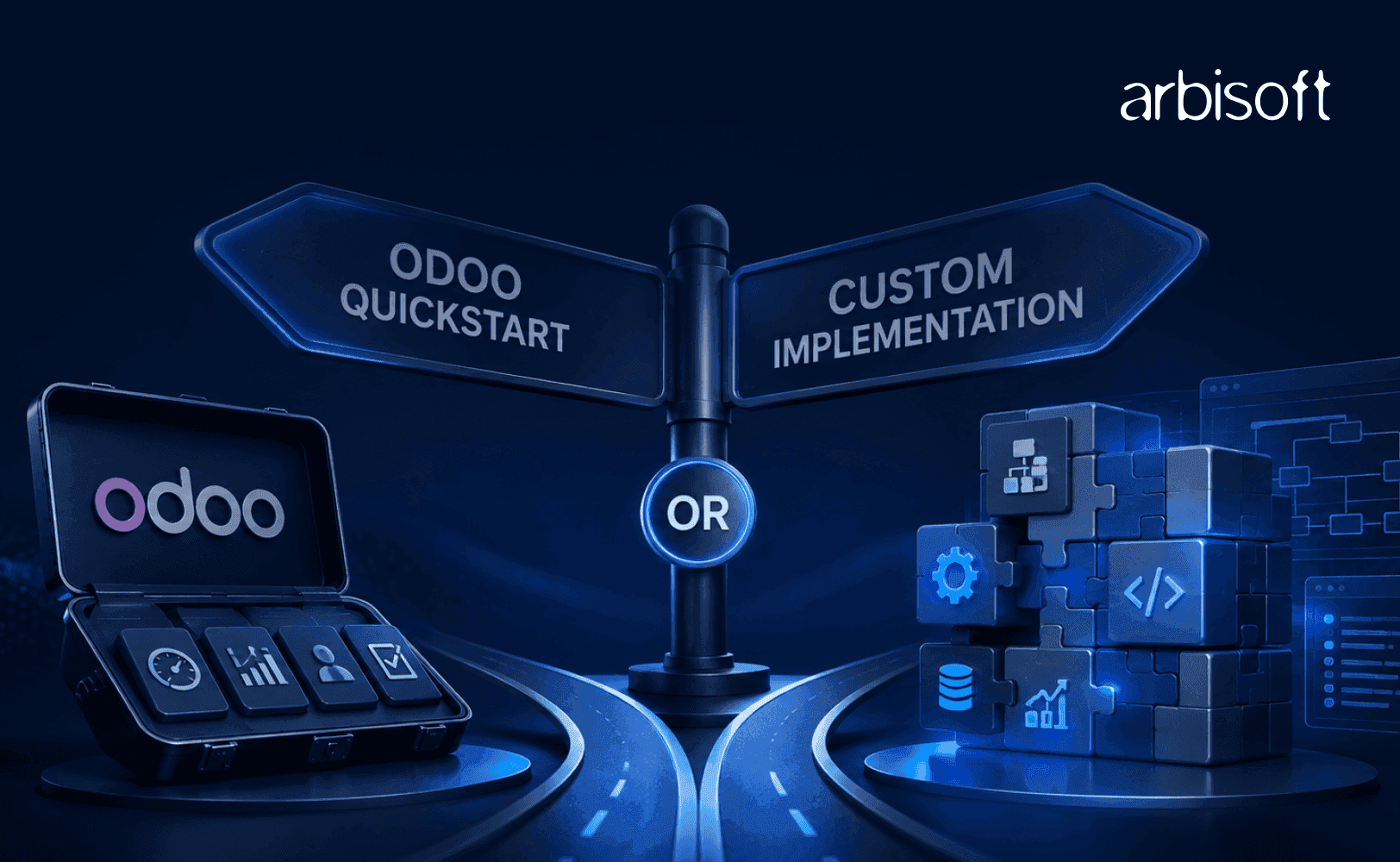
When a documented fit-gap analysis, which compares each business request against standard Odoo capability, shows configuration covers your critical workflows then choose a Quickstart-style Odoo implementation. When business-critical gaps survive that test, choose custom. The deciding dimension is verified process fit, not company size, budget, or launch speed. Six signals shape the call: process standardization fit, material customization need, integration dependency, data and reporting complexity, rollout breadth, and the organization's capacity to make binding decisions. No single signal settles it. Custom development earns its place when a requirement is necessary, cannot be met by configuration or Odoo Studio, and its business value outweighs the upgrade and maintenance burden custom modules create.
Choosing between Odoo Quickstart and a custom implementation is not mainly a question of company size, budget, or how fast you want to launch. The more useful question is simpler: how much of your operating model can stay standard, and which gaps are important enough to justify added complexity?
A constrained Quickstart-style approach can be a strong fit when standard Odoo processes already cover most critical needs. A custom implementation makes more sense when verified business requirements, integrations, data needs, or reporting dependencies cannot be absorbed by standard configuration. The decision should come from evidence, not from a label.
Odoo's implementation guidance puts fit-gap analysis at the center of project scoping. The practical task is to compare business requests with standard capabilities, then decide whether each gap should be handled through configuration, process change, Studio-level customization, integration, or custom development.
That makes Quickstart versus custom less like choosing between two fixed product tiers and more like choosing an implementation philosophy. Current Odoo documentation does not establish a universal commercial "Quickstart" package with one scope or timeline, so treat the term as something to verify with your implementation partner.
A Quickstart-style implementation works when tight boundaries help the project. Standard workflows already fit, major exceptions are limited, and the organization is willing to adapt some habits to the software rather than reproduce every existing process.
The useful proof is not a sales description. It is a documented fit-gap analysis showing which needs are covered by standard configuration and which exceptions remain.
Older Odoo partner training materials describe a QuickStart methodology built around prioritization and tight scope control. Because that terminology is not clearly established as a current universal program, confirm what your partner means by "Quickstart" before treating it as a defined package.
Custom implementation is justified when a requirement survives a harder test: standard configuration cannot meet it, the requirement is materially important, and the business value of changing the software outweighs the ongoing burden.
That burden matters. Odoo distinguishes between configuration, no-code changes in Studio, and code-level custom modules. Custom modules also need to remain compatible with upgrades and be tested as the platform changes.
A useful approval rule is to ask three questions before custom development starts: Is the requirement truly necessary? Can standard configuration or a less invasive option achieve the same outcome? Is the long-term maintenance cost justified by the business gain?
The decision becomes clearer when you stop looking for one threshold and examine six interacting signals instead:
No single signal proves that custom implementation is required. A complex data migration, for example, can still exist inside a largely standard implementation. What matters is how the signals combine.
Process fit is the foundation because every other decision depends on what the business actually needs. A fit-gap exercise should compare current workflows with standard Odoo flows and isolate the exceptions that cannot be resolved through configuration or reasonable process change.
The hard part is distinguishing a business-critical requirement from an inherited habit. Regulatory obligations, contractual requirements, financially material controls, and genuinely differentiating processes deserve stronger protection than preferences about screen layout or familiar step sequences.
Ask process owners to document contested exceptions and explain why each one matters. That record creates accountability and gives the implementation team something concrete to test.
The full fit-gap to go-live implementation process deserves its own treatment. For this decision, the key point is that customization should follow a verified gap, not precede it.
Technical dependencies can shift the implementation path even when process fit looks strong.
Integrations matter when Odoo must exchange data with external systems, especially where synchronization, triggers, or custom logic are required. Data migration adds another dimension through source-system count, data quality, transformation needs, and historical-data requirements. Reporting can also create a real gap if standard tools or reasonable external reporting options cannot satisfy a business-critical need.
Before choosing an implementation path, review three inventories: external integrations, migration sources and targets, and required reports. Tie each item to a current business process and a named owner. That helps separate genuine dependencies from speculative future requests.
A broad rollout can be difficult even in a relatively small company. A narrow rollout can be manageable inside a large one. Headcount is a weak proxy for implementation complexity.
What matters is how many process areas must be reconciled at once and whether the organization can resolve disagreements quickly. Odoo's methodology emphasizes a single point of contact and limited stakeholder groups to accelerate decisions.
Look for observable evidence of governance: named process owners, clear decision rights, a sponsor or point of contact with real authority, and a mechanism for closing disputes. If decisions are repeatedly reopened, ownership is unclear, or cross-functional conflicts remain unresolved, tight implementation constraints become harder to maintain.
There is no authoritative threshold such as "under five integrations" or "under 50 users" that determines whether Quickstart or custom is right. The six signals are more useful as a pattern.
A strong standard-fit pattern combines workflows that largely map to Odoo, few justified exceptions, limited and understood technical dependencies, and clear ownership. A Quickstart-style path is plausible.
A strong custom-fit pattern appears when several critical gaps remain after configuration is tested and material dependencies require custom logic or other extensions. A custom implementation is more defensible.
A mixed pattern has broad standard fit with one or two unresolved technical dependencies. Start with explicit boundaries and define what evidence would trigger escalation.
An unclear pattern combines uncertain process fit with fragmented ownership. In that case, validate requirements and governance before committing to either path.
These patterns are not a scoring model. They show which assumptions need proof before the project becomes harder to reverse.
A strong Quickstart-style fit usually has a consistent pattern: most critical workflows map to standard configuration, few gaps survive the necessity test, integrations are well understood, migration is manageable, rollout scope is deliberately bounded, and decision ownership is clear.
The main risk is false confidence. "Few gaps" can mean genuine fit, or it can mean difficult requirements were never surfaced.
Before approving a constrained path, review the fit-gap record and the accepted exception list. The evidence should show that standard fit was tested, not assumed.
A custom implementation becomes more defensible when material requirements remain after standard configuration and less invasive options have been tested.
Those gaps may involve essential process logic, external integrations, migration needs, or reporting dependencies that cannot reasonably be handled within the constrained model. The key is necessity. Custom work should solve a requirement the business can defend, not simply preserve a preference.
Custom work also creates lifecycle obligations. Odoo's upgrade guidance makes clear that custom modules must be made compatible with later versions and tested accordingly. That means the business case for a custom feature should include not only the initial gain but also the ownership and maintenance it creates.
Mixed cases are often the most realistic. Most departments may fit standard Odoo, while one integration or reporting requirement remains uncertain.
In that situation, avoid forcing an early binary answer. Define what remains standard, document the unresolved gaps, and state the evidence that would justify escalation.
An escalation trigger might be a verified requirement that standard configuration cannot satisfy, a confirmed integration dependency that needs custom logic, or a reporting requirement that remains unmet after native options are tested. Record the decision rather than allowing scope to expand through a series of informal exceptions.
Reversibility is a design choice. Clear boundaries and explicit triggers make it easier to change the implementation model deliberately instead of drifting into it.
Scope drift can expose a bad fit in either direction. A constrained implementation may quietly accumulate exceptions, while a custom implementation may solve problems that standard Odoo could have absorbed.
Watch for an expanding list of "small" exceptions, integrations, workarounds, and deferred requirements. Individually, each request may look manageable. Together, they can undermine the original scope.
A practical control is a running change log that records every deviation approved after the fit-gap baseline, along with its business justification. If that list keeps growing, formally reassess the implementation model instead of pretending the original boundaries still hold.
The opposite warning sign is customization approved because users prefer a familiar layout, sequence, or report format.
Before development, ask what measurable harm occurs if the customization is removed. If the answer is inconvenience rather than a material business impact, revisit standard configuration or process adaptation.
Require process-owner sign-off for significant deviations. That keeps customization tied to business value rather than familiarity.
The strongest implementation choice is one that has survived a small set of explicit tests. You do not need a complete delivery plan to make the initial decision, but you do need enough evidence to know which assumptions could change it.
Before committing to detailed build work, confirm five assumptions: critical processes have actually been tested against standard Odoo; required exceptions are documented and classified by business criticality; integration, migration, and reporting dependencies are inventoried with named owners; process ownership and decision rights are clear; and escalation triggers for additional customization are documented in advance.
The practical decision is not "Quickstart or custom?" in the abstract. It is whether your verified requirements still fit inside standard Odoo boundaries, and whether the exceptions are important enough to justify the complexity of breaking them.
Odoo QuickStart focuses on getting a business live quickly using mostly standard Odoo features and workflows. A custom implementation involves deeper process analysis, integrations, custom modules, automation, or workflow changes to match specific business requirements.
QuickStart is usually a good fit when your business can work with standard Odoo processes, has relatively straightforward requirements, and wants a faster, more controlled implementation. It can also work well as the first phase of a larger rollout.
Custom implementation is more suitable when critical business processes cannot be handled effectively with standard Odoo, or when you need complex integrations, industry-specific workflows, custom reports, advanced automation, or specialized functionality.
Yes. In many cases, starting with standard Odoo and adding customization after users have worked with the system can reduce unnecessary development. It also helps teams distinguish genuine business requirements from preferences based on their previous software.
Generally, yes. QuickStart usually requires fewer consulting and development hours because it relies more heavily on standard functionality. However, the total cost depends on your number of users, modules, data migration, training, integrations, and future customization needs.
It can. Custom modules, third-party applications, and heavily modified workflows may need testing or redevelopment when upgrading to a newer Odoo version. Keeping customizations well documented and limited to high-value requirements can reduce this risk.
There is no fixed percentage. A better test is whether each customization produces enough business value to justify its development, maintenance, testing, and future upgrade costs. If standard Odoo can achieve the same outcome with a reasonable process change, customization may not be necessary.
A partner can be especially valuable when the project involves complex workflows, integrations, data migration, localization, or custom development. Simpler implementations may require less external support, depending on the experience of your internal team.
...Loading Related Blogs
Trusted by top platforms for our transformative solutions and exceptional results: