
 Add as preferred on Google
How to Modernize a Legacy Learning Platform Without a Full RewriteRead More
You've built the product. Search works, checkout works. And there's nothing to sell, because there's no inventory in it.
Every travel build hits this wall. GDS integration for a travel website is where most teams stall. We've been writing travel software since 2007 and have been KAYAK's engineering partner for over 18 years. The inventory problem stops more projects than any technical challenge we see.
The standard advice for getting past it: sign up for the Amadeus self-service developer portal, grab a key, make your first call. That advice held for years. It stopped working in July 2026, and most of the internet hasn't noticed.
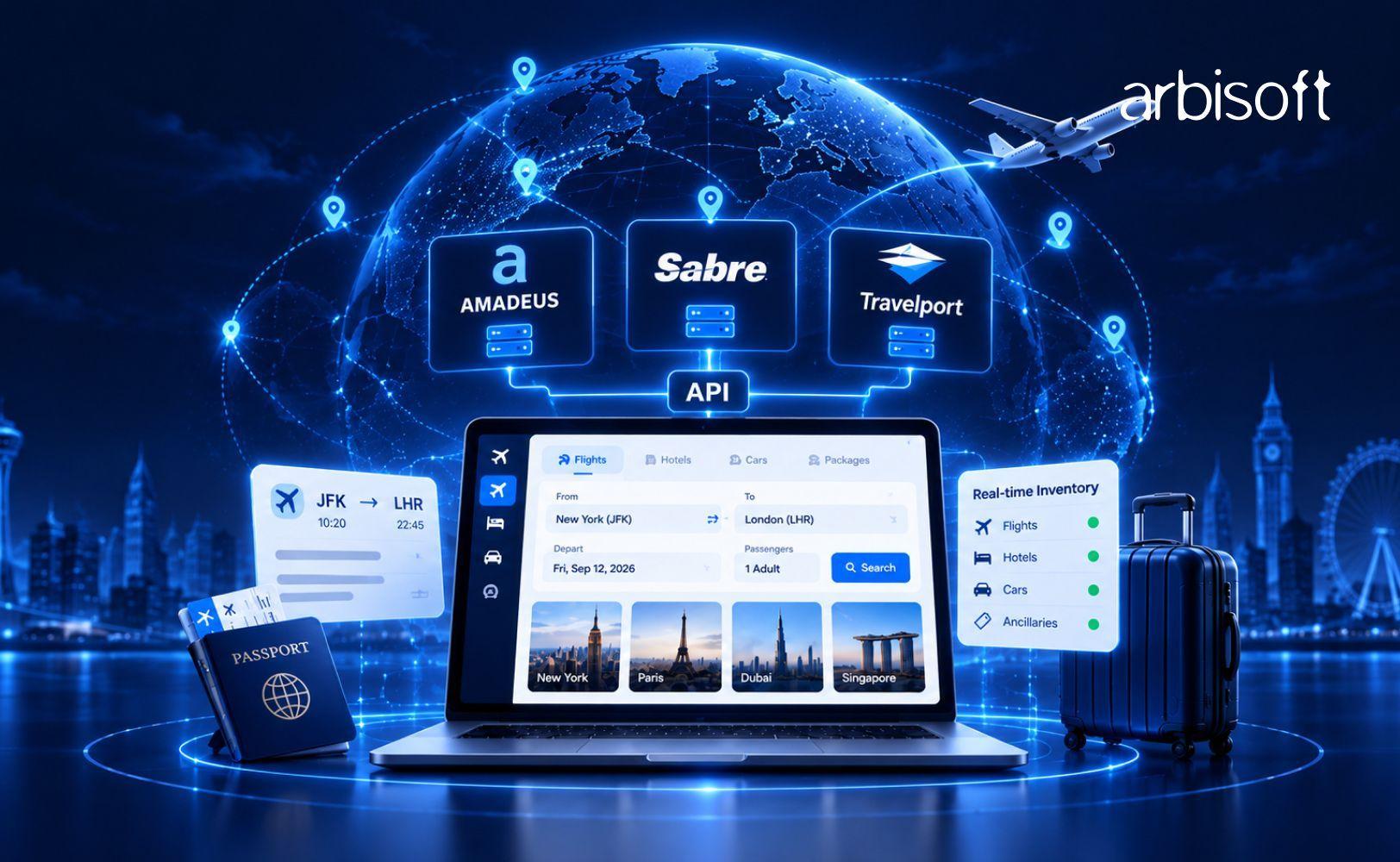
GDS integration means connecting your travel website to a global distribution system (Amadeus, Sabre, or Travelport) so it can search and book live flight and hotel inventory. The contract comes before the code. All three require a signed agreement, vetting, and certification before you touch live inventory.
Amadeus closed its free self-service tier in July 2026, so every remaining route there runs through sales. Direct GDS access typically takes six to fourteen months. An aggregator like Duffel or Kiwi.com takes one to four months and needs no travel-agent accreditation.
If you read one section, read the three gates.
Is the Amadeus Self-Service API still available? No. The self-service section of the Amadeus for Developers portal was decommissioned on 17 July 2026 and self-service API keys were deactivated.
The sourcing is mixed, and worth stating precisely. The date comes from a letter Amadeus sent to users, reported by PhocusWire in February 2026, with a spokesperson stating that only the self-service section was being decommissioned. Amadeus's own public statement never mentions the shutdown or the date; it responds to the coverage by clarifying that its Enterprise Portal and Enterprise APIs remain fully available. The corroboration sits in public code: the amadeus4dev GitHub organisation was archived on 17 July 2026, and the Python, Node and Java SDKs are now read-only behind a deprecation notice.
Is there still a way in for a small team? Yes, though nothing self-serve. Amadeus points to its Ventures and Partners programmes and runs an Amadeus for Startups track, which screens applicants (4,000+ screened, 40+ active) and offers a contact-sales form. Even the startup door at Amadeus opens onto a sales conversation.
The lesson holds even if you never touched Amadeus. This category is contract-gated end to end.
A global distribution system (GDS) is a commercial intermediary. It collects flights, hotel rooms and cars from thousands of suppliers, then resells access through APIs and agent terminals. When a booking site shows fares from twelve airlines at once, a GDS (or an aggregator sitting on top of one) is why.
A GDS is not a developer API product. You can't sign up and start selling the way you can with Stripe. "Content" is the industry word for the fares and inventory you're permitted to see, and your contract defines it. Two companies can integrate the same GDS and see different inventory. Treat it as a wholesale supply agreement that happens to be delivered over HTTP.
One thing you can stop worrying about: you will not need to learn a green screen. GDS terminal training takes months of supervised practice, but that's for travel agents booking by hand. You're integrating an API into a website.
Most guides open by counting airlines and hotels. That's the last thing that should drive your decision, because two earlier questions can rule out direct GDS access entirely.
To search fares, no accreditation is needed. To issue a ticket, you need accreditation from IATA (or ARC, the Airlines Reporting Corporation, in the United States), or you need somebody else's ticketing authority. Two different permissions. Conflating them is expensive, because teams discover it late, with a built product and a launch date.
Three ways through:
GDS economics are fixed-cost-forward. Setup fee, monthly minimums, certification, all payable before your first booking. Aggregator economics are purely variable.
If you can't forecast volume, a GDS contract is a bet on demand you haven't proven. Don't take that bet pre-revenue.
The arithmetic, using Duffel's published fees. On a $400 ticket with managed content, a booking costs about $7.00 ($3.00 per order plus 1% of order value). Against a $1,000 monthly GDS minimum, that's roughly 143 bookings a month before the minimum wins on variable cost alone. Against $2,500, roughly 357.
Treat those as a floor. The GDS side also carries setup, certification, per-segment fees on top of the minimum, accreditation, and six to fourteen months before your first sale. Pushing the other way, your own accreditation kills the 1% content fee and gives you margin control an aggregator won't. Our read: below a few hundred bookings a month the arithmetic doesn't favour direct GDS, and the gap widens once you price in time.
Now coverage matters. Direct GDS access wins when you need corporate and chain content, negotiated fares you've arranged yourself, or deep full-service-carrier inventory in one region. It matters less for leisure platforms, low-cost-carrier routes and independent hotels.
Do you need more than one GDS? Rarely at launch. Most run one and supplement it.
Airline counts are undated marketing figures that move constantly. Four things shape the choice between Amadeus, Sabre and Travelport.
| Amadeus | Sabre | Travelport | |
| Developer access | Self-serve closed July 2026; Enterprise or partnership programmes via sales | Free sandbox, open portal, paid production agreement | 30-day sandbox trial, evaluation only |
| Geographic strength | EMEA roots, strong Europe and Middle East | North American roots, strong corporate | Smallest of three, strong global hotel distribution |
| Content notes | Broad low-cost carrier (LCC) coverage including Ryanair | Exclusive NDC content from Turkish, ANA and the LATAM group | Combines Galileo, Apollo and Worldspan |
| Contract friction | Highest | Lowest | Medium: look, contract, then build |
The 2026 story is the divergence. Amadeus closed its open door. Asked directly whether its own developer access would be restricted, Sabre answered no, calling open developer access fundamental to its platform strategy rather than a temporary programme, and noting that while some platforms are closing self-service portals, it's expanding. That's Sabre's marketing position, so weigh it accordingly. Observers did independently note that Sabre has been adding agentic AI features to its developer portal.
Travelport sits between the two, and the detail matters. It offers a 30-day sandbox, but its own documentation states that sandbox credentials are for evaluation purposes only and that you must not conduct development without signing a contract. Pre-production credentials arrive after the contract, then certification follows. So Travelport lets you look. Sabre lets you build. In 2026 that's a live selection criterion, and we haven't seen another comparison treat it as one.
Conditionally: European or Middle Eastern market with volume and accreditation, Amadeus. Prototyping before you commit, or North American corporate focus, Sabre. Hotel-heavy with an existing relationship, Travelport. Pre-revenue, none of them yet.
Amadeus, Sabre and Travelport all decline to publish pricing. Each wants you to contact them, and the quote depends on your market, your forecast volume, and how much content you want. Sabre confirms it doesn't publish fixed pricing. These are genuinely negotiated contracts, which is why every figure you find online is an estimate, ours included.
Verified published pricing. Duffel's public pricing page, checked 3 September 2026:
| Item | Cost |
| Upfront | $0 |
| Per confirmed flight order | $3.00 |
| Managed Content (using Duffel's accreditation) | 1% of order value |
| Per paid ancillary | $2.00 |
| Excess search above a 1500:1 search-to-book ratio | $0.005 per search |
| Currency conversion | 2% |
Estimates for direct GDS. No rate card exists. The ranges below come from travel-technology integrators publishing indicative figures. Read them as an order of magnitude:
| Item | Reported range |
| Setup | $5,000 to $25,000 |
| Monthly minimum, smaller platforms | $1,000 to $5,000 |
That excess-search line catches people out. Metasearch products generate enormous search-to-book ratios by design. KAYAK, whose platform we help build, processes billions of searches a year. If your product is search-heavy and booking-light, per-search charges can become your largest line item. Model your ratio before your bookings.
Your own build cost sits outside all of this. Most articles fold engineering into "GDS cost." They're separate budgets, and engineering is usually the larger one in year one.
Verify every number yourself, ours included. Duffel's help centre currently states a 0.5% Managed Content fee while its live pricing page says 1%. If a vendor's own documentation disagrees with itself, treat third-hand blog figures accordingly.
Writing code is phase four of six. The sequence below is broadly the same for Amadeus, Sabre and Travelport.
Phase six is where the real work lives, and nobody scopes it properly. When we built the airline-facing side of Travelliance's platform, the interesting engineering sat in the disruption path: letting airline systems request accommodation for large disruptions, sometimes up to 500 passengers at once, then reconcile and invoice all of it afterwards. Booking a seat is a solved problem. Everything that happens when the plan changes is still hard.
An aggregator sits on top of multiple sources (GDS content, direct airline NDC connections, low-cost carriers) and gives you one API instead of several contracts. Duffel and Kiwi.com are the usual starting points, with TBO Air and Travelfusion filling low-cost carrier gaps.
What you gain: no upfront cost, no accreditation requirement, one to four months to launch, and costs that scale with revenue.
What you give up: a per-booking fee forever, partial coverage against a full GDS, dependence on someone else's accreditation and airline agreements, and less control over negotiated fares.
There's a real objection to our own advice, and the Amadeus Self-Service shutdown in July 2026 is it. The teams hurt worst were the ones who'd built on a tier they didn't control. Depending on any single supplier's goodwill carries risk, and an aggregator is still a single supplier.
So the mitigation matters more than the choice. Keep supplier-specific logic behind an internal interface. KAYAK aggregates hundreds of providers, and its architecture exists precisely so that no one provider's change becomes an emergency. The principle scales down. If swapping a supplier means touching one adapter instead of your whole codebase, a shutdown notice costs you a sprint instead of a quarter.
On NDC: it's a data standard for airlines to distribute richer offers, not a supplier you can call. Aggregators and GDSs both carry NDC content. You don't need a strategy for it on day one. You need to know your provider supports it.
Starting on an aggregator and migrating to direct GDS later is the normal path. It's what we recommend to most teams who ask.
For most travel platforms, a hotel wholesaler (a bedbank) rather than a GDS. Hotel inventory follows a different supply chain from flights.
| GDS hotel content | Bedbank / wholesaler | |
| Rate type | Commissionable | Net wholesale, you set the markup |
| Strongest on | Chains, corporate, negotiated rates | Independents, boutique, leisure |
| Examples | Amadeus, Sabre, Travelport | Hotelbeds, WebBeds, TBO, RateHawk |
| Best for | Corporate and managed travel | OTAs, metasearch, leisure |
GDS hotel APIs were built on airline reservation infrastructure from the 1990s. They're strong on major chains and corporate rates, weaker on independents, which is why most OTAs pair a GDS with at least one bedbank.
A useful ceiling, reported by hotel-aggregation specialists working across 100+ live integrations: four to six well-chosen suppliers (one global bedbank, one GDS, one OTA-wholesale source, one or two regional specialists) cover the large majority of globally bookable inventory. Past six, each new integration adds maintenance and duplicate properties faster than it adds unique hotels. Those specialists sell aggregation, so read it as directional. Either way, resist the urge to collect suppliers.
The hard parts of a GDS integration are fare rules, timeout and error handling, caching inside supplier limits, idempotency on booking, and servicing after the sale. Teams underestimate the last one almost universally.
The maintenance burden is real and current. Travelport deprecated all of its previous JSON API authentication endpoints on 30 January 2026 and issued new credentials to customers, with transactions to the old endpoints failing. That's a normal Tuesday in travel integration.
If you're hiring a partner, ask:
We're not going to publish a list of "top GDS integration companies," ourselves included. Those four questions will tell you more than any ranking. Our vetting checklist for travel software partners goes deeper.
| Your situation | Path | This week |
| Pre-launch, no accreditation, unproven demand | Aggregator with managed content | Sign up, build a search flow against the sandbox |
| Under ~300 bookings/month, growing | Aggregator, plan the migration | Model your crossover on your own average ticket value |
| Funded, forecastable volume, accreditation in hand | Direct GDS | Open commercial conversations with two, in parallel |
| Hotels only, leisure focus | Bedbank first | Request API access from one global bedbank |
| Corporate or chain-heavy | GDS for hotels too | Ask about negotiated-rate support |
No. The free self-service tier closed in July 2026. Enterprise access and Amadeus's partnership programmes remain available, both through a commercial conversation, and Amadeus doesn't publish pricing.
You can test against Sabre's free sandbox without it. Issuing real tickets requires accreditation, a consolidator or a host agency, plus a paid production agreement.
Roughly 24 to 60 weeks for direct access, covering commercial approval, development and certification. Aggregators typically take 4 to 16 weeks. These are integrator estimates.
Rarely at launch. Most platforms start with one and add supplementary sources for low-cost carriers or hotels.
An aggregator with managed accreditation. No upfront cost, no IATA requirement, and a per-booking fee of around $7 on a $400 ticket at Duffel's published rates.
...Loading Related Blogs
Trusted by top platforms for our transformative solutions and exceptional results: