 Add as preferred on Google
How a Repository Health Dashboard Helped Open edX Patch certifi in 48 HoursRead More
Our planning tiers put most app builds at $30,000 to $180,000 for a 2027 launch, and written scope assumptions explain most gaps between vendor quotes.
Fund a paid discovery phase of roughly $5,000 to $15,000 first, because it narrows the estimate before you commit.
Send one app idea to three vendors and the prices can differ by two or three times. That spread is normal. App cost follows scope, platform coverage, backend work, testing effort and team location, and most of the gap between quotes comes from assumptions that nobody wrote down before pricing the work.
So how much does it cost to make an app for a 2027 launch? A simple build typically costs $30,000 to $80,000, and a mid-complexity build $80,000 to $180,000. Complex or regulated platforms cost more. This guide shows which tier fits your app, what moves the price, which costs continue after launch and how to check a vendor quote line by line before signing it.
Most apps cost $30,000 to $180,000 to build. A clickable prototype can come in under $15,000, while an enterprise platform can pass $500,000. The table uses Arbisoft's planning tiers for a first budget, the kind written before discovery has tested any of the assumptions behind it, and we expect those tiers to hold for apps planned for 2027.
| Tier | Typical scope | Planning range | Typical timeline | Best for |
|---|---|---|---|---|
| Prototype or proof of concept | A few core screens, no production backend | Under $15,000 | Weeks | Testing an idea with users or investors |
| Simple app | One or two user roles, standard screens, basic backend | $30,000 to $80,000 | 2 to 4 months | Proving one core workflow with real users |
| Mid-complexity app | Several roles, payments, notifications, custom backend, admin panel | $80,000 to $180,000 | 4 to 7 months | Funded startups and SMBs launching a product |
| Complex or regulated app | Real-time features, marketplace flows, heavy integrations, compliance needs | $180,000 and up, with enterprise builds past $500,000 | 8 to 12 months | Healthcare, fintech and multi-tenant platforms |
Market data shows the same wide spread. Clutch's App Development Pricing Guide puts the average app project at $90,780 with a timeline of about 11 months. Most projects reviewed on Clutch fall between $10,000 and $49,999. That average mixes small engagements with large builds, which is why it says little about any one app.
Every number at this stage is a rough order of magnitude. Estimates narrow once user stories and integration details exist on paper, and a quote given before that work carries the widest error of any estimate in the project. Our guide on how to make an app covers that scoping work step by step.
Scope moves app development cost more than anything else. Platform coverage, backend work, design and QA effort, and the team's location and seniority come next. Arbisoft's mobile team places an app in a cost tier by checking five things: the number of user roles, any real-time or offline data needs, compliance obligations, custom design versus platform defaults, and native builds versus one shared cross-platform codebase.
Buyers tend to compare hourly rates first. The rate explains less of the final bill than the number of hours each feature takes once testing and release work are counted.
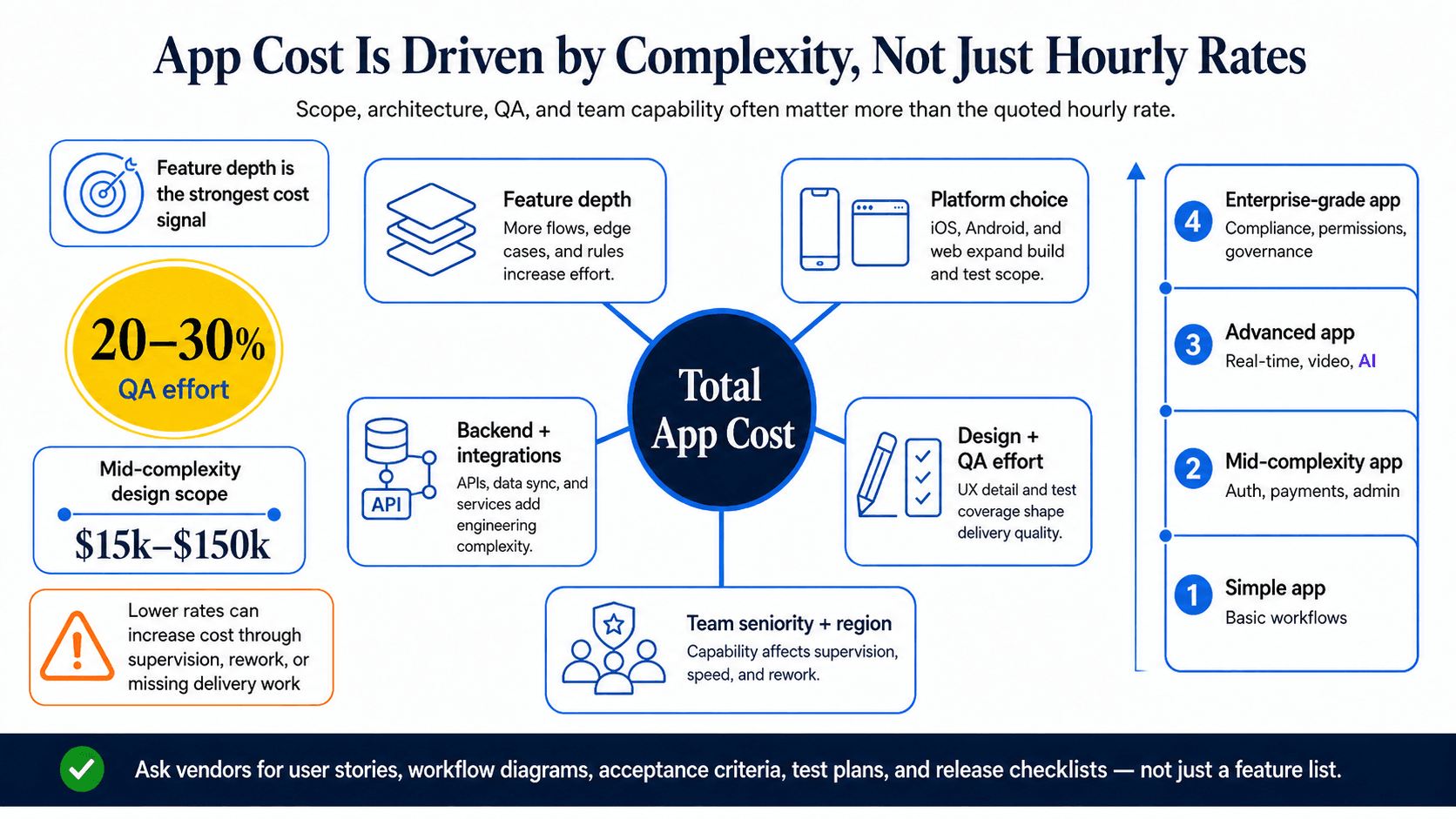
Each user role adds its own screens, permissions, workflows and test cases, which makes role count the quickest tier check. A booking app for customers only is a far smaller build than a marketplace where buyers, sellers, moderators and support agents each need their own views and test runs.
One-line features hide work. "Users can message each other" can mean authentication, real-time delivery, media uploads, push notifications, moderation and accessibility support, with each piece carrying its own design and test estimate. Two vendors pricing that sentence may be pricing different products. Asking for user stories with acceptance criteria makes every quote describe the same app.
Separate native iOS and Android apps usually cost the most, because each platform needs its own implementation and test cycle. Cross-platform frameworks such as Flutter and React Native share one codebase across both stores, which suits most business and consumer apps. The savings have limits. An app that depends on device hardware or heavy animation can spend all of those savings on plugin workarounds and extra testing across each store's devices before the first release.
A progressive web app skips store submission but gives up some device access and notification behavior, and our guide to choosing a mobile app platform works through that decision in more depth. For the budget, check which platforms and OS versions each quote covers.
The backend is where early app estimates are most often incomplete, because it holds the database, APIs, authentication, payments, notifications, hosting, analytics and the admin tools that staff will use every day. Buyers rarely see it, and they pay for all of it anyway.
Managed backend services lower the first invoice. Their usage-based billing grows with traffic, though, and we'd argue they also make custom logic and any later move to another provider harder. A custom backend costs more up front and needs DevOps and monitoring, but the team controls every part of it. Apps that handle payment or health data also need stronger authentication, encryption, penetration testing and a qualified compliance review, and each of those should appear as its own priced line in the quote.
UX research, UI design, product management, QA, documentation and release planning all take hours, and an unusually cheap quote tends to trim them first because they are the easiest work to leave off a proposal. A credible proposal lists wireframes or a prototype, a test plan, acceptance criteria and a release checklist as deliverables with their own effort. Watch the QA line. If it appears as a single line with no devices or test types named, it is probably underfunded.
Hourly rates change by region, and the lowest rate rarely produces the lowest project cost. Clutch's pricing guide lists typical app development agency rates of $25 to $49 per hour, with higher bands in Canada and Poland ($50 to $99) and Australia ($100 to $149), and rates under $25 in India.
Senior engineers cost more per hour. Per project, they can cost less, because they settle architecture questions early and cause less rework, which is why total hours by role and seniority make the fairer comparison between quotes. A cheaper team that needs two rounds of rework on the same feature has already lost its rate advantage.
AI coding agents and no-code builders can lower the cost of a small MVP, mostly by speeding up routine work. Plenty stays on the budget. Product decisions, architecture, security review, testing and human code review still need people and hours, and those are the parts of the budget where most of an app's delivery risk sits.
Measured gains are uneven. In a randomized study of early-2025 tools, METR found that 16 experienced open-source developers working on 246 real issues took 19 percent longer when AI tools were allowed. METR's February 2026 update said developers are likely sped up more by current tools, but called its newer data only weak evidence of how large that gain is.
No-code and low-code platforms suit prototypes and internal tools, and they are a cheap way to test demand. Their costs move later. Subscriptions grow with users, and a product that outgrows the tool needs a rebuild. Any build method also carries running costs for hosting, database growth, third-party APIs, model tokens for AI features and compute for video or real-time sync once the app has real users.
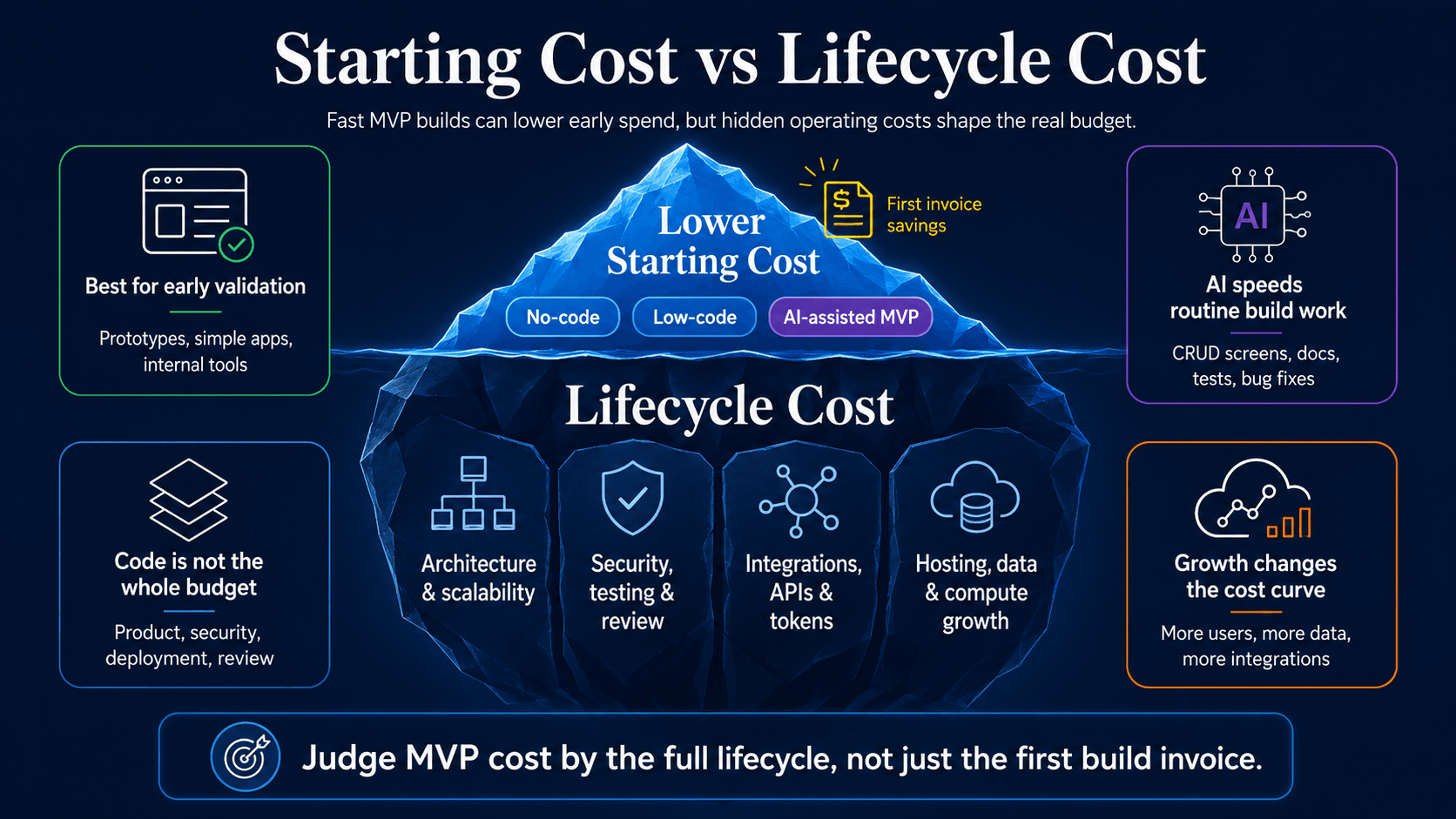
Our outlook for 2027 budgets is that AI-assisted teams will save the most time on familiar, low-risk work, such as apps with modest traffic and light compliance needs. Review and testing still cost hours. A quote that comes in far lower because "AI writes the code" should still show hours for human code review and security testing, because someone on the team has to check and approve whatever the tools produce before it reaches users.
Pricing models decide who pays for change. Fixed price shifts risk to the vendor, who usually prices it back in through buffers and change orders. Time and materials keeps flexibility with the buyer, who then has to govern the burn rate sprint by sprint and decide at each review whether the remaining scope is still worth paying for.
| Model | How billing works | Main risk | Best for |
|---|---|---|---|
| Fixed price | One price for a defined scope | Change requests and hidden assumptions | Stable, documented scope with acceptance criteria |
| Time and materials | Billed for hours worked | Spend drifts without sprint budgets and burn reporting | Evolving MVPs and discovery-heavy work |
| Dedicated team | Monthly fee for a stable team | Needs internal product leadership | Long-term product roadmaps |
| Staff augmentation | Specialists join the buyer's team | Buyer owns delivery management | Filling specific skill gaps |
| Hybrid | Paid discovery, then capped milestones | Needs clear exit criteria per phase | First builds where scope is partly known |
In our view, hybrids suit most first builds. Discovery runs as a small separate engagement, and implementation is then priced by milestone with a spending cap both sides can see, which keeps the buyer's flexibility without leaving the vendor to guess at buffers. The custom software development pricing and budgeting guide covers each model's contract terms and guardrails.
A defensible app development budget is a short set of written decisions that any vendor can price the same way. Work through them in this order.
Testing demand before the full build is the cheapest cost control available. When Arbisoft added in-app course purchases to the edX mobile app, the team first ran a painted door test, an upgrade button that measured interest, and then an A/B test that gave the new feature to 50% of users. An MVP with 50 courses followed. edX went live with all courses on February 1, 2024, and each step capped spending until demand was proven.
Post-launch spending is a recurring line. Arbisoft's planning rule sets aside 15 to 25 percent of the initial build cost each year for maintenance alone, covering bug fixes, OS compatibility updates, dependency and security patches, and small improvements. Hosting, monitoring, user support and new features come on top.
The app stores add their own fees and rules, and several of those rules turn into engineering work each year:
For 2027 budgets, we'd treat one target-level or SDK update per platform each year as planned work, because both stores raised these minimums in 2026 and an app that skips them loses reach or cannot ship updates. Usage-based costs also grow with the product. Hosting for a low-traffic app can be small, while video and AI features scale with every active user, so model them at the user count expected for month 12.
Compare app development quotes by their assumptions and exclusions, and read the totals last. A lower price often reflects missing discovery, design, testing, store submission, security review or support, and none of that work disappears just because a quote skipped it, since the buyer simply pays for it later.
A complete app quote names its exclusions. Common ones are content migration, store submission, third-party fees, analytics setup, compliance support, penetration testing, accessibility audits and post-launch maintenance. The quote should also state buyer responsibilities, who owns third-party accounts and source code, included team hours, milestone deliverables, test environments and handover terms, which tells both sides who pays for what once work starts.
An assumptions log lists what must be true for an estimate to hold, such as "the payment provider's API supports partial refunds" or "the client supplies all copy by week four." Ask each vendor for one. Side by side, the logs show gaps quickly, and one vendor may turn out to have assumed social login while another left it out. After that, feature scope, platforms, team roles and seniority, timeline, QA plan and support terms can be compared on equal terms.
Claims about agile delivery are easy to make. Sample artifacts from earlier projects are harder to fake, such as discovery notes, an architecture plan, a product backlog, a QA plan, a release plan and a risk register.
When scope is still loose, a paid discovery phase of roughly $5,000 to $15,000 produces the user stories and architecture decisions that make the next estimate far narrower. Our view is that it is cheap insurance for a first-time app buyer.
A cheap-looking app estimate is often an incomplete one. These signs mean part of the real cost sits somewhere the quote does not show:
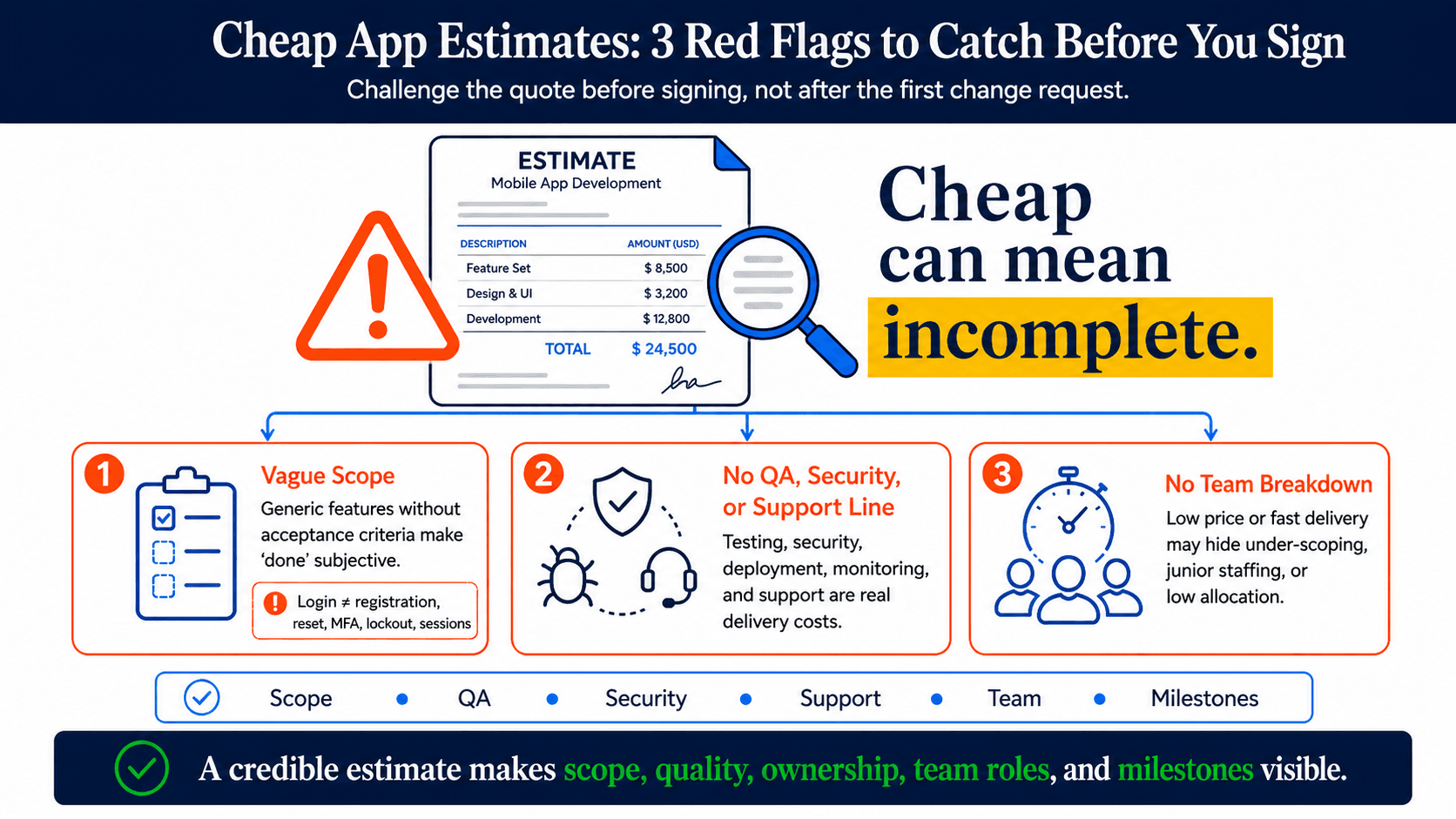
Each of these is easiest to fix before signing. After the first change request arrives, the buyer has far less room to negotiate.
A simple app, with one or two user roles and a basic backend, typically costs $30,000 to $80,000 and takes 2 to 4 months. Platform choice and team location move it within that range. A clickable prototype built only to test an idea can cost under $15,000.
Simple apps usually take 2 to 4 months, mid-complexity apps 4 to 7 months and complex or regulated apps 8 to 12 months. Unclear scope and slow feedback stretch every tier.
For most production apps, the lowest-cost route is a cross-platform build in Flutter or React Native with a managed backend service, which covers iOS and Android from one codebase and cuts infrastructure work. No-code tools cost less for prototypes but often bring migration costs once the product needs custom logic. AI coding agents trim routine hours without removing review and testing.
Apple's Developer Program costs $99 per membership year, and a Google Play developer account costs a one-time $25. Store commissions on digital sales inside the app come on top and grow with every sale, so they belong in the revenue model as well as the launch budget.
The honest answer to "how much does it cost to make an app" is a tier plus the written assumptions behind it. Start the budget from the tier that matches the app's roles and integrations, and keep contingency and maintenance as separate lines. The number will still move once discovery tests the scope. Funding discovery first keeps that movement small.
Arbisoft's mobile app development services cover native and cross-platform apps, progressive web apps and wearable companion apps, with a detailed estimate after a requirements discussion. Buyers who already hold vendor quotes can bring them along with their budget checklist, because comparing the assumptions behind each quote is the quickest way to see which number reflects the real scope.
...Loading Related Blogs
Trusted by top platforms for our transformative solutions and exceptional results: