

 Add as preferred on Google
The Future of Education Technology in 2027: How AI Is Changing Learning for All AgesRead More
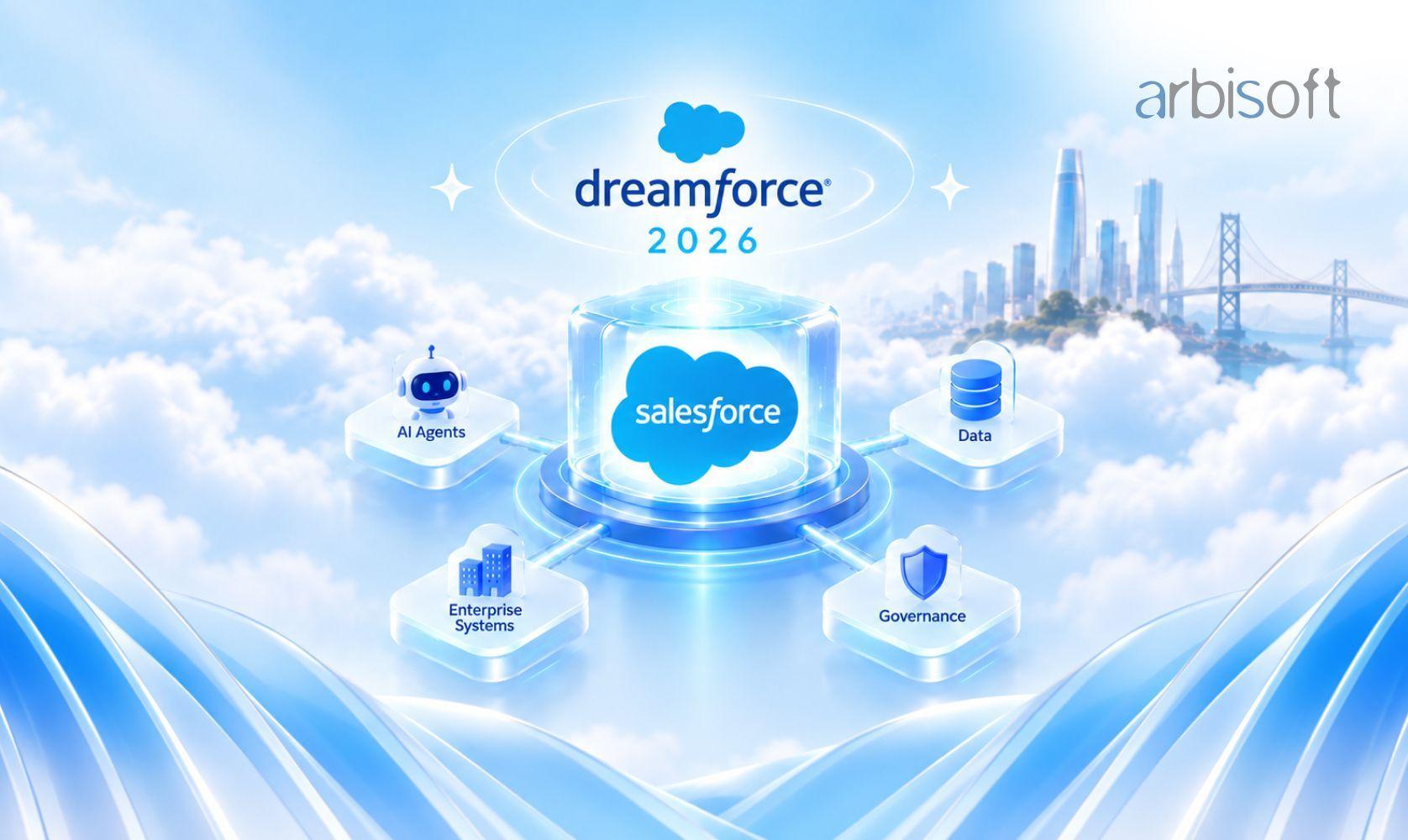
At Dreamforce 2026, Salesforce announced AIforce and said, more or less in these words, that AI is replacing the user interface. Strip the keynote framing and you get a claim about enterprise AI architecture. Your system of record becomes reachable from Claude, from Slack, from anywhere, without anyone opening Salesforce at all.
That is useful. It is also the reason to look at your own org before you look at the roadmap. The Salesforce interface was doing four governance jobs nobody ever wrote down, and AIforce removes it without handing those jobs to anyone else.
What follows: what Salesforce announced, what is available today, the four jobs your UI was doing, and four questions to answer about your own instance before October.
AIforce is a live interface layer. It exposes Salesforce data, workflows, business logic, semantics and permissions to AI agents running outside Salesforce. Underneath it sits the Headless Toolkit, the open architecture that exposes platform elements through MCP servers, APIs, plug-ins and skills. MCP (Model Context Protocol) is the open standard agents use to call tools and data.
AIforce launched on three surfaces. Claudeforce brings Salesforce into Claude, shipping first as Salesforce in Claude, a prebuilt MCP server with 37 sales skills. Slackforce does the equivalent in Slack. Agentforce Coworker sits in the Lightning interface itself. Alongside them, Salesforce introduced Koa, its first CRM reasoning model, built with NVIDIA on the Nemotron open-weight family.
Marc Benioff called it an interface revolution. The more revealing moment came from Patrick Stokes, Salesforce president of applications and marketing, in a press briefing before the event. "The UI is not actually our product," he said, describing the platform instead as where customers store their data, metadata, workflows, permissions and security.
Stokes was building on a comment by Parker Harris, who built the Lightning interface and had already told an audience they might never need to log into Salesforce again. When the person who designed the UI says that, read it as strategy rather than showmanship.
Plenty else was announced at Dreamforce 2026. None of it changes the argument below, so we are leaving it out.
No. Agentforce and AIforce do different jobs.
Agentforce is the agent workforce, the agents you build and deploy inside Salesforce. AIforce is the layer that makes Salesforce reachable from outside it. Claudeforce, Slackforce and Agentforce Coworker are the three places AIforce currently appears.
Worth saying plainly, since most Dreamforce 2026 coverage will not: AIforce is largely a naming layer over components Salesforce shipped across 2026. That is a fair way to communicate platform strategy, and the bundle describes something real. It does change what you are evaluating. The decision in front of you concerns how you expose a Salesforce platform you already own, which is a larger question than a purchase and arrives looking like a smaller one.
Capability | Status as of Sept 16, 2026 | Key date |
Salesforce in Claude (Claudeforce) | Open beta via AppExchange plugin, org ID required | Announced Sept 15, 2026 |
Agentforce Coworker | Generally available, auto-enabling for eligible orgs | Rolling since Aug 4, 2026 |
Koa CRM reasoning model | Select pilot customers only | Announced Sept 15, 2026 |
Salesforce Winter '27 release | General availability | October 12, 2026 |
Salesforce's own AIforce announcement carries a line worth reading before you plan anything around it. Pricing and packaging are subject to change, and customers should base purchasing decisions on products and services currently available.
Standard legal language, and the correct instruction. It is also the sentence most likely to be left out of every Dreamforce summary published this week.
Consider what a Salesforce page layout actually does. It shows one record. It shows the fields somebody chose, to a person who navigated there deliberately, with the buttons that exist, at the speed a human can click.
Every one of those constraints is a control. None of them were written into a governance document, because nobody thinks of a page layout as governance. It was just how the screen worked.
Here are the four jobs, and where each one lands once agents reach Salesforce directly.
Access was governed by the Salesforce sharing model in theory. In practice it was governed by the screen.
Salesforce now describes agents reading across hundreds of records at once and pulling in connected systems to reason with a complete view of the business. That is the pitch, and it is a good one. It also leaves the sharing model as the only thing standing between an agent and the data.
Anyone who has run an access audit on a mature Salesforce org knows what tends to be in there. Profiles cloned from profiles cloned from something built in 2018. A permission set created for a pilot that ended before its owner left. Sharing rules nobody will delete because nobody can prove what breaks if they do. Nobody was careless. This is what happens to any system edited by many people over many years while the interface politely hides the result.
Permission debt, the accumulated profiles and sharing rules nobody has reviewed, used to be an untidiness problem. It is becoming an exposure problem.
Actions were the buttons that existed, in the order the screen allowed, with validation firing wherever someone put it years ago.
Now the available actions are whichever skills, actions and MCP tools you choose to expose. Our working assumption, based on how tool-calling tends to behave, is that a smaller set of well-scoped actions will produce better agent behaviour than everything you could possibly turn on. We would treat that as an expectation rather than a settled finding. It happens to point the same direction as the security argument, which is a convenient place to be.
A user clicked, and the log said the user clicked.
Now an agent acts under a user's permissions from inside Claude or Slack. The authorization check passes cleanly, since Salesforce is explicit that an agent sees only what the person asking can see. Attribution is the part that does not resolve as neatly. Your Salesforce audit trail ends up holding an action a named employee did not perform, may not have read, and possibly cannot reconstruct six months later when somebody asks about it.
If you work in financial services, healthcare, or anything with a regulator attached, take this one into your next architecture review. Not because anyone has got it wrong yet, since AIforce has been available for a day, but because "the permission check passed" and "we can explain who decided this" are different sentences, and only one of them satisfies an auditor.
We have not seen a good public answer to this, including from Salesforce. It is early, and that is fair. It is still the gap we would be watching.
People work at human speed. Crude as limits go, but real, and it caps how much damage a single mistake does before somebody notices.
Salesforce describes agents acting at a speed and scale no human ever could. That is the entire point of the product and the right ambition to have. It also means the fourth job has not been reassigned anywhere. A bad automation against a few thousand records is a Tuesday. The same logic against a database in the millions is a different conversation, and the difference is arithmetic.
Yes. This is the strongest objection to everything above, and it deserves a straight answer.
The control surface has not changed. The Salesforce API has been there for twenty years. Anyone with credentials and intent could already read thousands of records and write back at scale. Nothing about the permission model got weaker this week.
What changed is the traffic through it.
API access was self-limiting by friction. It took provisioned credentials, deliberate engineering work, and somebody who understood the consequences of getting it wrong. That friction was doing the work of an approval process nobody had designed, staffed or documented. It worked precisely because it was annoying.
Salesforce now describes employees who have never opened a dashboard asking questions, updating records and triggering workflows.
The door has not changed. The number of people walking through it, and the speed they move, have. A permission model that was adequate while friction did half the work will not automatically be adequate once the friction is gone.
One honest exception. If your Salesforce org is young, has a single admin, a clean sharing model and a short list of integrations, this is a smaller problem for you than the internet will suggest this month. Note the October date and get on with your quarter.
Koa runs on NVIDIA Nemotron. Claude is available as a reasoning model inside Agentforce through Amazon Bedrock, within the Salesforce trust boundary, so inference stays inside the perimeter. Gemini models arrive through the Google Cloud partnership. Agentforce also supports A2A natively, the agent-to-agent protocol for delegating work between agents, which lets Agentforce orchestrate agents on other platforms or run as a subagent underneath somebody else's orchestrator.
For a CIO this is mostly good news, since it is real model choice rather than lock-in. Model selection now behaves like a database decision. It looks like procurement on the day you make it and like enterprise AI architecture for the next five years. Routing, evaluation and fallback behaviour become things somebody owns, and that somebody is usually not on the Salesforce team.
Two stories are being covered separately this week, and they are the same story.
The first is Dreamforce 2026, where agents became reachable from any interface. The second is Salesforce Winter '27, which enables Agentforce by default across orgs with Agentforce access and removes the toggle from Setup. Agentforce Coworker has been switching on for eligible customers since August 4, 2026. Winter '27 reaches general availability on October 12, 2026.
The timeline is not "when we decide to adopt this." For many organizations it has already started.
One number deserves a second look. Salesforce reports 100,000 users activated Agentforce Coworker in its first 35 days. The figure is accurate. Read alongside the auto-enablement schedule, it measures how many orgs had the feature switched on, which is a different question from how many people asked for it. That distinction will matter when somebody puts the number in a board deck.
Anyone projecting confidence on these this week is guessing. We would rather say so, partly because we will be among those asked to make it work in six months.
One per job the interface was doing. None of them require Salesforce to answer.
There is a useful precedent from a very different kind of project. Nobody migrates data into Salesforce without a mock cutover. You rehearse it, reconcile it, and find the three things that only break at volume. Opening your org to agent access is a cutover too. It just does not feel like one, because nothing appears to move.
Salesforce AIforce is a live interface layer announced at Dreamforce 2026 that lets AI agents reach Salesforce data, workflows and business logic from outside Salesforce, through MCP servers, APIs and skills.
Does AIforce replace Agentforce? No. Agentforce is the agent workforce running inside Salesforce. AIforce is the layer that makes Salesforce reachable from other interfaces, including Claude and Slack.
For eligible customers, yes. Salesforce began enabling Agentforce Coworker on a rolling basis from August 4, 2026, and removes the Agentforce toggle from Setup in the Winter '27 release.
Headless enterprise software is software whose data, logic and workflows are reached programmatically by agents and other systems instead of through its own interface. Salesforce's Headless Toolkit is a current example.
Salesforce says no, since agents run on your existing permissions and business rules. That is exactly the issue. Your current Salesforce permission model becomes the only enforcement surface you have.
Salesforce has been clear about where it is going and said so on the record. What it cannot tell you is whether the governance your interface was silently providing exists anywhere else in your organization.
A keynote does not answer that. An access audit, a dependency map and an honest look at technical debt do, which is where every Salesforce platform assessment we run begins, and which is about to get considerably more interesting than it used to be.
If you are working through what agent access means for your architecture before October, that conversation is worth having early.
...Loading Related Blogs
Trusted by top platforms for our transformative solutions and exceptional results: